
TL;DR: An insurance adjuster’s words can carry real legal weight. When an adjuster with authority over your claim admits fault or confirms coverage, the insurance company often cannot quietly walk that back. Understanding the difference between a genuine admission and ordinary negotiation talk is key to protecting your rights.
After an accident, you just want straight answers. You hear an insurance adjuster say something that sounds reassuring, like “we accept responsibility.” Then, weeks later, the company’s story changes. It is confusing, and it is exhausting. The truth is that some of what an adjuster says is more than talk, it can become evidence that holds the insurer to its position. Knowing when their statements lock a company in can mean the difference between a fair settlement and a drawn-out fight.
Insurance adjusters are trained to protect their company’s interests, but they are still people, and what they say can commit their employer. Under Florida’s evidence rules, when an adjuster acting as the company’s agent admits a key fact within the scope of that role, the admission can be treated as the insurance company’s own. Once the company concedes something important, it cannot simply erase that concession later because it has become inconvenient.
Statements That Count as Binding Admissions

Under Florida law, statements made by a company’s agent or employee about matters within the scope of that role, made during the relationship, are not treated as hearsay when offered against the company. So when an adjuster whose job is to evaluate and settle your claim acknowledges that their insured was at fault, or that your injury is covered by the policy, that statement becomes a meaningful piece of evidence, one that can be used if the insurer changes course later.
Imagine a common scenario: you were rear-ended at a stoplight. The other driver’s adjuster reviews the crash report and photos, then emails your attorney, “Liability is clear. We’re ready to discuss damages.” That email is a party admission on the question of fault. If the insurance company later argues that you share some of the blame, perhaps for stopping too suddenly, that email can be used to undercut the argument. A clear statement, in writing, is hard for an insurer to explain away.
Recorded phone calls and the adjuster’s own claim notes matter just as much. Florida is a two-party (all-party) consent state for recording private conversations, so you generally cannot secretly record a call with an adjuster. In practice, though, insurers themselves often record these calls and announce that they are doing so, and adjusters routinely document their conclusions in the claim file. If an adjuster says on a recorded line, “We accept responsibility for the accident,” that recording is solid proof of the company’s stance on liability. Likewise, claim notes showing the adjuster concluded their insured was 100% at fault can become powerful evidence if the company later invents a reason to dispute liability.
Confirming Coverage and the Adjuster’s Authority
When an adjuster with authority over the claim confirms that the policy covers your accident, that confirmation carries significant weight. If an insurer states you are covered, takes control of handling the claim, and sets aside money to resolve it, it generally cannot change its mind later and deny coverage based on facts it knew about all along.
For example, if an adjuster sends a letter saying, “Your claim is covered under our insured’s policy, and we are prepared to negotiate a settlement,” the insurance company has taken a position. If it later reaches for a policy exclusion to deny the claim, arguing, for instance, that the driver was using a personal car for business, that earlier confirmation may block the reversal. Florida courts apply waiver and estoppel principles when an insured or a claimant reasonably relied on the insurer’s conduct to their detriment, such as by not pursuing another responsible party in time.
The adjuster’s level of authority matters, though. A statement from a junior representative who only takes initial loss reports may not bind the company the same way. Courts look at whether the statement concerned a matter within the scope of that person’s duties. An admission from an adjuster who evaluates, reserves, and settles claims speaks for the insurer. An offhand comment from a call center intake employee usually does not.
Valuation Statements and Reserving Rights
A settlement offer, by itself, does not lock the company into that number. In Florida, offers to compromise a disputed claim are not admissible to prove liability or the amount of the claim. There is an important limit to that rule, however: it does not automatically shield every factual statement made along the way.
Say an adjuster writes, “We agree that your client’s surgery was necessary and directly caused by the accident, and based on that, we are offering $45,000.” The $45,000 figure is generally off-limits at trial. The factual concession about the surgery may be a different story, and your attorney can argue it should come in, particularly if the insurer’s retained physician later testifies that the surgery was unnecessary. Courts weigh these questions carefully, so how and where the statement was made can matter a great deal.
Insurance companies protect themselves by sending a “reservation of rights” letter. That is formal notice that they will investigate and handle the claim without giving up the right to deny coverage later based on specific policy terms. Without that reservation, an insurer’s conduct, paying benefits, controlling the defense, actively negotiating, can support a waiver or estoppel argument down the road. For more detail on how medical payments affect settlements, see Med Pay Coverage: What It Releases When You Settle.
The Risk of Bad Faith When an Insurer Changes Its Story
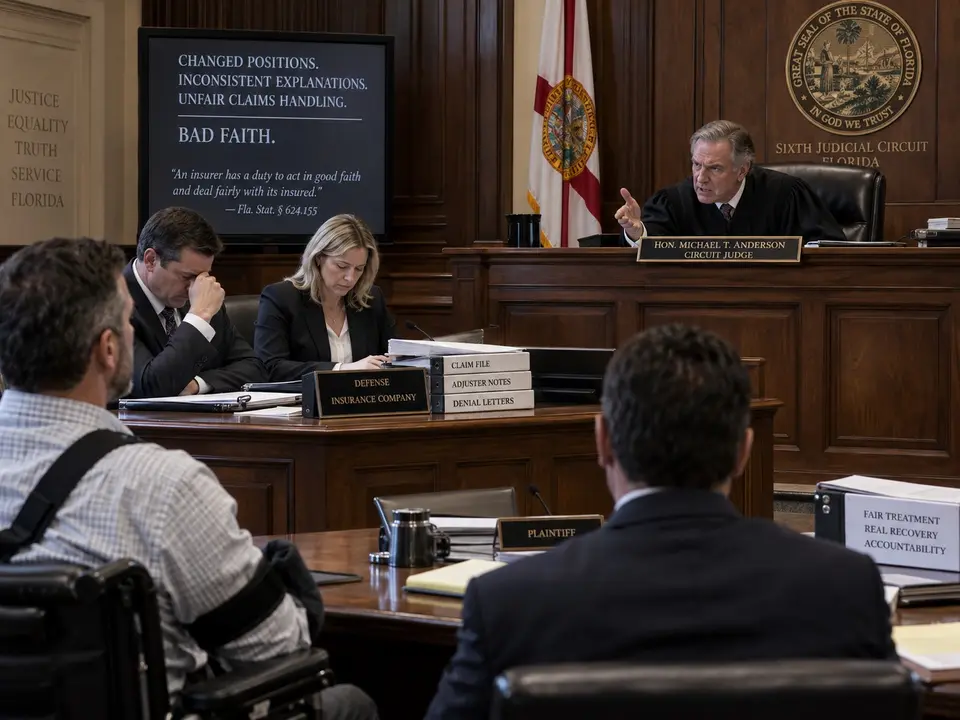
Florida law requires insurance companies to handle claims fairly and honestly. When an adjuster admits liability or coverage and the company later reverses course without a legitimate reason, it exposes itself to a bad faith claim under Florida’s civil remedy statute and the common law.
An injured person generally cannot sue the at-fault driver’s insurer directly for bad faith, because there is no contract between them. The adjuster’s admissions still matter enormously. If an adjuster admits their insured is at fault, recognizes the damages exceed the available coverage, and then refuses a reasonable demand within policy limits, the at-fault driver is left personally exposed. If a jury returns a verdict above the limits, that driver may have a bad faith claim against their own insurer, and can assign it to the injured person. The adjuster’s early admissions then become evidence that the insurer had no honest reason to refuse a fair settlement.
In bad faith cases, courts commonly look at questions like these:
- Did the adjuster conduct a reasonable investigation before taking a position?
- Do the adjuster’s notes and letters show a consistent, fair evaluation of the claim?
- Did the insurer reverse its position without any new evidence?
- Did the company ignore its own adjuster’s conclusions or the medical records to manufacture a reason not to pay?
- Did the company cause unreasonable delay after it was clear what it owed?
A clear admission, “we are responsible,” “this injury is covered,” sets a benchmark for how the company must behave afterward. A sudden change of heart with no valid explanation is not just frustrating. It can be evidence of bad faith.
Telling the Difference: Negotiation vs. Admission
Not everything an adjuster says is an admission. It is important to separate a negotiating posture from a statement of fact. Hypotheticals, conditional offers, and “what if” framing generally are not admissions.
An adjuster who says, “If we were to accept liability, the claim might be worth around $30,000,” has not admitted fault. That is a hypothetical floated to test the waters. An adjuster who says, “Our investigation is complete, and we have determined our insured is 100% at fault,” has made a direct factual statement that can be used against the company.
Similarly, an adjuster offering a modest amount “to avoid the cost of litigation” has not conceded your claim is worth more. But one who writes, “We recognize your injury is permanent and warrants a payment near the policy limit, but we hope you’ll accept less to speed things up,” has conceded meaningful facts about your injury and the value of your claim.
The strongest evidence is in writing, emails, letters, and text messages, or on a call the insurer itself recorded with notice. Spoken words in a casual conversation are far harder to prove. By understanding which statements carry legal weight, you and your attorney can preserve that evidence and hold the insurance company to its word. For guidance on how early settlement offers interact with ongoing treatment, see When a Settlement Offer Arrives Before Treatment Ends.
An adjuster’s words matter. When they state factual conclusions within the scope of their job, and you have proof of it, those statements can bind the insurance company in ways it never intended. Knowing the difference between a negotiating tactic and a real commitment is essential to protecting what you are owed.
Closing Remarks
If an insurance adjuster told you one thing and is now doing another, you may feel powerless. Their own words may be exactly what holds them accountable. At CDB Injury Law, Chris Debari has spent his career standing between injured people and companies that hope they will simply give up. We know how to find these admissions, preserve them, and use them. You do not have to face this alone. Call us at (727) 656-7852 or contact us online for a confidential consultation at our Tampa office. Let us talk about your recovery.
Frequently Asked Questions
Can an adjuster’s verbal statement about fault be used in court if nothing was put in writing?
Yes, a verbal admission can be used if you can prove it was made. Testimony from someone who heard the statement, or a recording the insurer itself made with notice to everyone on the line, can establish it. Keep in mind that Florida requires the consent of all parties to record a private conversation, so you should not secretly record an adjuster. Without solid proof, a verbal admission becomes a “he said, she said” dispute, which is much harder to win. That is why written proof like emails and letters is always stronger.
Does an adjuster’s admission of fault prevent the carrier from arguing comparative negligence at trial?
It can make that argument much harder. Florida uses a modified comparative negligence system, so an insurer has a strong incentive to shift blame onto you. If its own adjuster stated in writing that the insured was 100% at fault, that admission can be put in front of the jury to undercut the new position. Reversing course after admitting full responsibility, with no new evidence, can also support a bad faith claim.
What happens if an adjuster admits coverage but the carrier later denies the claim based on a policy exclusion?
If the insurer knew the facts behind the exclusion when it confirmed coverage and handled the claim anyway, it may have waived that defense or be estopped from raising it, particularly where someone reasonably relied on the confirmation and was harmed by that reliance. The main protection insurers use is a timely “reservation of rights” letter, which preserves the right to raise coverage defenses later.
Are settlement offers made by an adjuster admissible as evidence of a claim’s value?
Generally no. Under Florida’s evidence code, offers to compromise a disputed claim are not admissible to prove liability or the amount of the claim, which is meant to encourage open settlement talks. Factual statements made during negotiations are treated differently in some situations, so whether a particular concession comes into evidence depends on the wording and the context. That is a judgment call your attorney should make with the actual documents in hand.
Can an insurance company be held liable for bad faith if its adjuster initially accepted liability then later disputed it?
It can be strong evidence of bad faith. If an insurer accepts liability and then reverses without new evidence or a legitimate reason, a court or jury may find it acted unfairly toward its insured. Florida’s civil remedy statute also requires a written civil remedy notice and a 60-day cure period before a statutory bad faith suit can proceed, so timing and procedure matter as much as the underlying conduct.
References
- Fla. Stat. § 90.803(18) (Hearsay exception; admissions of a party opponent, including statements by an agent or servant concerning a matter within the scope of the agency or employment).
- Fla. Stat. § 90.408. (Compromise and offers to compromise inadmissible to prove liability or absence of liability for a claim or its value).
- Fla. Stat. § 624.155. (Civil remedy against insurers, including the written civil remedy notice and 60-day cure requirement).
- Fla. Stat. § 768.81. (Comparative fault).
- Fla. Stat. § 934.03. (Interception of wire, oral, or electronic communications; Florida’s all-party consent requirement).
- Boston Old Colony Ins. Co. v. Gutierrez (386 So. 2d 783 (Fla. 1980). (Insurer’s good faith duty to its insured in handling claims)).
- State Farm Mut. Auto. Ins. Co. v. Laforet (658 So. 2d 55 (Fla. 1995). (Bad faith standards under Florida law)).