
Uninsured and underinsured motorist coverage steps in when the at-fault driver has no insurance or insufficient limits to cover the full extent of injury damages. This coverage is part of the injured person’s own policy, but accessing it often requires navigating technical notice requirements, policy exclusions, and disputed valuations that insurers use to minimize payouts.
A collision happens. Injuries are clear. Liability is not in question. Then comes the moment when the at-fault driver’s insurance information arrives, and the policy limit is $25,000. The medical bills alone exceed $60,000. Surgery is pending. Lost income is mounting. The person responsible for the crash cannot cover the harm caused. This is when the promise embedded in an often-overlooked section of the injured person’s own auto policy becomes the only path to full recovery.

Uninsured motorist coverage and underinsured motorist coverage exist for exactly this scenario. They transform the injured person’s own insurance carrier into a secondary source of compensation when the at-fault party’s coverage falls short or does not exist. But this coverage does not activate automatically, and the carrier paying the claim is not an ally, it is still an insurer with financial incentives to limit exposure. Understanding how these claims work, what triggers the duty to pay, and where disputes most often arise can mean the difference between partial recovery and full compensation.
What Uninsured and Underinsured Motorist Coverage Actually Covers
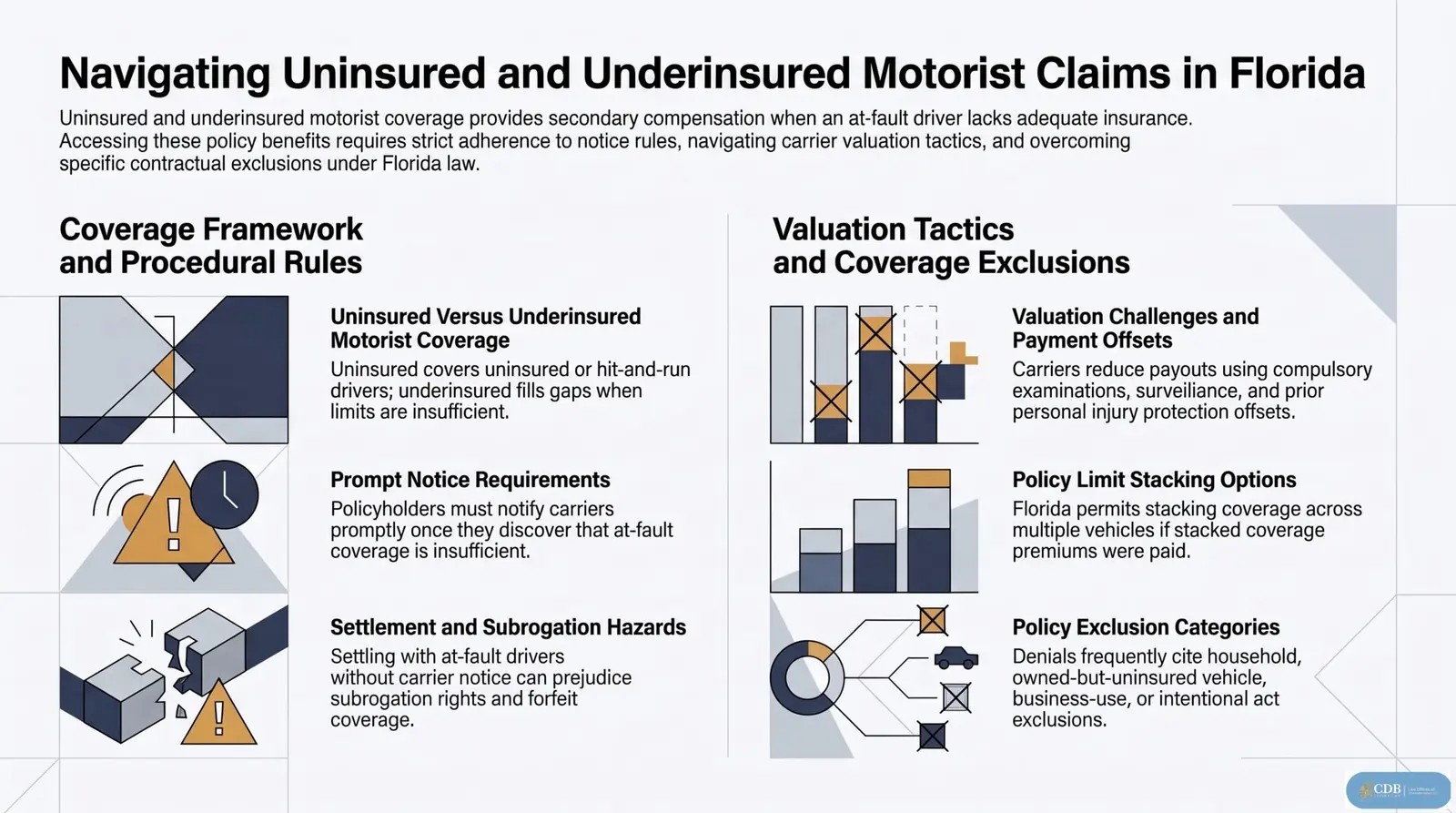
Uninsured motorist coverage applies when the at-fault driver has no liability insurance at all, when the driver flees the scene and is never identified, or when the at-fault driver’s insurer becomes insolvent. Underinsured motorist coverage applies when the at-fault driver carries liability insurance, but the policy limits are insufficient to cover the full extent of the injured person’s damages.
In Florida, insurers must offer uninsured motorist coverage to every policyholder who purchases bodily injury liability coverage, but the policyholder can reject it in writing. Many do, often without understanding what they are giving up. When uninsured motorist coverage is in place, it provides a second layer of protection that generally mirrors the bodily injury liability limits on the policy unless the policyholder selected lower limits or rejected coverage in the manner required by Florida law.
Underinsured motorist claims arise when the at-fault driver’s liability limits are exhausted but the injured person’s damages exceed that amount. Consider a hypothetical: a driver with $25,000 in liability coverage causes a crash that results in $150,000 in medical expenses, lost wages, and pain and suffering. The at-fault driver’s insurer pays the $25,000 limit. The injured person can then turn to their own underinsured motorist coverage for the remaining $125,000, up to the policy limits. This coverage does not duplicate recovery; it fills the gap between what the at-fault driver could pay and what the harm actually cost.
Notice Requirements and Timing Traps That Can Jeopardize Coverage
Uninsured and underinsured motorist claims are governed by notice and cooperation requirements written into the policy. Missing a required step or failing to provide required documentation can give the insurer a coverage defense, even when the underlying injury claim is valid.
Most policies require the injured person to notify their own insurer of a potential uninsured or underinsured motorist claim promptly or within a specific time frame set out in the policy. The safest course is to provide written notice as soon as the injured person knows, or has reason to know, that the at-fault driver’s coverage may be unavailable or insufficient. Oral reports to an agent or a claims adjuster may not satisfy the requirement unless the policy explicitly allows it.
Another common trap involves settling with the at-fault driver’s insurer before giving the injured person’s own uninsured motorist carrier proper notice and an opportunity to protect any subrogation rights. Florida law and many policies create specific procedures when the at-fault driver’s liability insurer offers to tender its limits. If those procedures are ignored, the uninsured motorist carrier may argue that its rights were prejudiced and that coverage should be limited or denied.
Cooperation clauses also require the injured person to provide medical records, submit to examinations under oath, and participate in discovery. Refusal to comply, or even delay that the insurer characterizes as non-cooperation can trigger a coverage defense. These procedural hurdles are not incidental; they often become the battleground where insurers look for reasons to reduce or deny payment.
How Insurers Dispute Valuation and Offset Recovery
Even when coverage is not in dispute, the amount owed almost always is. The injured person’s own insurer will use the same tactics employed by third-party liability carriers: minimizing injury severity, challenging causation, disputing the necessity of treatment, and undercutting economic loss projections.
Uninsured motorist carriers routinely deploy compulsory medical examinations, surveillance, and social media monitoring to build arguments that the injuries are not as severe as claimed or that they pre-existed the crash. The insurer may also argue that the injured person failed to mitigate damages by delaying treatment or refusing recommended care. These arguments are often advanced to reduce payout, even when the injured person’s day-to-day reality tells a very different story.
Offsetting prior payments is another common battleground. Florida law prevents duplicate recovery and allows uninsured motorist carriers to reduce their payment by amounts already recovered from the at-fault driver’s liability policy, from personal injury protection benefits, and in some cases from medical payments coverage. The insurer will apply these offsets aggressively, sometimes including amounts that should not be credited under the policy language or that were already allocated to different categories of loss. When navigating these offset disputes, precise documentation of how prior payments were allocated becomes critical, a task often requiring the guidance of an experienced car accident attorney.
Policy limits stacking is another area of conflict. Florida allows insureds to stack uninsured motorist coverage across multiple vehicles on the same policy if they paid the premium for stacked coverage. But insurers often deny stacking claims by asserting that the injured person was not occupying the correct vehicle at the time of the crash, that the policy does not permit stacking, or that the premiums were miscalculated. These disputes turn on close reading of policy declarations pages, endorsements, and underwriting records that the insurer controls.
Arbitration Clauses and Forum Selection Risks
Some uninsured and underinsured motorist policies contain arbitration provisions or other dispute-resolution procedures. When the injured person and the insurer cannot agree on the amount owed, the policy language may affect whether the dispute proceeds in court, arbitration, or another forum. That forum can have significant consequences for recovery.
Arbitration is a private process that may move faster than litigation, but it can also limit discovery, narrow procedural protections, and restrict appellate review depending on the policy terms and the arbitration agreement. The rules are not always the same as the rules that apply in a Florida courtroom, and the decision-maker may evaluate injury valuation differently than a jury would.
Juries in Florida personal injury cases have the power to award full compensation for pain and suffering, emotional distress, and loss of enjoyment of life based on testimony and demonstrative evidence. Arbitration panels may take a more conservative approach, particularly for non-economic damages. The practical result is that the forum where the dispute is decided can influence the final value of the claim.
Not every policy removes the right to file suit, and not every arbitration clause operates the same way. Some provisions require written demands, timely objections, or compliance with specific pre-suit steps. Understanding the procedural rights embedded in the policy, and preserving them, can determine where and how the final valuation occurs.
When Uninsured Motorist Coverage Is Denied Outright
Insurers sometimes deny uninsured motorist claims on coverage grounds rather than valuation grounds. These denials rest on exclusions written into the policy or on allegations that the injured person violated a policy condition.
- Household exclusion: Some policies exclude coverage when the at-fault driver is a relative residing in the same household as the injured person.
- Owned-but-uninsured vehicle exclusion: If the injured person owns a vehicle not listed on the policy and is injured while occupying that vehicle, coverage may be excluded.
- Business-use exclusion: If the crash occurred while the injured person was using the vehicle for commercial purposes not disclosed during underwriting, the insurer may deny the claim.
- Intentional act exclusion: If the insurer alleges that the injured person provoked the collision or engaged in road rage, it may argue that the resulting injuries are not covered.
Challenging these denials requires careful analysis of the policy language, the factual record, and Florida case law interpreting ambiguous exclusions against the insurer. Courts construe coverage exclusions narrowly, but insurers write them broadly, and disputes often turn on facts developed through discovery, facts the insurer has no incentive to present fairly in a denial letter.
Bad faith claims can arise when an insurer denies a valid uninsured motorist claim without a reasonable basis or when it engages in dilatory tactics to delay payment. Florida law imposes a duty of good faith and fair dealing on insurers when handling claims made by their own policyholders. A statutory bad faith claim also requires compliance with Florida’s civil remedy notice process and is often pursued only after the underlying coverage, liability, and damages issues are resolved. Extra-contractual exposure may include damages caused by the insurer’s violation and, in limited circumstances, punitive damages. For readers navigating related issues around policy interpretation and liability, PIP vs. Bodily Injury Coverage in Florida offers additional context.

Uninsured and underinsured motorist claims represent a shift in the relationship between the injured person and the insurance system. The carrier is no longer a neutral party evaluating a third-party claim, it is a party with a direct financial interest in minimizing the amount paid. Every procedural requirement, every offset argument, and every valuation dispute is an opportunity for the insurer to reduce its exposure. The coverage exists because Florida law recognizes that injury victims should not bear the full cost of another driver’s inadequate insurance. But accessing that coverage requires navigating a system designed to limit, delay, and deny.
Closing Remarks
If your uninsured motorist carrier has denied coverage, disputed the valuation of your claim, or invoked procedural defenses to avoid payment, the stakes are not abstract; they are the difference between recovering fully and carrying the financial and physical consequences of someone else’s actions. CDB Injury Law holds insurers to the promises they made when they collected premiums. You do not have to face that fight alone. Contact us to discuss your case and the path forward: (727) 656-7852.
Frequently Asked Questions
Can uninsured motorist coverage be rejected in Florida?
Yes. Florida law requires insurers to offer uninsured motorist coverage, but policyholders can reject it in writing. Many people reject this coverage without understanding that it protects them when the at-fault driver has no insurance or insufficient coverage. A written rejection may remain effective for renewals, replacement policies, or changes unless the policyholder later requests uninsured motorist coverage in writing. Reviewing existing policies to confirm whether uninsured motorist coverage is in place is a critical step after any crash where the at-fault driver’s insurance is inadequate.
Does uninsured motorist coverage apply if the at-fault driver flees the scene?
Yes, in most cases. Uninsured motorist coverage is designed to provide compensation when the at-fault driver cannot be identified or located. Hit-and-run crashes fall squarely within the coverage. However, the policy may require the injured person to report the crash to law enforcement within a specific time frame and to cooperate with the insurer’s investigation. Failing to file a police report or providing inconsistent statements about the crash can give the insurer grounds to deny the claim.
What happens if the at-fault driver’s insurer goes bankrupt?
If the at-fault driver’s liability insurer becomes insolvent before paying the claim, the injured person can turn to their own uninsured motorist coverage. Insolvency is treated the same as the at-fault driver having no insurance at all. Florida also maintains the Florida Insurance Guaranty Association, which may provide limited compensation in cases of insurer insolvency, but the amounts are capped and often insufficient to cover serious injuries. Uninsured motorist coverage provides a more reliable path to recovery in these situations.
Can uninsured motorist benefits be stacked across multiple vehicles?
Yes, if the policyholder paid for stacked coverage. Florida allows stacking of uninsured motorist coverage when the policy covers more than one vehicle. Stacking multiplies the available coverage limits, which can significantly increase the amount recoverable after a serious crash. However, insurers often deny stacking claims by arguing that the injured person was not occupying the correct vehicle, that the policy does not permit stacking, or that the premium calculation was incorrect. These disputes require close examination of the policy declarations and endorsements, as well as the insurer’s underwriting records.
Can an insurer reduce the uninsured motorist payment by PIP benefits already received?
Yes, in most cases. Florida law allows uninsured motorist carriers to offset the amount they owe by personal injury protection benefits already paid. The insurer will apply this offset to reduce its liability. However, the offset must be applied correctly, and disputes often arise over whether certain PIP payments should be credited, whether the payments were allocated to covered expenses, and whether the insurer is attempting to double-count offsets. These disputes require careful accounting of all payments made and a precise understanding of how Florida law treats PIP offsets in uninsured motorist claims.
References
- Fla. Stat. § 627.727 ((2023). Motor vehicle insurance; uninsured and underinsured vehicle coverage).
- Fla. Stat. § 95.11 ((2023). Limitations other than for the recovery of real property).
- Fla. Stat. § 624.155 ((2023). Civil remedy).