


Med Pay coverage helps pay medical bills after an accident, but settling a claim often requires signing a release that bars future recovery from the same event. Understanding what rights are waived and which liens survive protects against unexpected obligations and ensures the settlement actually resolves the financial exposure it was meant to cover.
Medical payments have been submitted. The insurance carrier has issued a check. A release form arrives for signature. Everything feels like progress, until the question surfaces: what exactly is being given up? Med Pay benefits flow quickly, often before fault is determined and long before a bodily injury claim settles. That speed creates comfort in the moment and confusion later, especially when multiple coverages, liens, and claims overlap. The release that accompanies Med Pay reimbursement is not ceremonial. It is a binding waiver, and what it surrenders depends on how it is written, what other claims exist, and whether the injured person understands the difference between closing one bucket of coverage and foreclosing all rights tied to the same crash.

Med Pay, formally called medical payments coverage, is a first-party benefit available under many Florida auto insurance policies. It pays medical expenses arising from a covered accident regardless of fault, up to the policy limit. Unlike PIP, which is mandatory in Florida and subject to strict thresholds and limitations, Med Pay is optional. It sits quietly in the declarations page, often purchased in small amounts, $1,000, $2,500, or $5,000, and activates when medical bills begin to arrive. The carrier pays providers directly or reimburses the policyholder without requiring proof of liability. Depending on the policy, it may have no separate deductible, no requirement to prove permanent injury, and no comparative fault reduction. It is designed to be simple, fast, and non-adversarial.
That simplicity ends when the claim is exhausted or the insured seeks to close it out. Med Pay carriers do not typically releasebenefits in perpetuity. Once the limit is reached, or once the claimant indicates there are no more medical expenses to submit, the insurer will request a release. That document, often a single page, acknowledges receipt of payment and purports to close the Med Pay claim. The stakes lie in the scope of that release.
What a Med Pay Release Typically Covers
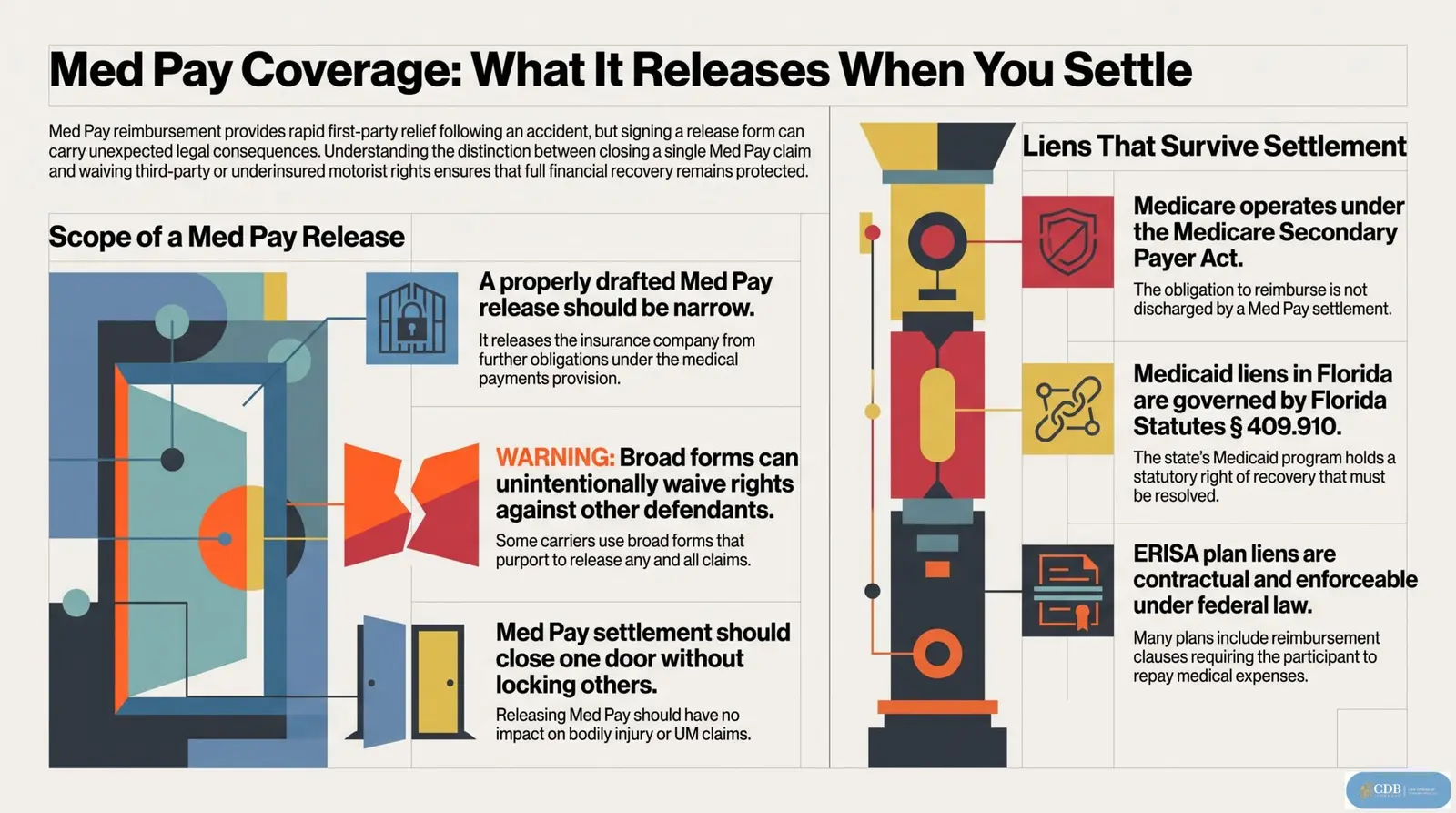
A properly drafted Med Pay release should be narrow. It releases the insurance company from further obligations under the medical payments provision of the policy for the specific accident date and covered injuries. It does not and should not release the at-fault driver, the policyholder’s underinsured motorist carrier, or any bodily injury claim that remains pending. The release is transactional: payment has been made under one coverage; that coverage is now closed.
But release language varies. Some carriers use broad forms that purport to release “any and all claims” arising from the accident. Others include indemnity clauses requiring the insured to reimburse the carrier if duplicate recovery occurs later. Still others condition payment on a full release of the insurer and all related entities. When a release is overbroad, signing it can unintentionally waive rights against other defendants, other policies, or other coverages that were never part of the Med Pay transaction.
Reading the document is not optional. If the release references anything beyond the specific Med Pay policy and the medical expenses already paid, it warrants scrutiny. If it includes language about subrogation, reimbursement, or claims against third parties, those terms may create obligations that survive settlement and resurface when a larger recovery is obtained. A Med Pay settlement should close one door without locking others.
The Intersection with Bodily Injury and UM Claims
Med Pay is often just the first layer of recovery. Behind it sits a bodily injury claim against the at-fault driver, a claim under the injured person’s own uninsured or underinsured motorist coverage, or both. These claims cover a broader universe of damages: pain and suffering, lost wages, future medical care, disability, and loss of enjoyment of life. They are not redundant with Med Pay. They are separate causes of action with separate policy limits and separate settlement negotiations. Releasing Med Pay should have no impact on those claims, unless the release says otherwise.
Problems arise when a claimant signs a Med Pay release without understanding that the same carrier may also be the UM insurer. In that scenario, the release language becomes critical. If it purports to release the carrier from all obligations arising from the accident, that same carrier may later argue that the UM claim has been waived. Under general Florida contract principles, a release should be clear and unambiguous before it is used to bar a separate claim. But disputes still occur, and they are costly to litigate. The cleanest path is to ensure the Med Pay release explicitly preserves all other claims and coverages.
Consider a hypothetical: a driver is rear-ended and submits $5,000 in hospital bills to her Med Pay carrier. The carrier pays and sends a release. She signs it without reading. Six months later, she settles her bodily injury claim with the at-fault driver’s insurer for the $10,000 policy limit. Her own UM carrier, the same company that paid her Med Pay, then denies her underinsured claim, citing the release she signed months earlier. The carrier argues she released all claims. She argues she released only Med Pay. The outcome depends entirely on what the document actually said. Ambiguity in a release is usually construed against the drafter, but litigation to enforce that principle consumes time and money that a careful review would have saved.
Preserving UM and Bodily Injury Rights
Before signing any Med Pay release, confirmation is needed that it does not affect pending or potential claims. This can be accomplished through explicit carve-out language, separate acknowledgment from the carrier, or refusal to sign an overbroad form. Many carriers will provide a narrower release upon request. Others will not. When a carrier insists on broad language and also provides UM coverage, the conflict of interest is clear. Independent review protects against that conflict turning into a waived claim. For guidance on how different insurance coverages interact in Florida auto injury cases, an experienced car accident attorney can provide critical insight.
Liens That Survive Settlement
A Med Pay release resolves the insurer’s obligation under that coverage, but it does not extinguish every outside repayment claim tied to the same medical care. Medicare, Medicaid, ERISA-governed health plans, hospitals with valid local liens, and some medical providers with enforceable contractual rights may still claim reimbursement from a later settlement or judgment. Those rights arise from statute, contract, federal law, local ordinance, or a signed treatment agreement. They do not depend on the Med Pay carrier’s release, and signing that release does not automatically satisfy them.
Medicare, for instance, operates under the Medicare Secondary Payer Act. When Medicare pays for treatment related to an injury caused by another party, it generally must be repaid from any settlement or award, subject to Medicare’s procurement-cost reductions and administrative process. The obligation to reimburse is not discharged by a Med Pay settlement, and failure to satisfy it can result in double damages and referral to the U.S. Department of Justice. Medicaid operates under a separate framework. In Florida, the state’s Medicaid program holds a statutory right of recovery that must be resolved under Florida Statutes § 409.910, including the statute’s allocation and reduction procedures.
ERISA plans, employer-sponsored health insurance governed by federal law, create yet another layer. Many of these plans include reimbursement clauses requiring the participant to repay medical expenses if a third-party recovery is later obtained. The enforceability of these clauses has been the subject of extensive litigation, but the U.S. Supreme Court has repeatedly affirmed that ERISA plans may obtain reimbursement from identifiable settlement proceeds when the plan documents clearly provide for it. The Med Pay release has no bearing on this obligation. It is a separate, contractual duty that travels with the claim and must be addressed during settlement allocation.
- Medicare liens require repayment under the Medicare Secondary Payer Act, subject to applicable reductions and appeal rights.
- Medicaid liens in Florida are governed by Florida Statutes § 409.910 and calculated under the statutory recovery framework.
- ERISA plan liens are contractual and enforceable under federal law when the plan language supports reimbursement.
- Hospital liens may be filed under county-specific ordinances or special laws for emergency services provided in Florida.
- Provider balances or lien claims may also arise from signed agreements, letters of protection, or other enforceable contracts.
- Each valid lien or reimbursement claim must be analyzed independently of any Med Pay settlement or release.
When settlement is imminent, understanding which liens exist and how they will be satisfied is essential. A settlement that appears to resolve the case may leave the injured person liable for substantial unreimbursed balances if valid liens or repayment claims are overlooked. Distribution must account for each creditor with a valid claim to the funds, and that accounting cannot begin until every lien is identified.
Settlement Distribution and the Common Fund Doctrine
Once all claims, coverages, and liens are identified, settlement funds must be allocated. Florida recognizes common-fund principles that may allow attorney fees and costs to be deducted from a lienholder’s recovery when the attorney’s work created or preserved the fund from which the lien is being satisfied. This principle prevents unjust enrichment: a lienholder should not receive full reimbursement from a settlement the attorney worked to obtain without contributing to the cost of that recovery.
Application of the doctrine is not automatic. Medicare applies a statutory procurement-cost formula. Medicaid’s recovery under Florida Statutes § 409.910 follows a specific methodology for calculating the state’s share, including reductions tied to attorney fees and costs. ERISA plans, by contrast, are often governed by plan language and federal preemption principles, which may limit state-law equitable reductions. Each lien must be analyzed individually to determine what reductions apply and how much will ultimately be owed. For more on how medical liens are resolved after settlement in Florida, see Medical Liens After Settlement in FL.
The distribution statement becomes the roadmap. It shows gross settlement, deducts attorney fees and costs, accounts for each lien, and allocates the remainder to the client. Transparency at this stage prevents post-settlement disputes and ensures compliance with ethical rules governing trust accounts. A narrow Med Pay release signed months earlier generally plays no role in this calculus, but an overbroad release may affect whether additional funds remain available from other policies or defendants.

Clarity at the front end prevents chaos at the back. Med Pay is a benefit, not a trap. Treated correctly, it provides early relief without compromising future recovery. Treated carelessly, it becomes a vehicle for waiving claims, triggering reimbursement obligations, and locking in settlements that leave money, and rights, on the table. The release is the hinge point. What it says, what it preserves, and what it waives will determine whether the settlement delivers resolution or simply relocates the problem.
Closing Remarks
If a Med Pay release contains language that appears to waive other claims, if liens from Medicare, Medicaid, or a health plan remain unresolved, or if a settlement offer has arrived but the full picture of what will be released is unclear, the decision ahead is not one to make alone. CDB Injury Law helps injured Floridians navigate insurance coverage, lien resolution, and settlement strategy with the clarity and protection those decisions demand. Contact us today to discuss your case and your path forward.
Frequently Asked Questions
Does signing a Med Pay release prevent me from pursuing a claim against the at-fault driver?
A properly drafted Med Pay release should only close the medical payments claim under the specific policy. It should not release the at-fault driver or affect a bodily injury claim. However, some releases are written broadly and may be interpreted to waive other claims if the language is not carefully reviewed. Before signing, confirmation is needed that the release explicitly preserves all claims against third parties and other coverages, including uninsured and underinsured motorist benefits.
Can my insurance company require me to repay Med Pay benefits if I later recover from the at-fault driver?
It depends on the policy language and the release signed. Some Med Pay policies include subrogation or reimbursement clauses that allow the carrier to seek repayment if the insured later recovers damages from a third party. If the release includes an indemnity provision, the insured may be obligated to reimburse the carrier. Disputes often turn on the exact policy terms, the release language, and whether the reimbursement provision is enforceable under Florida law.
What happens to Medicare or Medicaid liens when I settle my injury claim?
Medicare and Medicaid liens survive any Med Pay settlement. Both programs may be entitled to reimbursement from a third-party recovery obtained by the injured person. Medicare operates under federal law and must be repaid from settlement proceeds according to its statutory and administrative process, including applicable procurement-cost reductions. Medicaid liens in Florida are governed by Florida Statutes § 409.910 and must be calculated and resolved under that statute before funds are distributed. Failure to satisfy these liens can result in penalties, collection actions, and in the case of Medicare, federal enforcement.
If I settle my Med Pay claim, does that affect my ability to make a UM claim with the same insurance company?
It should not, but the language of the release determines the outcome. Med Pay and uninsured or underinsured motorist coverage are separate policy provisions with separate purposes. A Med Pay release that is narrowly tailored to the medical payments claim will not affect UM rights. However, if the release purports to waive all claims arising from the accident, the carrier may later argue that the UM claim was released. Florida law generally requires clear and unambiguous language before a release will be used to bar a separate claim. Even so, disputes over release scope can delay or derail a UM claim, making advance clarity essential.
References
- 42 U.S.C. § 1395 (y(b)(2) (Medicare Secondary Payer Act)).
- Fla. Stat. § 409.910 (Medicaid Third-Party Liability Act).
- Employee Retirement Income Security Act of 1974 (ERISA), 29 U.S.C. § 1001 (et seq).