
Bodily injury claims compensate harm to people, medical bills, lost income, pain. Property damage claims cover vehicles and belongings. Florida law treats them as separate categories of loss with different insurance structures, settlement timelines, and proof requirements, and a single crash often triggers both.
The collision ends in seconds. The insurance company opens two files. One covers the crumpled hood; the other addresses the fractured wrist and the sleepless nights that follow. Bodily injury and property damage claims spring from the same accident, but they move on parallel tracks; different adjusters, different coverage limits, different deadlines, and different standards of proof. Confusion between the two can leave settlement dollars on the table or stall recovery when clarity matters most.

Understanding how Florida separates these claims, what each one covers, and how they interact restores control when the paperwork starts to pile up and the at-fault driver’s insurer begins making early offers that bundle everything into a single check.
What Bodily Injury Claims Cover
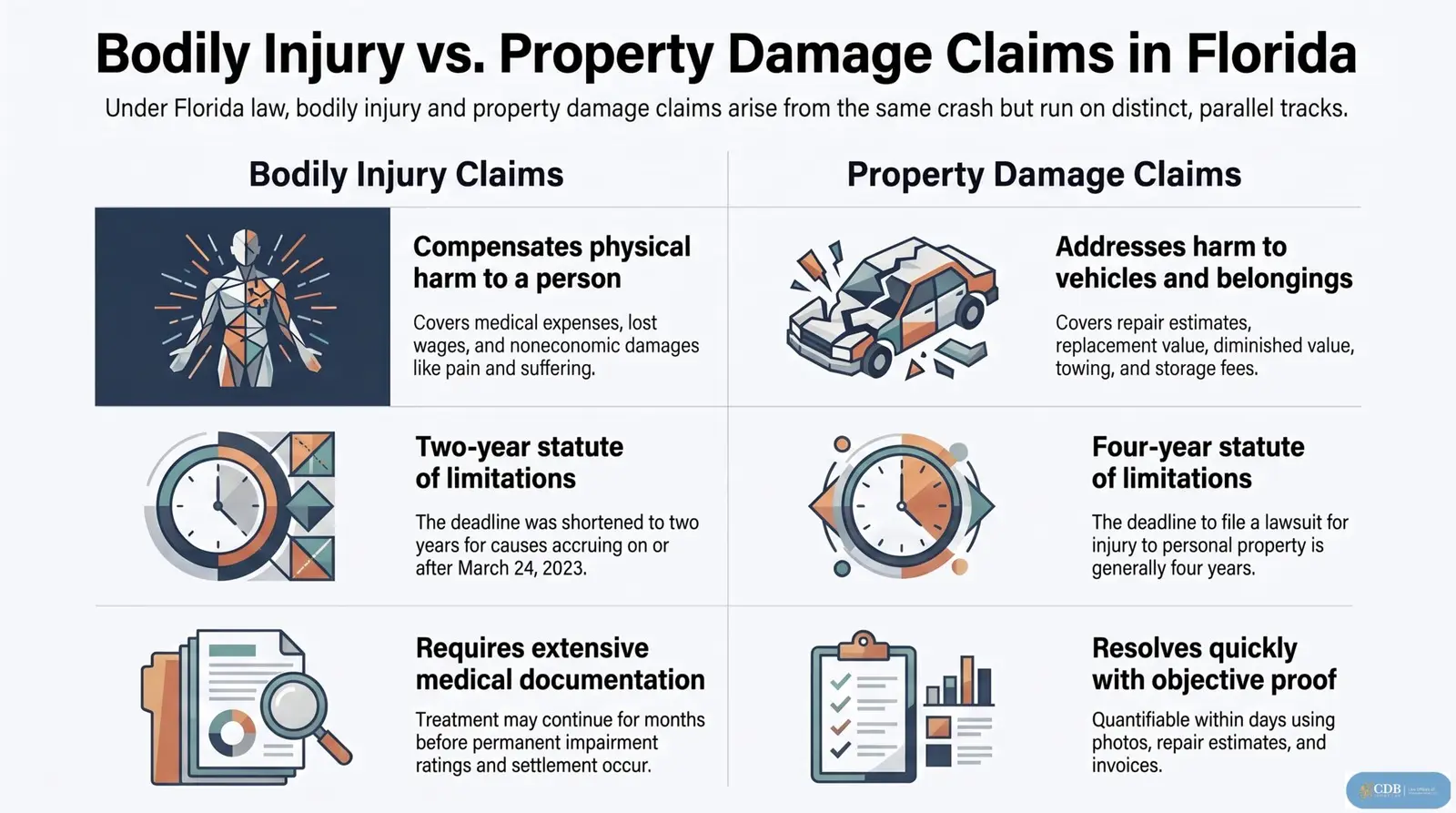
Bodily injury claims compensate physical harmto a person. Medical expenses form the foundation, emergency transport, hospital stays, surgery, physical therapy, prescription medications. But the claim extends beyond bills. Lost wages account for time away from work during treatment and recovery. When injuries prevent a return to the same job or the same earning capacity, future lost income becomes part of the demand.
Pain and suffering, emotional distress, and loss of enjoyment of life fall under noneconomic damages. In Florida auto cases, recovery for pain, suffering, mental anguish, and inconvenience generally requires meeting the state’s tort threshold, such as a significant and permanent loss of an important bodily function, permanent injury, significant and permanent scarring or disfigurement, or death. When that threshold is met, these harms often exceed the value of medical bills when injuries are severe or permanent. Scarring, disfigurement, and limitations on mobility or daily activities elevate the claim’s settlement range.
Bodily injury (BI) liability coverage on the at-fault driver’s policy funds these claims. While Florida does not require all drivers to carry BI coverage from the start, the state’s Financial Responsibility Law effectively mandates it after an accident causing injury. When this coverage is in place, the state-required minimums are typically $10,000 per person and $20,000 per accident, though many policies carry higher limits. Personal injury protection (PIP) provides first-party coverage for some medical bills and lost wages regardless of fault, but PIP does not address pain, suffering, or the full scope of economic loss. When PIP coverage is exhausted or losses exceed what PIP pays, the bodily injury claim against the at-fault party becomes the primary avenue for fuller recovery, subject to Florida’s tort-threshold rules for noneconomic damages.
What Property Damage Claims Cover
Property damage claims address harm to vehicles, personal belongings inside the car, and sometimes real property struck during the collision. Repair estimates, replacement value, diminished value, and towing or storage fees all fall within the claim’s scope. The measure of recovery is typically the lesser of repair cost or fair market value before the crash.
Property damage liability coverage on the at-fault driver’s policy pays these claims. Florida requires a minimum of $10,000 in property damage liability. When the at-fault driver lacks insurance or carries insufficient limits, collision coverage on the victim’s own policy may step in, subject to a deductible.
Property damage claims resolve faster than bodily injury claims. The loss is usually quantifiable within days: photos, repair estimates, and invoices provide objective proof. No waiting period for maximum medical improvement, no need to assess long-term pain or future surgeries. Adjusters often issue payment for property damage while the bodily injury file remains open, sometimes for months or years.
Why Florida Treats Them as Separate Claims
Florida law recognizes bodily injury and property damage as distinct categories of loss that may be pursued separately within or alongside a negligence claim. A single rear-end collision can give rise to both a property damage claim and a bodily injury claim, each with its own damages, evidence, and proof requirements. The separation reflects different policy structures, different adjusters, and different valuation methods.
Consider the personal injury claim that demands medical records, expert testimony, and documentation of future impact. The property damage claim requires repair invoices and fair-market appraisals. Bundling the two into a single settlement check before the full extent of injury becomes clear forecloses the right to reopen the bodily injury claim when complications arise six months later.
Statute of limitations periods may run separately. In Florida, the deadline to file a lawsuit for injury to personal property is generally four years. For bodily injury claims based on negligence, a significant legislative change in 2023 shortened the period from four years to two years for causes of action accruing on or after March 24, 2023. Settling property damage early does not restart or extend the bodily injury deadline. Missing the correct deadline because the car was repaired and the matter felt “closed” eliminates the legal right to compensation for medical bills, lost income, and pain.
Insurance Adjuster Tactics That Exploit the Separation
Adjusters sometimes issue a property damage check accompanied by a release that purports to settle “all claims arising from the accident.” Signing that release can extinguish the bodily injury claim before treatment concludes or maximum medical improvement arrives. Other times, the adjuster offers a combined lump sum, $15,000 to “cover everything,” when the vehicle damage alone totals $8,000 and medical bills already exceed $12,000. The offer sounds generous until the math reveals the shortfall.
Separating the claims preserves leverage. Accepting payment for the totaled car does not prevent pursuit of compensation for the herniated disc or the surgery scheduled for next quarter, provided the release is limited to property damage only.
Proof Requirements and Settlement Timing
Property damage claims demand documentation that is usually available within days:
- Photographs of vehicle damage
- Repair estimates from licensed body shops
- Receipts for towing, storage, or rental reimbursement
- Pre-accident fair market valuations when the vehicle is a total loss
Bodily injury claims require medical records, billing statements, wage-loss certifications from employers, and sometimes expert opinions on causation, prognosis, and future care needs. Treatment may continue for months. Permanent impairment ratings come only after the condition stabilizes. Settling before the injury picture is complete undervalues the claim.
Adjusters push for quick releases on bodily injury claims by leveraging the urgency of property loss. “Sign now and we’ll get your car fixed this week” becomes the framing. But comparative negligence in Florida may still allow recovery when the injured party shares some fault, so long as the injured party is not more than 50% at fault in most negligence cases. There is no legal requirement to settle both claims simultaneously, and no penalty for waiting until the medical outcome is clear.
When One Claim Settles and the Other Remains Open
Accepting payment for vehicle repairs does not waive the right to pursue bodily injury compensation, if the release is drafted narrowly. A property-damage-only release states clearly that it resolves harm to the vehicle and personal property, and nothing more. The bodily injury file stays open.
Problems arise when the release language is broad or ambiguous. “Settlement of all claims arising out of the accident on 2026” can be interpreted to include future medical treatment, ongoing pain, or complications that surface after signing. Once signed, reopening the claimrequires proving fraud, duress, or mutual mistake. A steep burden.
Separate settlements also allow separate negotiations. The at-fault driver may carry $10,000 in property damage liability and $100,000 in bodily injury liability. Resolving the property claim for $8,000 leaves the full $100,000 available for medical bills, lost wages, and noneconomic damages. Bundling both into a single $25,000 settlement leaves $83,000 on the table when the injury turns out to require surgery and six months of rehabilitation.

The separation between bodily injury and property damage is not an administrative nicety; it is a structural feature of Florida claims handling that protects the injured party’s ability to recover fully for each category of harm. Treating them as a single “car accident claim” invites early settlement pressure, waiver of future rights, and valuation errors that no second chance will correct.
Closing Remarks
If an adjuster has bundled a property damage check with a release that mentions “all claims,” if treatment is still ongoing but pressure mounts to settle everything now, or if the at-fault driver’s insurer has offered a lump sum that does not account forfuture medical needs, the stakes are not abstract, they are financial and medical. CDB Injury Law separates what belongs apart, preserves what the law protects, and fights for complete recovery when insurance carriers blur the lines. Contact us today for a consultation that costs nothing unless we win.
Frequently Asked Questions
Can a property damage settlement close the bodily injury claim?
Only if the release language extends to bodily injury. A narrowly drafted property-damage-only release resolves vehicle and personal property loss without waiving the right to pursue medical bills, lost income, or pain and suffering. Broad release language that references “all claims” can extinguish both, even when bodily injury damages are not yet known. Reviewing the release before signing prevents inadvertent waiver.
Do bodily injury and property damage claims have the same deadline?
No. In Florida, the statute of limitations for injury to personal property is typically four years. However, for bodily injury claims based on negligence, a 2023 law change shortened the deadline from four years to two years for incidents occurring on or after March 24, 2023. It is crucial to use the correct deadline for each claim type, as relying on the property damage timeline for a bodily injury claim can result in a permanent loss of the right to sue.
What happens if the at-fault driver has low liability limits?
When the at-fault driver carries low liability coverage, such as $10,000 per person for bodily injury when BI coverage applies and $10,000 for property damage, the available funds may not cover the full loss. Uninsured motorist coverage and underinsured motorist coverage on the injured party’s own policy can help fill the gap if that coverage was purchased and applies, but those claims require separate notice, investigation, and sometimes arbitration. Collision coverage addresses vehicle damage when the at-fault party’s property damage liability is exhausted.
Can someone settle property damage themselves and hire a lawyer for the bodily injury claim?
Yes, provided the property damage release is limited and does not include bodily injury. Many injured parties handle vehicle repairs directly with the at-fault insurer, then retain counsel once the extent of medical treatment and long-term impact becomes clear. The key is ensuring that no general release is signed during the property claim and that all medical records, billing, and wage-loss documentation are preserved from the outset.
Does PIP coverage count as a bodily injury settlement?
No. Personal injury protection is first-party coverage that pays medical bills and a portion of lost wages regardless of fault. It does not address pain, suffering, or the full economic loss. Exhausting PIP benefits does not settle or release the negligence claim against the at-fault driver. The bodily injury claim proceeds independently, and PIP payments may be credited or reimbursed depending on the policy terms and the final settlement or verdict.
References
- Florida Statutes § 324.021 (Financial Responsibility Law).
- Florida Statutes § 95.11 (Statute of Limitations).
- Florida Statutes § 627.736 (Required Personal Injury Protection Benefits).
- Florida Statutes § 627.737 (Tort Threshold).
- Florida Statutes § 768.81 (Comparative Fault).