


A pre-suit demand letter can accelerate settlement by presenting organized evidence and clear damages before litigation costs escalate. Insurers often settle strong claims when confronted with documented liability and concrete figures. Timing, detail, and supporting documentation determine whether the letter opens negotiation or gets dismissed.
After an injury, your focus should be on healing, not preparing for a legal battle. Yet, the pressure of medical bills, missed work, and calls from insurance adjusters can feel overwhelming. A well-crafted pre-suit demand letter is more than a legal formality; it is a crucial step toward taking back control. It tells the insurance company, in clear and undeniable terms, what happened, how you were harmed, and what it will take to make it right. When done correctly, it can pave the way for a fair settlement, allowing you to focus on your recovery without the stress of a lawsuit.

Pre-suit demand letters function as structured arguments delivered outside the courtroom. They present the facts, attach the documentation, quantify the harm, and make an offer. When executed effectively, they convert insurance carriers from adversaries defending reserves into businesses calculating risk. The letter does not guarantee settlement, but it creates the conditions under which settlement becomes the insurer’s rational choice.
When Documentation Drives the Carrier’s Decision
Insurers settle when the cost of defending exceeds the probable cost of paying. A demand letter that delivers comprehensive medical records, police reports, photographs of the scene, witness statements, and itemized economic damages removes the carrier’s ability to minimize exposure through gaps in proof. The adjuster reviewing the file sees a claim that will cost more to litigate than to resolve now.
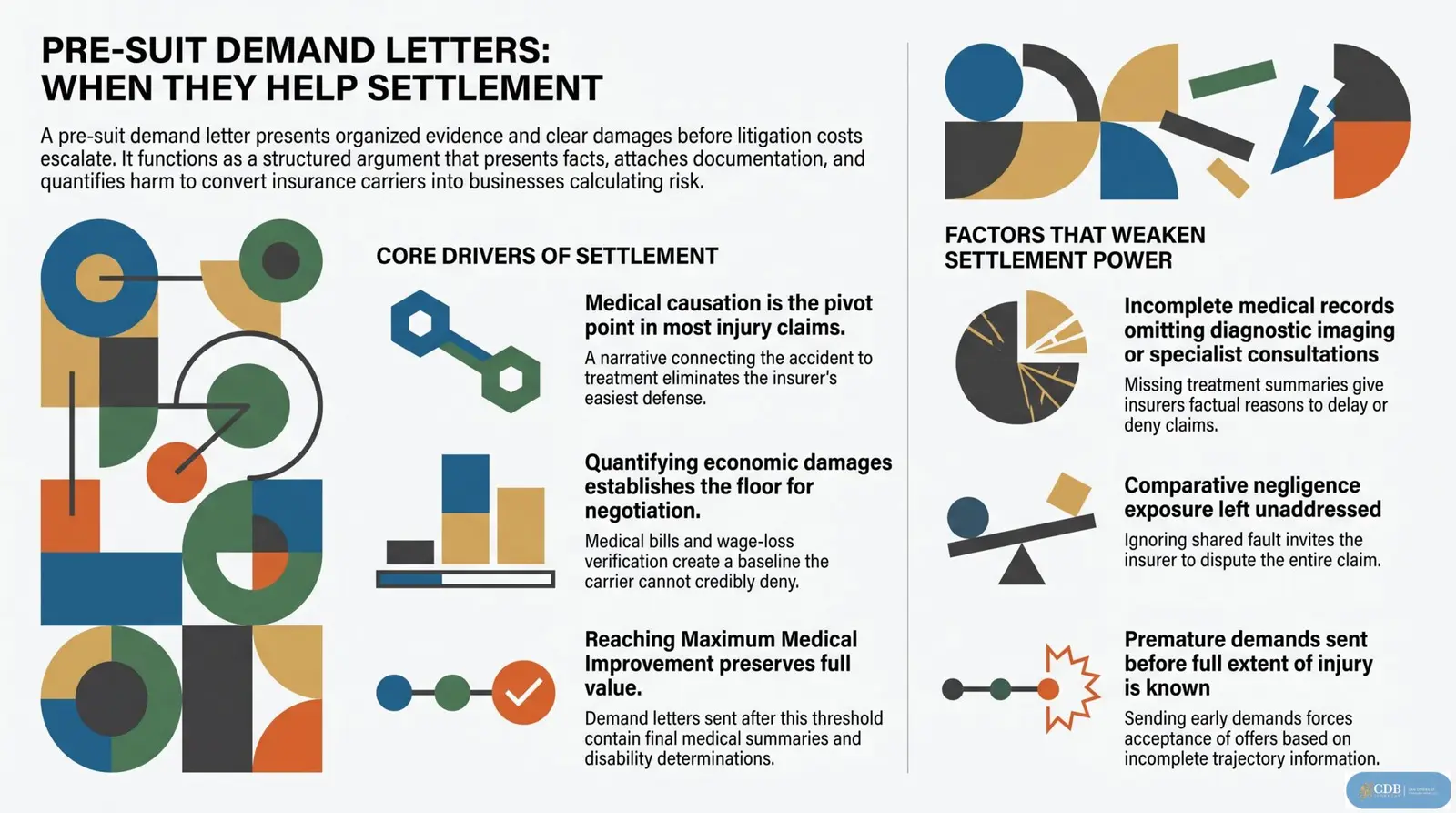
Medical causation is the pivot point in most injury claims. A demand letter that includes initial emergency-room documentation, diagnostic imaging results, specialist reports, and a narrative connecting the accident to each phase of treatment eliminates the insurer’s easiest defense. When causation is clear and treatment appears reasonable, the claim becomes harder to contest than to pay.
Liability documentation works the same way. Accident reconstruction summaries, traffic-violation citations, admissions captured in recorded statements, and photographic evidence of vehicle damage or hazardous conditions narrow the carrier’s options. A personal injury claim supported by this level of proof removes the uncertainty that keeps adjusters from making settlement offers.
How Economic Damages Shape the Settlement Range
A demand letter that quantifies economic damages with precision establishes the floor for negotiation. Medical bills, wage-loss verification, and receipts for out-of-pocket expenses create a baseline the carrier cannot credibly deny. When the numbers are documented and the math is transparent, the insurer’s response shifts from denial to negotiation over noneconomic damages and future expenses.
Future medical expenses require expert support. When a treating physician includes anticipated surgeries, rehabilitation timelines, or permanent-care needs in a signed report, the insurer must account for those costs in its reserve. A demand letter that attaches such projections moves the settlement calculation beyond what has already been billed to what will be required.
Lost earning capacity matters in claims involving permanent impairment. When the injured party cannot return to prior employment, or returns at reduced hours or wages, an economic expert’s analysis quantifies the lifetime differential. Attaching that analysis to the demand letter forces the carrier to confront the claim’s true exposure rather than treating it as a short-term medical case.
Timing and Maximum Medical Improvement
Sending a demand letter before maximum medical improvement invites the insurer to undervalue future treatment. A settlement offer made when the injury’s full trajectory remains unclear often excludes complications, additional surgeries, or chronic-care needs. The carrier locks in a number based on incomplete information, leaving the injured party to absorb costs that emerge later.
Maximum medical improvement marks the point where doctors can assess permanence, forecast future needs, and assign impairment ratings. A demand letter sent after reaching that threshold contains final medical summaries, disability determinations, and credible projections. The insurer cannot argue that conditions might improve when the medical record confirms they will not.
Statute-of-limitations deadlines impose a backstop. Under Florida law, the time limit for filing most negligence claims changed recently. For incidents occurring on or after March 24, 2023, the deadline is now two years. For incidents that occurred before that date, a four-year deadline generally applies. Waiting too long erodes the letter’s leverage. Insurers discount demands sent days before the statute expires because they know litigation will follow regardless of their response. The letter gains power when sent early enough that the carrier views settlement as avoiding litigation, not merely delaying it.
Pre-Suit Negotiation and Settlement Authority
Adjusters operate under settlement authority limits. A demand letter that exceeds those limits triggers referral to supervisors, coverage counsel, or excess carriers. Understanding this internal process explains why some demands produce immediate offers while others meet silence. The letter’s dollar figure must align with the adjuster’s authority or the insurer’s willingness to escalate review.
Policy limits define the insurer’s contractual exposure. When a claim’s value clearly exceeds available coverage, the demand letter should be structured with Florida’s bad-faith framework in mind, including the insurer’s opportunity to evaluate the claim based on sufficient evidence and tender where appropriate. A well-supported, time-limited policy-limits demand can create serious pressure, but it should avoid artificial deadlines or conditions that undermine its reasonableness. For guidance on structuring these demands, see Demand Letter Timing: When to Send Before Suit Filing.
Factors That Weaken a Demand Letter’s Settlement Power
Certain deficiencies give insurers reasons to delay or deny. Recognizing these gaps before sending the letter preserves its effectiveness:
- Incomplete medical records that omit diagnostic imaging, specialist consultations, or treatment summaries
- Vague or unsupported claims of future medical needs without physician documentation
- Economic-damages calculations that lack supporting invoices, wage statements, or employer verification
- Comparative negligence exposure left unaddressed when the insured driver or property owner can credibly argue shared fault
- Premature demands sent before the full extent of injury or permanent impairment is known
- Demands that ignore available insurance defenses, coverage limitations, or policy exclusions
Addressing these vulnerabilities before the letter goes out removes the carrier’s easiest objections. An adjuster who cannot find a factual or legal basis to reduce the claim is more likely to respond with a settlement offer than a denial.
How Insurers Use the Demand Letter Against the Claim
A poorly drafted demand letter can shape the defense if the case proceeds. Statements that overreach, misrepresent medical findings, or inflate damages give defense counsel material to challenge credibility. Exaggerations undermine trust. Unsupported assertions invite discovery disputes, defense attacks, and closer scrutiny of the entire claim.
Factual statements in the letter can also be difficult to walk back. Although settlement communications are often subject to evidentiary limits, factual concessions about fault, injury severity, or the accident sequence may still influence litigation strategy or become relevant in limited contexts. Every factual assertion in the letter must be defensible under cross-examination.

Demand letters also establish the claimant’s valuation in negotiation and may become relevant in limited contexts, such as bad-faith disputes or credibility challenges involving specific factual statements. The concern is not that every jury will automatically see the pre-suit demand. It is that a figure that appears inflated or arbitrary can undermine negotiations, weaken later strategy, and make the claim harder to resolve fairly.
Closing Remarks
Navigating the path to recovery is challenging enough without the added stress of a protracted legal fight. A strategic demand letter can be the key to securing a fair settlement without stepping into a courtroom. You do not have to face this alone. At CDB Injury Law, we build your case with care and precision, presenting a clear and compelling argument for the compensation you deserve. Let us talk about restoring your peace of mind.
Frequently Asked Questions
Should a demand letter include a specific settlement amount or a range?
A specific demand anchors the negotiation. Ranges invite the insurer to focus on the low end, treating the bottom figure as the starting point rather than the midpoint. A single number backed by documented damages forces the carrier to respond with a counteroffer or justify a denial, clarifying whether settlement is achievable without litigation.
What happens if the insurer does not respond to the demand letter?
Silence often signals that the adjuster lacks authority to settle at the demanded amount or believes the claim is defensible. Some insurers ignore demands tactically, hoping the claimant will reduce the figure or abandon the claim. A reasonable response deadline can create urgency and help determine when filing suit should be considered, but the timing should account for the statute of limitations, the available insurance coverage, and Florida insurance-law requirements that may apply to policy-limits or bad-faith demands.
Can a demand letter be revised after it is sent?
Revisions are possible but weaken the letter’s credibility. Reducing the demand after the insurer rejects it signals desperation and invites further lowball offers. Increasing the demand after sending it appears opportunistic unless new medical evidence, additional surgeries, or worsening permanent impairment justifies the adjustment. The initial letter should reflect the claim’s full value based on complete information.
Does sending a demand letter waive the right to file a lawsuit?
No. A demand letter is an invitation to settle, not a binding commitment. If the insurer rejects the demand or allows the response deadline to expire, filing suit remains available within the statute of limitations. The letter preserves a record of the attempt to resolve the claim pre-suit, which may support later arguments, when legally appropriate, about the insurer’s bad faith or unreasonable refusal to settle.
How does comparative negligence affect the demand letter’s settlement value?
Florida’s modified comparative negligence rule bars recovery if the injured party is more than 50 percent at fault and reduces damages proportionally when fault is shared. A demand letter must acknowledge any comparative negligence exposure and adjust the settlement figure accordingly. Ignoring clear evidence of shared fault invites the insurer to dispute the entire claim rather than negotiate over the percentage allocation.
References