


When a permanent injury becomes apparent before settlement talks conclude, waiting to file suit can erode leverage and allow critical evidence to fade. Florida’s permanent injury threshold and statute of limitations create narrow windows that demand strategic timing, not patience.
The call from the adjuster arrives with a number, lowball, vague about permanence, silent on future limitations. Meanwhile, the orthopedist’s report sits on the desk: fusion recommended, ROM permanently reduced, maximum medical improvement still months away. The gap between what the injury will cost and what the carrier offers isn’t just wide; it’s a chasm. And the clock is running.

Settlement before litigation closes the file quickly, but speed traded for adequacy becomes regret. Permanent injuries, scarring that won’t fade, joints that won’t heal, nerve damage that reshapes daily life, demand compensation that reflects not just past treatment, but decades of limitation ahead. When the insurer’s timeline and the injury’s reality don’t align, filing suit may be the only move that forces recognition of what the injury truly means.
The Permanent Injury Threshold and Why It Matters Before Settlement
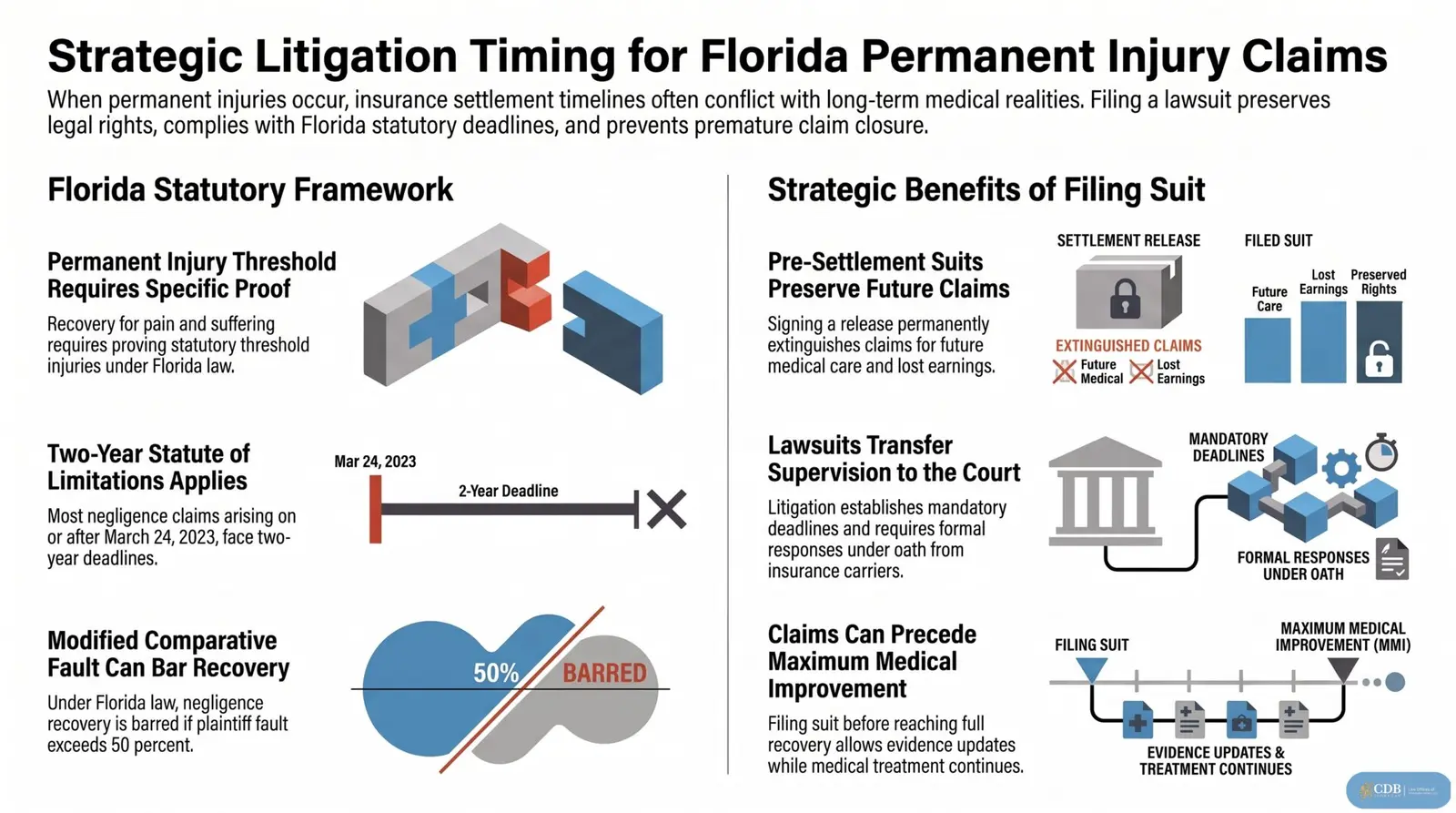
In Florida, the law makes a critical distinction between an injury that heals and one that changes your life forever. This is known as the “permanent injury threshold,” and it is a hurdle insurance companies use to limit what they have to pay in many motor vehicle injury claims. Under Florida Statutes § 627.737, to recover damages for pain, suffering, mental anguish, and the loss of enjoyment of life after a covered auto accident, you generally must prove one of the statutory threshold injuries, such as a significant and permanent loss of an important bodily function, a permanent injury within a reasonable degree of medical probability, significant and permanent scarring or disfigurement, or death. If your doctor confirms your injury is permanent but the insurance company’s offer doesn’t reflect that reality, they are dismissing the future you now face.
Separately, the insurance company will also look at who was at fault for the accident. Under Florida’s modified comparative fault rule (Florida Statutes § 768.81), your total compensation can be reduced by your percentage of blame, and in most negligence cases recovery can be barred if you are found more than 50% at fault. Insurers often try to use both of these rules against you, downplaying the permanence of your injury while overstating your role in the accident. Filing a lawsuit forces them to confront the medical facts and argue about fault based on evidence, not just accusations.
The insurance adjuster knows this law inside and out. If there’s any ambiguity about whether your injury is permanent, their offers will be designed to pay for your past medical bills, not your future limitations. They are betting you’ll accept a low offer now, before the full, lifelong impact of the injury is undeniable. Accepting that offer is like closing a door on your future needs. Filing a lawsuit, however, forces them to look at the whole picture. It brings your doctors’ opinions, vocational expert reports, and life care plans to the forefront, translating your permanent medical condition into the financial reality of what you’ll need to live.
Consider a hypothetical: A delivery driver suffers a tibial plateau fracture and partial ACL tear in a collision. Six months post-accident, she is ambulatory but experiences daily pain, instability, and cannot return to her job in warehouse logistics. The adjuster offers $45,000 to settle all claims. Her orthopedist, however, has documented permanent range-of-motion loss and recommends future arthroscopic revision. She has not reached maximum medical improvement. Signing the release now extinguishes her claim to future surgery costs, diminished earning capacity, and noneconomic damages tied to permanent impairment, categories that may collectively exceed six figures. Filing suit preserves those categories and forces the carrier to account for the permanence her doctor has already documented.
Statute of Limitations and the Cost of Waiting
While you are focused on healing, a legal clock is ticking relentlessly in the background. For most Florida negligence claims arising on or after March 24, 2023, you generally have two years to file a lawsuit (Florida Statutes § 95.11). Claims based on earlier incidents, wrongful death claims, and claims involving government entities or other special defendants may have different rules or notice requirements. The safest approach is to treat the deadline as urgent from the beginning. It does not pause for your surgeries, your physical therapy, or the insurance adjuster’s endless requests for “one more document.” It does not care if you have reached maximum medical improvement or if your doctor has officially declared your injury permanent. It just runs.
It feels logical to wait until you have a complete picture of your recovery before taking legal action. But waiting too long can be a trap. If you wait until month 22 of a 24-month deadline, you hand all the power to the insurance company. The time needed to identify every responsible party, preserve evidence, serve the complaint, and prepare a strong case shrinks to almost nothing, creating a frantic rush that benefits their delay tactics. Filing your lawsuit earlier, even before you have reached MMI, protects your rights. It puts you in control of the timeline, allowing your case to develop as your medical treatment progresses. It is not about rushing to a trial; it is about preserving your ability to fight for a fair outcome on your own terms.
- Suit filed at eighteen months leaves time to serve defendants, correct party-identification issues, and begin discovery without last-minute pressure.
- Suit filed at twenty-three months may trigger a race to investigate, draft, file, and serve before avoidable mistakes become case-threatening.
- Suit not filed by the applicable deadline can extinguish the claim entirely, regardless of injury severity.
Discovery Rule Exceptions and Permanent Injuries That Emerge Gradually
Sometimes, the most serious injuries do not show themselves right away. The adrenaline of the crash can mask symptoms, and conditions like traumatic brain injuries, herniated discs, or post-traumatic arthritis can develop slowly over weeks or months. You might think you are getting better, only to find a new, more serious problem emerging. But you should not assume Florida’s deadline will be extended just because the full extent of the injury was discovered later. Florida’s delayed-discovery rules are narrow, and courts do not apply them broadly to ordinary accident claims. If there is any chance an injury may be permanent, the safer course is to investigate and protect the claim early rather than hope an exception will apply later.
Insurance companies are experts at using this uncertainty against you. If you reported any back pain at all after the crash, they may argue that a herniated disc diagnosed months later was part of the same claim and should have been addressed before settlement. They may push for a quick, early release before that MRI is ever done. If you accept, you can sign away your rights to compensation for that severe injury, even though you did not know its full extent. This is one of the most critical reasons to consider filing a lawsuit before you settle. It protects you from being locked into a deal that does not account for injuries that are still being diagnosed.
Pre-Suit Demand Letters and When They Become Insufficient
Sending a pre-suit demand letter is an important step. It is a formal, organized presentation of your case to the insurance company, outlining your injuries and demanding fair compensation. But when your injury is permanent, a demand letter alone is often not enough to get the insurer to take your future needs seriously. They may respond with an offer that covers your emergency room visit and a few weeks of lost wages, while completely ignoring the lifetime of pain, limitation, and medical care your doctors have predicted.
A demand letter is an invitation to negotiate; it does not put the case under court supervision. The adjuster can delay, question your doctor’s findings, or minimize the letter’s most serious points. Filing a lawsuit changes the dynamic entirely. Suddenly, there are court-ordered deadlines. The insurance company must formally answer your complaint, turn over documents, and justify its positions under oath. The power shifts from the adjuster’s desk to a legal process governed by rules of fairness and evidence.
When demand letter timing and injury permanence collide, the question is not whether to send the letter; it is whether to file suit immediately after the carrier’s inadequate response, rather than negotiate further from a position that rewards patience over leverage.
Maximum Medical Improvement and the Trap of Premature Closure
Your doctors may talk about reaching “Maximum Medical Improvement” (MMI). This is the point where they believe your condition has stabilized and is unlikely to get any better. It is a sobering moment, as it is often when the permanent nature of your injury becomes medically clear. Insurance companies, however, hate waiting for you to reach MMI. They would much rather offer you a settlement while you are still in treatment, still holding out hope for a full recovery. They are counting on that hope to make you accept less than you deserve. Signing a release before you reach MMI is a gamble you should not have to take, as it closes the book on any future surgeries or care you may need.
Filing a lawsuit before you reach MMI protects you from this pressure. It does not mean your case is set in stone. Your damages evidence can be updated as your medical journey continues. What filing does is establish your formal intent to seek full and fair compensation, preventing the insurance company from closing your file for a fraction of its worth while you are still healing and facing an approaching legal deadline.
Permanent injuries do not resolve on the adjuster’s schedule. Litigation aligns the timeline with medical reality, not the carrier’s quarterly close-out targets.

Permanent injuries rewrite lives. They deserve compensation that reflects the permanence, not the impatience of an adjuster managing a caseload. When the gap between the injury’s trajectory and the settlement offer becomes undeniable, waiting for the carrier to recognize that gap is a choice to surrender leverage, time, and evidence. Filing suit is not an admission that settlement failed. It is a recognition that settlement on inadequate terms is worse than no settlement at all.
Closing Remarks
If a treating physician has documented permanent impairment, if the statute of limitations is approaching, or if the carrier’s offer ignores future medical needs and diminished earning capacity, the decision to file suit may be the move that preserves full recovery. CDB Injury Law represents injured Floridians when permanence demands recognition and carriers demand closure. You do not have to face this pressure alone. Contact us to discuss the timing and strategy that your injury, and your future, require.
Frequently Asked Questions
Can a lawsuit be filed before reaching maximum medical improvement?
Yes. Filing suit before maximum medical improvement does not prevent your damages evidence from being supplemented as treatment progresses and permanence is documented. Early filing preserves the claim within the statute of limitations and allows discovery to proceed while medical care continues. Waiting until MMI to file can compress the litigation timeline and risk missing the deadline entirely, particularly when the filing deadline is nearing expiration.
Does accepting a settlement offer before permanence is confirmed bar future claims for the same injury?
In most cases, yes. A general release signed as part of settlement extinguishes all claims arising from the incident, including future medical expenses, loss of earning capacity, and noneconomic damages tied to permanent impairment, even if those consequences were not apparent at the time of signing. Once the release is executed and consideration is paid, the claim is closed. Filing suit before settlement prevents this outcome and allows damages to be updated as the injury’s permanence becomes clear.
What happens if the carrier denies that the injury is permanent?
Disputes over permanence are resolved through expert testimony, medical records review, and sometimes medical examinations requested by the defense. If the carrier contests permanence during pre-suit negotiations, filing suit allows the plaintiff to pursue document production, question medical witnesses under oath, and present treating physician testimony. The courtroom, not the adjuster’s desk, becomes the forum for resolving the dispute; the rules of evidence favor documented medical opinion over carrier skepticism.
How does comparative negligence affect the decision to file suit for a permanent injury claim?
Florida’s modified comparative negligence law (Florida Statutes § 768.81) means your compensation can be reduced by the percentage of fault assigned to you, and in most negligence cases you may be barred from recovery if you are found more than 50% at fault. Insurance adjusters know this and will often try to pin as much blame on you as possible during settlement talks, even if it is unfair. This is especially damaging when you have a permanent injury. By filing a lawsuit, you gain access to legal tools like accident reconstruction, document production, and witness depositions that can help prove what really happened. It takes control of the story away from the adjuster and ensures that any discussion of fault is based on facts, not just self-serving accusations.
References