


The timing of a demand letter is key to opening a productive conversation about settlement. Sending it too early, before your medical recovery is clear and all damages are known, can result in an undervalued claim. Sending it too late can create unnecessary pressure and may lead to litigation that both sides might prefer to avoid.
After an accident, you are focused on healing while the medical bills begin to arrive. A demand letter is a formal step taken during this time, marking a point between private negotiation and a public lawsuit. Its timing is crucial. A well-timed letter can open the door to a fair settlement. Sent too early, before the full extent of your injuries is known, it may not be taken seriously. Sent too late, it can close off opportunities for negotiation. Finding the right moment requires a clear understanding of what the insurance company needs to see to fully appreciate what you have been through.

The timing of a demand letter is about clarity and readiness. An insurance carrier can only engage in meaningful settlement discussions when they understand the full impact of your injuries. A letter sent before all the facts are gathered can feel incomplete or rushed. One sent too close to a legal deadline can create unnecessary pressure. Both situations can make it harder to reach a fair resolution, which is why thoughtful preparation is so important.
Maximum Medical Improvement: The Foundation of Timing
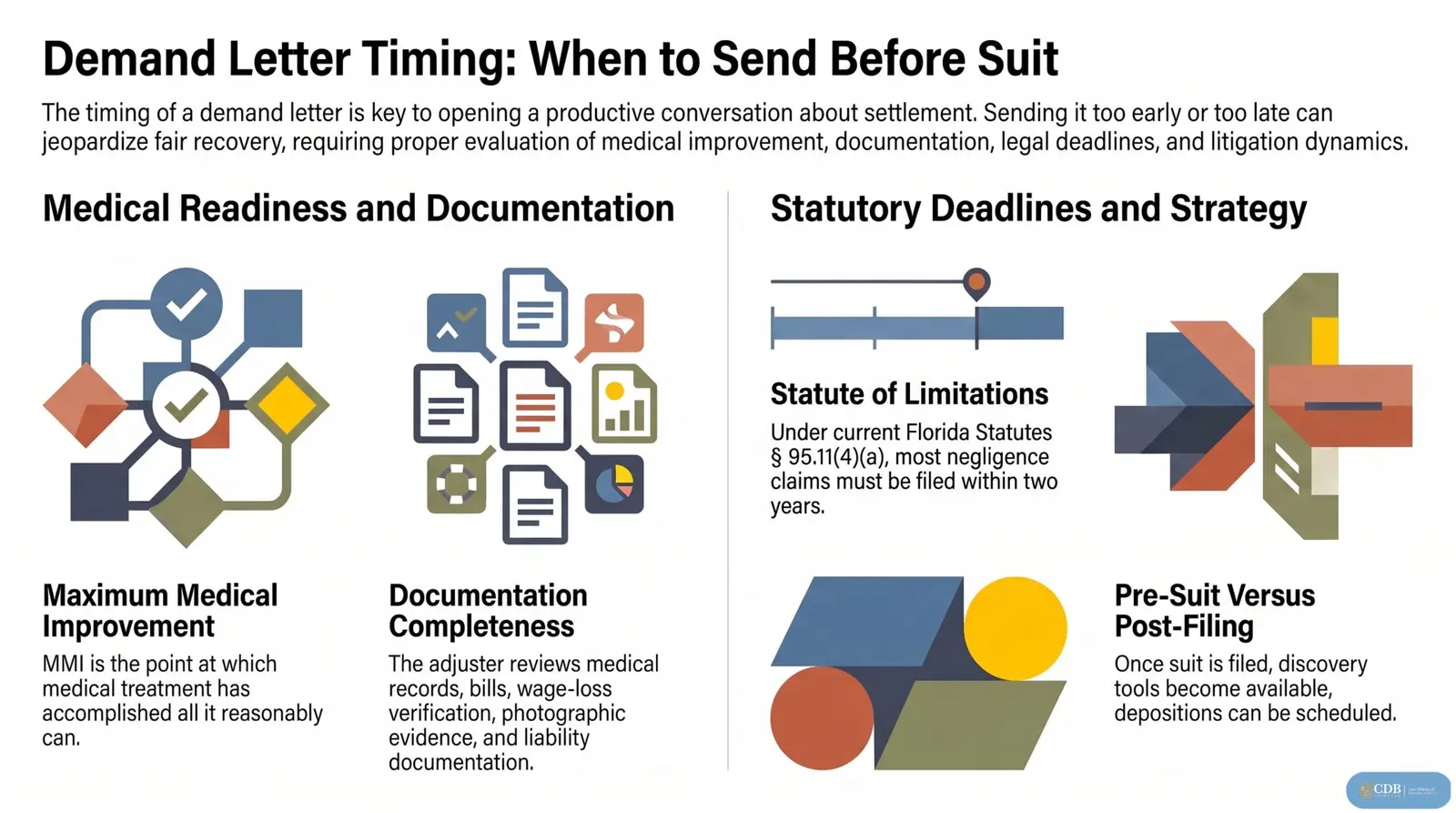
Most personal injury claims cannot be accurately valued until the injured person reaches maximum medical improvement. MMI is the point at which medical treatment has accomplished all it reasonably can, and any remaining symptoms are considered permanent. Before MMI, the full extent of the injury, the necessity of future care, and the permanence of impairment remain speculative. Insurance adjusters know this. A demand letter that arrives while treatment is ongoing invites a lowball offer based on incomplete damages, and once a release is signed, no additional recovery is possible even if the condition worsens.
MMI is declared by the treating physician, not by the carrier and not by the injured person. It may occur weeks after a soft-tissue injury or years after a catastrophic one. Until that determination is made, the demand letter may lack the foundation the carrier needs to evaluate permanent injury, scarring, disfigurement, or the need for future medical expenses. Sending the letter before MMI is not just premature. It can lead to a settlement that does not reflect the claim’s true value.
There are narrow exceptions. In cases involving clear liability, minimal treatment, and no ongoing symptoms, early resolution may serve the injured party’s interest. But those cases are the minority. Most personal injury claims involve contested fault percentages, evolving medical causation, or injuries that reveal their permanence only over time. In those cases, waiting for MMI is not a delay. It is a crucial part of preparing a complete and accurate claim.
Documentation Completeness: What the Adjuster Requires
A demand letter is only as strong as the documentation behind it. The carrier’s claims adjuster does not take the injured party’s word for damages. The adjuster reviews medical records, bills, wage-loss verification, photographic evidence, and liability documentation. If any of those elements is missing or incomplete, the adjuster either requests additional information, delaying the process, or makes an offer based solely on what was provided, leaving money on the table.
Before the demand letter goes out, the file should contain:
- Complete medical records from all treating providers, including emergency room, primary care, specialists, and physical therapy
- Itemized billing statements showing the full cost of treatment
- Employer wage-loss verification, including pay stubs and a letter confirming missed time
- Photographs of injuries, vehicles, or accident scenes
- Police reports, witness statements, and any accident reconstruction reports
- Documentation of permanent impairment or scarring, supported by physician narrative
Gathering this documentation takes time. Providers do not release records instantly. Billing departments lag behind treatment. Employers require formal requests for wage verification. Rushing the demand letter before these records are assembled weakens the claim and signals disorganization. A complete and organized file demonstrates that you are serious about receiving a fair outcome.
Statute of Limitations Pressure: The Negotiating Deadline
Florida law imposes a statute of limitations on personal injury claims. Under current Florida Statutes § 95.11(4)(a), most negligence claims must be filed within two years. That deadline is not negotiable, and once it passes, the claim may be barred regardless of its merit. The statute of limitations creates a ticking clock that affects both sides, but it affects the injured party more acutely because the carrier knows that as the deadline approaches, the opportunity to settle before a suit is filed diminishes. The date of the accident and the type of claim matter, so the deadline should always be confirmed early.
Sending a demand letter with ample time remaining, after the claim is medically and factually ready, and with as much time as circumstances allow, allows for thoughtful negotiation. It shows the insurance company that you are prepared while also keeping all options open, including filing a lawsuit if a fair agreement cannot be reached. When a letter arrives with only weeks to spare, it can force both sides into a defensive posture, making a lawsuit feel inevitable. This can close the door on productive conversation. The goal is to create a window for dialogue, not to rush toward a deadline.
Conversely, sending the demand too early in the limitations period, within months of the accident, can give the adjuster reason to pause. If they sense uncertainty, they might issue a low counteroffer and simply wait. This can add to the stress of an already difficult time. Timing the demand to allow for both productive negotiation and the preservation of your legal rights is a balancing act, and it shifts depending on the complexity of the claim.
Adjuster Authority and Settlement Reserves: Internal Constraints
The insurance adjuster reviewing a demand letter operates within settlement authority limits set by the carrier’s claims management. Those limits are determined by the carrier’s evaluation of liability, damages, and litigation risk. A demand letter that arrives before the adjuster has sufficient information to set a reserve, or before the reserve has been approved, will sit unanswered while internal processes play out. Understanding those internal constraints explains why some demand letters trigger immediate counteroffers while others receive only acknowledgment letters requesting more time.
Adjusters cannot authorize settlement payments that exceed their individual authority without supervisor or committee approval. In high-value claims, that approval process can take weeks. A demand letter sent without awareness of these timelines can create the false impression that the carrier is ignoring the claim, when in reality the adjuster is waiting for internal clearance. Timing the demand to allow for that internal process, while still preserving your legal options, improves the likelihood of a substantive response.
Additionally, carriers sometimes delay responding to demand letters as a tactic. If the adjuster believes the injured party is anxious to settle or unlikely to pursue litigation, the carrier may wait to see if the demand softens or if the claimant accepts a lower offer. A demand letter timed strategically, with clear documentation and sufficient runway before the statute of limitations, helps ensure your claim is addressed on its merits, without unnecessary delays.
Pre-Suit Versus Post-Filing Dynamics: Strategic Choices
Not every case requires a pre-suit demand letter. In some claims, particularly those involving disputed liability, minimal policy limits, or carriers with reput ations for refusing reasonable pre-suit settlement. Filing the lawsuit first changes the negotiating environment. Once suit is filed, discovery tools become available, depositions can be scheduled, and the carrier faces defense costs that climb every month. This reality often encourages more focused settlement discussions.
However, litigation is expensive and time-consuming for both sides. Most personal injury claims settle before trial, and many settle before suit is filed. A well-timed pre-suit demand letter preserves the possibility of resolution without the cost, delay, and uncertainty of litigation. The decision to send a demand letter before filing, or to skip the pre-suit demand and file immediately, depends on the carrier’s history, the strength of liability documentation, and the injured party’s tolerance for delay. Neither choice is universally correct, but both require deliberate timing.

A pre-suit demand letter can be a powerful tool for resolution when the facts are clear and the insurance carrier is willing to negotiate in good faith. It allows for a direct path to a fair settlement. However, when those conditions aren’t met, filing a lawsuit may be the necessary next step to ensure your story is fully heard. Deciding on the right path requires a careful understanding of your unique situation and what it will take to move your recovery forward.
Closing Remarks
Navigating the path to recovery after an injury can feel overwhelming. You may be wondering if you have reached the right point to act, worried about looming deadlines, or feeling pressured to settle before you have all the answers. The timing of each step is critical to protecting your peace of mind and your future. At CDB Injury Law, we understand that this is more than a legal claim, it is your life. We are here to bring clarity and steadiness to the process, ensuring your story is told completely and your needs are fully represented. You do not have to face this alone. Let us talk about your recovery.
Frequently Asked Questions
Can a demand letter be sent before medical treatment is finished?
Technically, yes, but doing so risks undervaluing the claim. A demand letter sent before maximum medical improvement makes it harder to evaluate future medical expenses, permanent impairment, or scarring with confidence. Once a settlement is reached and a release is signed, no additional compensation is available even if the condition worsens. Carriers know this and often make early offers designed to close the file before the full extent of damages is known. Waiting until MMI helps ensure the demand reflects the complete picture.
What happens if the statute of limitations is about to expire and no settlement has been reached?
If the statute of limitations is approaching and the carrier has not made a reasonable offer, filing suit becomes necessary to preserve the claim. Some carriers may use delays as a tactic, which can put you under immense pressure as the deadline nears. Filing suit before the statute expires preserves your right to pursue the claim and shifts the negotiating environment. Many cases still settle after suit is filed, but the lawsuit must be on file before the limitations period runs.
Do all personal injury claims require a pre-suit demand letter?
No. In some cases, particularly those involving disputed liability, carriers known for denying pre-suit demands, or minimal insurance coverage, filing suit immediately is more effective. A pre-suit demand letter works best when liability is clear, damages are documented, and the carrier has a history of good-faith negotiation. In cases where those factors are absent, the demand letter may unfortunately only delay the process and may not lead to productive conversations.
How long does an insurance carrier have to respond to a demand letter?
Florida law does not impose one universal response deadline for every third-party bodily injury demand letter, though Florida claims-handling law requires insurers to acknowledge and act promptly on claim communications and to conduct reasonable investigations. Most carriers respond within thirty to sixty days, but some may use delays as a way to pressure you. If the carrier does not respond within a reasonable period, or if the response is a lowball offer with no supporting explanation, you can either follow up with additional documentation or proceed to litigation.
What should be included in the demand letter to ensure the carrier takes it seriously?
A demand letter that triggers serious settlement negotiation includes a clear liability narrative supported by evidence, a complete medical summary with records and billing, documentation of wage loss and other economic damages, a discussion of noneconomic damages including pain and suffering, and a specific demand amount with a reasonable deadline for response. While it is important to convey the human impact of your injuries, adjusters respond best to a clear story backed by complete, organized documentation.
References
- Fla. Stat. § 95.11(4) (a).