
Insurance carriers often push for settlement before medical treatment concludes, hoping to minimize payout before the full scope of injury becomes clear. Accepting an early offer forfeits the right to recover compensation for complications, permanent impairment, or future care needs that emerge later. Once a release is signed, the claim is closed. No matter what happens next.
The call comes weeks after the crash. The adjuster is polite, apologetic, even sympathetic. A check can be issued tomorrow, enough to cover the bills so far, a little extra for trouble. Treatment is still ongoing. The orthopedist mentioned possible surgery. But the offer is there, now, certain. And everything else feels uncertain.
What gets lost in that moment is not just money. It is the ability to know what was truly taken.
Settlement offers issued before treatment ends arrive at the most vulnerable point in a claim. Medical bills are accumulating. Work schedules are disrupted. The adjuster presents the offer as a solution to financial pressure. But the signature on a release does not just resolve a claim; it forecloses the right to pursue additional compensation for injuries not yet diagnosed, documented, or fully understood.
Why Carriers Prefer Early Resolution
Insurance companies understand that injury progression is unpredictable. Soft tissue damage may evolve into chronic pain. Concussion symptoms can persist for months. What appears to be a straightforward sprain may require surgical intervention after conservative treatement fails. Early settlement eliminates the risk to the carrier that the claim will grow more expensive as the injury reveals itself.
The adjuster is not withholding information out of malice. The adjuster simply does not wait for it. The offer is calculated on incomplete medical records, preliminary diagnoses, and treatment bills submitted to date. Anything that emerges after acceptance is the injured party’s problem.
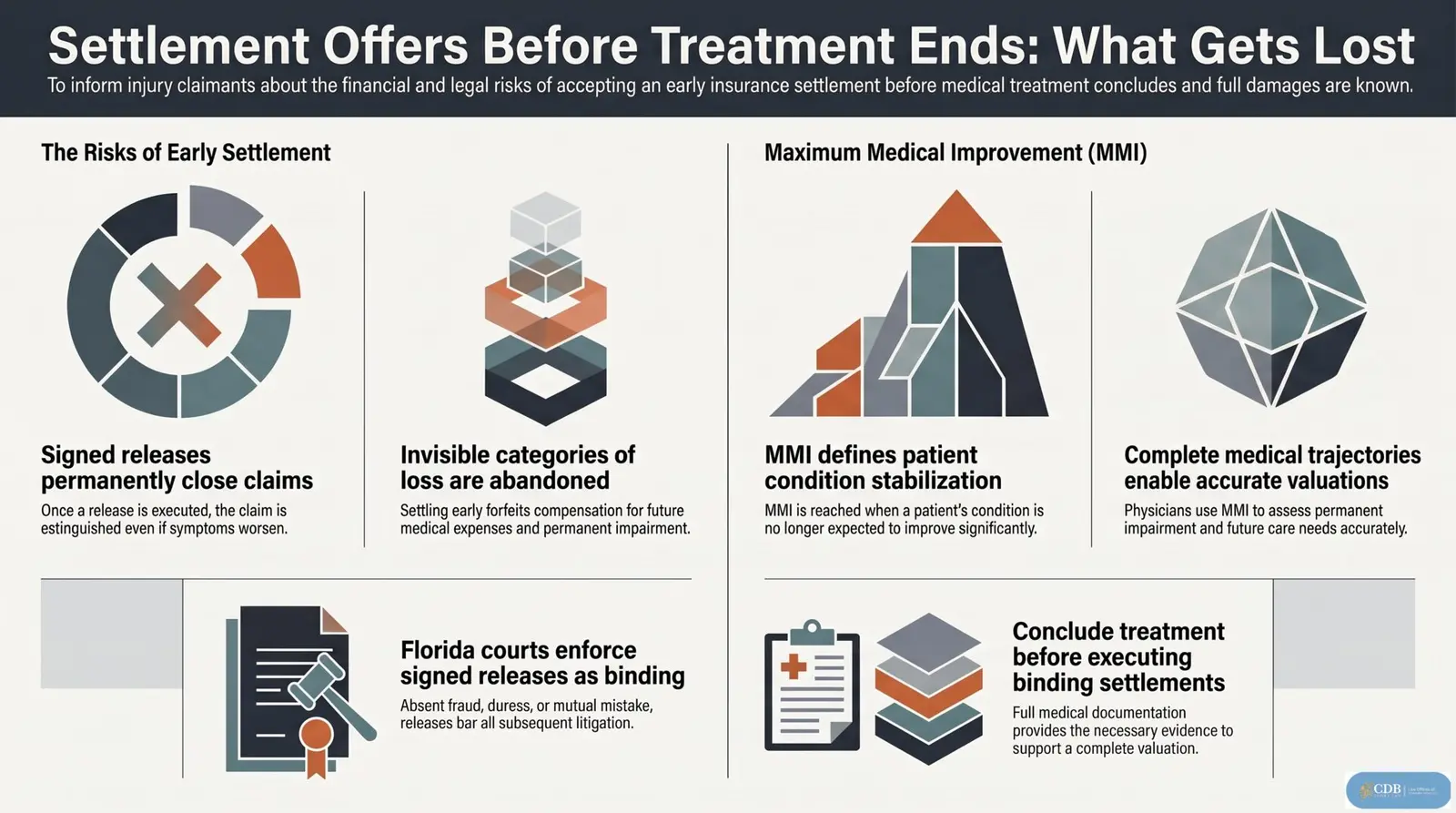
Florida law does not require carriers to delay settlement until maximum medical improvement. The burden to protect future recovery falls entirely on the claimant. Once a general release is executed, the claim is extinguished, even if surgery is scheduled, even if a specialist has not yet weighed in, even if symptoms worsen the following week.
What Maximum Medical Improvement Actually Means
Maximum medical improvement (MMI) is the point at which a patient’s condition has stabilized. Symptoms may remain, but they are no longer expected to improve significantly with continued treatment. Physicians use MMI as a benchmark to assess permanent impairment, ongoing care needs, and functional limitations.
Reaching MMI does not mean the injury is healed. It means the trajectory is known. And knowing that trajectory is essential to valuing a claim accurately. Until MMI is reached, the scope of loss remains speculative. Settlement before that point locks in compensation based on partial information.
Consider a hypothetical: a rear-impact collision results in lumbar strain. Physical therapy begins. After six weeks, pain persists. An MRI reveals a herniated disc. The surgeon recommends a trial of injections before discussing surgery. An early settlement offer arrives during the injection phase, reflecting only the cost of therapy and diagnostics to date. Accepting that offer means forfeiting recovery for the surgery, post-operative care, work restrictions during recovery, and any permanent limitation the surgeon later documents. The release bars any subsequent claim.
Categories of Loss That Remain Invisible Early On
Certain categories of damage cannot be quantified until treatment concludes and the long-term prognosis is established. Settling before that point means abandoning compensation for:
- Future medical expenses: Surgery, physical therapy, pain management, assistive devices, and prescription medications required after settlement.
- Permanent impairment: Loss of range of motion, chronic pain, scarring, disfigurement, and reduced physical capacity that affect daily life and employability.
- Diminished earning capacity: Inability to return to prior work, need for vocational retraining, or limitations that reduce income potential over a working lifetime.
- Loss of enjoyment of life: Activities, hobbies, and physical pursuits no longer possible due to lasting injury.
- Aggravation of pre-existing conditions: Injuries that accelerate degenerative conditions or convert asymptomatic vulnerabilities into active impairments.
These losses do not appear on an emergency room discharge summary. They emerge over weeks and months as treatment progresses, fails, or reaches its limit. An offer calculated before they materialize cannot account for them.
The Release Language That Ends the Claim
General releases used in personal injury settlements are broad by design. The standard language discharges all claims, known and unknown, arising from the incident. It does not carve out exceptions for complications that surface later. Once signed, the release is binding.
Florida courts enforce settlement agreements and releases as contracts. Absent fraud, duress, or mutual mistake of material fact, a signed release bars subsequent litigation even when the injury proves more severe than anticipated at the time of settlement. The claimant’s subjective belief that the injury was minor, or that the offer was adequate, does not provide grounds to set aside the release.
There is no statutory cooling-off period. No provision allowing rescission if surgery becomes necessary. The moment funds are accepted and the release is executed, the legal right to pursue additional compensation is extinguished.
Why Waiting Is Not Delay. It Is Diligence
Waiting until treatment concludes is not an effort to inflate a claim. It is an effort to know what the claim is. Injuries develop. Prognoses change. Treatments fail. A responsible valuation cannot occur until the medical picture is complete.
Carriers may frame delay as obstruction. But the timeline that matters is not the adjuster’s closing schedule; it is the patient’s recovery and the applicable filing deadline. For negligence claims that accrued before March 24, 2023, Florida generally allowed four years to file suit; for negligence claims accruing on or after that date, the deadline is generally two years. Some claims have shorter deadlines, so the statute of limitations should be confirmed early, but an insurer’s preference for quick closure is not the same as a legal deadline.
Rushing settlement to ease immediate financial pressure trades long-term security for short-term relief. Medical bills can often be managed through provider liens, payment plans, or letters of protection that defer collection until settlement. Lost income during treatment is itself a category of recoverable damages. These pressures are real, but they do not justify abandoning compensation for losses that have not yet been identified.
The question is not whether the offer feels fair now. The question is whether it accounts for everything that will be lost. Before treatment ends, that question has no answer. And signing a release converts “not yet known” into “never compensable.”
Closing Remarks
If an insurance adjuster has made an offer while treatment is still ongoing, if a physician has not yet determined maximum medical improvement, or if questions remain about surgery, long-term care, or permanent restrictions, the decision to settle should not be made in isolation. CDB Injury Law evaluates settlement offers in the context of complete medical documentation, future care needs, and the full scope of loss. Contact us before signing anything that closes your claim.
Frequently Asked Questions
Can a settlement be reopened if my injury gets worse after I sign a release?
Generally, no. A signed release discharges all claims arising from the incident, including those for conditions that worsen or complications that emerge later. Florida courts enforce releases as binding contracts. Absent fraud, duress, or a mutual mistake of material fact regarding the nature of the injury, the release cannot be set aside simply because the injury proved more serious than anticipated.
What is maximum medical improvement, and why does it matter for settlement?
Maximum medical improvement (MMI) is the stage at which a patient’s condition has stabilized and is not expected to improve significantly with further treatment. Reaching MMI allows physicians to assess permanent impairment, future care needs, and functional limitations. Settling before MMI means valuing the claim without knowing the full extent of loss, often resulting in compensation that does not cover later medical expenses, diminished earning capacity, or lasting impairment.
What happens if I need surgery after accepting a settlement offer?
If a general release has been signed, the carrier is not obligated to pay for surgery or any other treatment required after settlement. The release extinguishes the right to pursue additional compensation, regardless of how the injury progresses. Surgical costs, post-operative care, lost wages during recovery, and any complications become the injured party’s sole responsibility once the claim is closed.
How long should I wait before considering a settlement offer?
There is no fixed timeline, but settlement should not occur until the treating physician has determined that the condition has reached maximum medical improvement and documented any permanent impairment or future care needs. This ensures that all categories of loss, medical expenses, lost income, diminished capacity, and pain and suffering, can be accurately assessed. Accepting an offer before that determination risks forfeiting compensation for losses not yet diagnosed or quantified.
Can I negotiate with the insurance company while I am still receiving treatment?
Negotiation can begin at any time, but no binding settlement should be executed until treatment is complete and the full scope of injury is known. Discussions during treatment may help establish a framework for resolution, but signing a release or accepting funds before maximum medical improvement closes the claim prematurely. Ongoing treatment provides the documentation necessary to support a complete and accurate valuation.
References
- Fla. Stat. § 95.11(4) ((a) (2023). Verified by CDB Injury Law).
- Ch. 2023-15, §§ 7, 30, Laws of Fla. Verified by CDB Injury Law
- Ch. 2023-15, §§ 7, 30, Laws of Fla