

Insurance adjusters sometimes make early admission-of-liability statements to project cooperation and push claimants toward fast settlement before the full injury picture emerges. These admissions rarely bind the insurer to full compensation, and accepting an early offer based on partial liability acknowledgment often forfeits substantial future damages. Understanding what these statements mean, and what they deliberately omit, protects leverage during the claim.
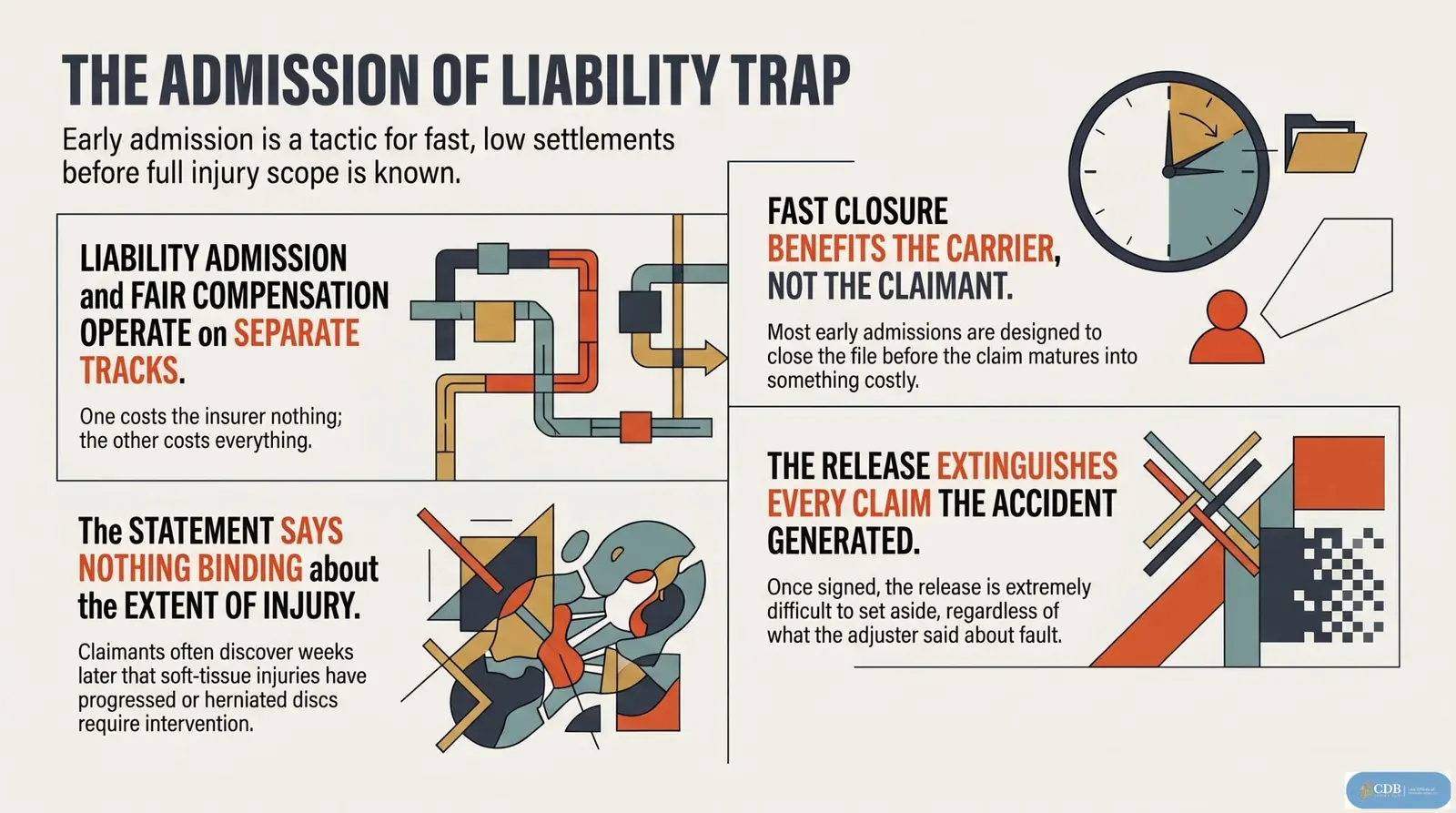
The adjuster calls within days of the accident. Professional. Apologetic. “Our insured was at fault. We’re accepting liability. Let’s get this wrapped up quickly so you can move forward.” The words feel like relief after chaos; someone finally taking responsibility. But liability admission and fair compensation operate on separate tracks. One costs the insurer nothing. The other costs everything. Fast closure benefits the carrier, not the claimant, and most early admissions are designed to do exactly that: close the file before the claim matures into something costly.

Admission of liability sounds definitive. It is not. The statement acknowledges fault for the collision but says nothing binding about the extent of injury, the scope of recoverable damages, or the final settlement figure. Adjusters deploy these admissions strategically, offering just enough validation to build rapport and just enough urgency to suppress further investigation. The tactic works because injured claimants want resolution. Pain, disruption, and medical uncertainty create pressure to accept the first offer that feels reasonable. But “reasonable” at day ten looks radically different than reasonable at maximum medical improvement.
Why Insurers Admit Liability Early
Early liability admissions serve three tactical purposes. First, they project good faith. The adjuster appears cooperative, transparent, and aligned with the claimant’s interest in swift resolution. That manufactured alignment builds trust and discourages the claimant from retaining counsel. Second, the admission creates urgency. Once fault is conceded, the adjuster frames further delay as unnecessary. “We’ve already accepted responsibility; now we just need to agree on a number.” The implication: questioning the offer is obstinate or greedy. Third, the admission anchors the negotiation around present symptoms, not future consequences. By acknowledging fault before diagnostic imaging, specialist referrals, or symptom progression, the insurer defines the claim’s value at its lowest visible point.
None of these purposes align with full compensation. The admission costs the carrier nothing because Florida operates under a modified comparative negligence framework where liability and damages remain distinct. Fla. Stat. § 768.81 generally bars recovery in negligence actions when a claimant is more than 50% at fault and otherwise reduces damages in proportion to the claimant’s percentage of fault. An early admission of 100% liability does not guarantee 100% of actual damages. It may narrow one contested issue while leaving valuation open to dispute. Most claimants interpret the admission as a green light to settle. The carrier interprets it as a tool to prevent the claim from reaching its true value.
What the Admission Does Not Cover
Liability admissions address fault for the accident. They do not address:
- Extent of bodily injury attributable to the collision
- Necessity or reasonableness of medical treatment
- Permanency of impairment or scarring
- Noneconomic damages such as pain, suffering, or loss of capacity
- Future medical expenses beyond those already incurred
- Lost earning capacity versus documented lost wages
Each of these elements remains contestable even after fault is conceded. Adjusters use the admission to skip past the liability fight and move directly to damage suppression. The offer that follows typically covers only visible, quantifiable losses, emergency room bills, a few physical therapy sessions, minimal property damage, while excluding latent injuries, specialist care, imaging-confirmed trauma, and long-term impairment. Claimants who accept these offers often discover weeks later that soft-tissue injuries have progressed, disc herniations require intervention, or Florida’s serious injury threshold for noneconomic damages has been met. By then, the general release has extinguished all claims.
The Timing Trap
Speed serves the insurer. The faster a claim closes, the less the carrier pays. Early liability admissions accelerate that timeline by removing the most time-consuming dispute, fault, and replacing it with a low-stakes negotiation over incomplete damages. The adjuster presents the offer as if it reflects full compensation, when in fact it reflects only the damages visible at that snapshot in time. Injuries evolve. Symptoms plateau, flare, or worsen. Diagnostic findings emerge. Treatment plans extend. Maximum medical improvement, the point at which a physician can reliably assess permanency often arrives months after the collision. Settling before that point means settling without critical information.
Florida law does not require claimants to settle before treatment concludes. Personal injury protection coverage under Fla. Stat. § 627.736 provides initial medical and wage-loss benefits regardless of fault, subject to statutory conditions and limits, including timely medical care. Once PIP coverage exhaustion occurs, the bodily injury claim against the at-fault party’s liability insurer becomes the primary recovery vehicle. In motor vehicle cases, Fla. Stat. § 627.737 also governs when an injured person may recover noneconomic damages such as pain and suffering. Settling that claim prematurely forfeits compensation for injuries not yet diagnosed and treatments not yet rendered. The admission of liability does nothing to change that calculus. It simply makes the premature settlement feel safer than it is.
The Language of the Release
Most insurance settlements include a general release. The document typically discharges all claims arising from the accident, known and unknown, past and future, in exchange for the settlement payment. Once signed, the release is extremely difficult to set aside absent narrow grounds such as fraud, duress, or mutual mistake. Florida courts generally enforce these agreements even when the claimant later discovers injuries far more severe than initially apparent. The liability admission makes no difference. The release governs. Adjusters know this. The combination of an early liability admission and a quick settlement offer creates a psychological environment where signing feels like formality rather than finality. It is not. The release extinguishes every claim the accident generated, regardless of what the adjuster said about fault.
Consider a hypothetical: A driver rear-ends a vehicle at a stoplight. The at-fault insurer calls the injured party two days later, admits 100% liability, and offers $7,500 to cover the emergency room visit, vehicle damage, and “pain and suffering.” The injured party feels sore but functional and accepts. Three weeks later, an MRI reveals a herniated cervical disc requiring epidural injections and potential surgery. The general release has already been executed. The $7,500 covered nothing close to the actual loss, but the admission of liability gave the offer an air of completeness. The insurer paid a fraction of the claim’s value and closed the file permanently.

Liability admissions are not concessions, they are tools. They remove friction from the settlement process, build false confidence, and anchor valuation at the claim’s least-developed stage. The statement “we accept liability” answers only whether the insurer’s driver caused the collision. It says nothing about whether the offer reflects the injury’s true cost. Evaluating that cost requires complete medical information, an understanding of permanency, and a realistic assessment of future needs. Rushing past those steps to accept an early offer trades long-term recovery for short-term closure. The insurer benefits. The claimant does not.
Closing Remarks
If an adjuster has admitted liability but pressured settlement before treatment finished, or if an early offer excluded future medical expenses or permanent impairment, the stakes extend beyond the immediate claim; they shape financial recovery for years. CDB Injury Law evaluates personal injury claims after liability admissions to determine whether settlement offers reflect actual damages or simply expedite closure. Contact us before signing any release or accepting any offer that does not account for the full injury picture.
Frequently Asked Questions
Does an admission of liability guarantee a fair settlement offer?
No. Admission of liability addresses only fault for the accident, not the value of the claim. Insurers routinely admit liability while offering settlements far below actual damages, especially before injuries fully manifest or treatment concludes. The admission removes the liability dispute but leaves damage valuation entirely in the carrier’s hands, often resulting in offers that cover only immediate, visible losses.
Can an insurer withdraw a liability admission after making it?
In most cases, yes. Early liability admissions are not binding stipulations unless formalized in a written agreement signed by both parties. Adjusters make verbal or informal written admissions to facilitate fast settlement, but these statements carry no independent legal effect. If the claim does not settle quickly and later investigation reveals disputed facts, the insurer may revise its liability position or assert comparative fault defenses under Florida’s comparative negligence statute.
What happens if symptoms worsen after accepting an early settlement based on a liability admission?
Once a general release is signed, all claims arising from the accident are typically extinguished, including those for injuries not yet diagnosed or symptoms not yet apparent. Florida courts generally enforce releases even when the claimant later discovers conditions far more serious than anticipated at the time of settlement. The liability admission does not reopen the claim or create an exception to the release. The settlement is final unless a narrow legal basis exists to challenge the release itself.
Should treatment be delayed to wait for a settlement offer after liability is admitted?
No. Medical treatment should proceed based on physician recommendations, not settlement timing. Delaying necessary care risks worsening the injury and creates gaps in the treatment record that insurers exploit to argue the condition was not accident-related. Florida’s personal injury protection statute can provide initial coverage for medical expenses regardless of fault when statutory requirements are met, allowing treatment to proceed while the bodily injury claim develops. Settlement should generally occur after the medical picture is stable, not before.
How does an early liability admission affect the claim if the injured party was partially at fault?
Under Florida’s modified comparative negligence framework, a claimant’s recovery is generally barred if the claimant is more than 50% at fault in a negligence action and otherwise reduced by the claimant’s percentage of fault. If the insurer admits 100% liability for its insured, that removes comparative fault as a contested issue, but only if the admission is memorialized and the claim settles on that basis. If the claim proceeds without settlement, the insurer may later argue the claimant bore partial responsibility, reducing or potentially defeating the damage award under Fla. Stat. § 768.81. Early admissions are strategic, not contractual, and can be revised if the file remains open.
References
- Fla. Stat. § 768.81 ((2023). Comparative fault. Source: The 2023 Florida Statutes).
- Fla. Stat. § 627.736 ((2023). Personal injury protection. Source: The 2023 Florida Statutes).
- Fla. Stat. § 627.737 ((2023). Tort exemption; limitation on right to damages; punitive damages. Source: The 2023 Florida Statutes).