
Police accident reports are essential records that document crash scene details, but they often miss critical information that affects injury claims—witness statements, vehicle positioning, and physical symptoms that emerge later. What appears in the official report shapes how insurers evaluate liability, and what gets left out can weaken recovery before negotiations even begin. Understanding both what officers document and what they overlook helps preserve the full picture of what happened.
A collision occurs. Officers arrive, take measurements, exchange insurance information, and clear the scene. Days later, the report arrives—three pages summarizing a life-altering event. Everything that matters seems condensed into checkboxes and narrative fields. But official documentation captures only a fraction of what happened, and the gaps between what police record and what actually occurred often determine whether an injury claim succeeds or stalls.
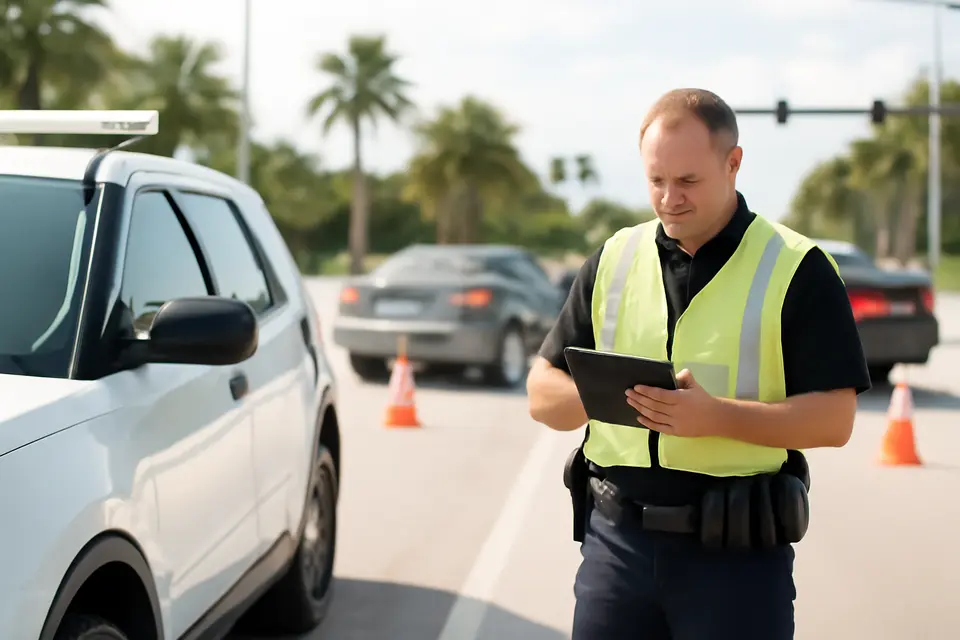
Accident reports serve as the foundation for nearly every injury claim arising from traffic collisions. Insurers pull them immediately. Adjusters cite them when denying claims. Defense attorneys use them to challenge liability. Yet these reports are created under time pressure, often at chaotic scenes, by officers whose primary mission is traffic clearance and public safety—not building a civil case. Knowing what these documents capture, what they miss, and why those omissions matter transforms how injury victims protect their rights from the first moments after impact.
What Police Reports Typically Include
Florida law requires law enforcement to investigate and document any crash involving injury, death, or property damage meeting statutory thresholds under Florida Statute § 316.066. The resulting report—commonly called the Traffic Crash Report Long Form—follows a standardized format that includes:
- Driver and vehicle information for all parties involved
- Date, time, location, and environmental conditions
- Diagram of the crash scene showing vehicle positions and roadway configuration
- Narrative summary describing the sequence of events
- Officer’s determination of contributing factors (driver inattention, speed, impairment)
- Citations issued, if any
- Identification of injured parties and transport destinations
This framework provides an official baseline. Insurance carriers treat it as a quasi-neutral account, even though the officer rarely witnesses the collision itself. The narrative section holds particular weight—adjusters parse verb tenses, note which driver the officer interviewed first, and interpret passive construction as uncertainty about fault. A phrase like “Vehicle 1 was struck by Vehicle 2” carries different implications than “Vehicle 1 pulled into the path of Vehicle 2,” even when both describe the same physical event.
Citations documented in the report create a rebuttable presumption of fault in many claims. Florida Statute § 316.650 establishes that traffic citations are admissible in civil proceedings, and insurers leverage this. When one driver receives a citation for failure to yield and the other receives none, the report shifts the burden of proof before any investigation begins. But citations reflect only what the officer observed or inferred at the scene—not the totality of contributing factors.
Critical Details That Frequently Go Undocumented
The standardized format imposes limits. Officers work within fixed fields and time constraints, especially when multiple crashes demand attention or traffic backlog creates hazards. What falls outside the template often disappears from the official record entirely.
Witness Statements and Contact Information
Independent witnesses provide the most powerful third-party corroboration of how a collision occurred. Yet police reports frequently list witnesses without recording their statements, or omit witnesses altogether if those individuals leave the scene before officers arrive. Bystanders who stopped briefly, pedestrians on nearby sidewalks, or occupants of vehicles not directly involved rarely make it into the narrative. When statements are included, they may be paraphrased into a single sentence that strips out critical detail—the difference between “the car ran the light” and “the southbound sedan entered the intersection five seconds after the signal turned red” can be dispositive.
Physical Evidence and Scene Conditions
Skid marks, debris fields, fluid trails, and damage patterns tell a mechanical story about speed, braking, and point of impact. Officers document some of this in diagrams, but resource limitations mean most agencies do not photograph every relevant detail unless the crash involves fatalities or requires reconstruction. Roadway defects—potholes that caused evasive maneuvers, faded lane markings, obstructed sightlines from overgrown vegetation—rarely appear in reports unless the officer deems them direct contributing factors. Once the scene is cleared and traffic resumes, this evidence vanishes.
Delayed-Onset Injuries
Adrenaline suppresses pain. Soft-tissue injuries, concussion symptoms, and internal bleeding may not manifest until hours or days after impact. The injury section of a crash report reflects only what is observable or reported at the scene. Someone who declines ambulance transport and is marked “uninjured” on the report may later discover herniated discs or traumatic brain injury. Insurers use the initial report designation to argue that injuries are unrelated to the crash, even when medical records establish clear causal connection. Understanding how personal injury claims account for delayed symptoms becomes essential when the official record shows no immediate harm.
Driver Statements and Admissions
What drivers say at the scene gets filtered through officer interpretation. Apologizing—a reflexive social response—can be recorded as an admission of fault. Explaining what happened while still disoriented from impact may produce a statement that conflicts with later recollection once shock subsides. Officers rarely capture the full context of these statements, and the report locks in a version that becomes difficult to clarify later. Insurers quote these statements verbatim during claim negotiations, treating them as binding admissions even when the speaker had no legal duty to provide them and no understanding of their implications.
How Reporting Gaps Affect Injury Claims
Insurance adjusters receive crash reports within days of a collision, often before injury victims have consulted anyone about their rights. The report becomes the claim file’s cornerstone. When key details are missing, the burden shifts to the injured party to fill those gaps—but insurers resist supplemental evidence that contradicts the official narrative.
Florida’s comparative negligence rule under Florida Statute § 768.81 means that any fault attributed to the injured party reduces recovery proportionally. If a police report suggests shared responsibility—”both drivers failed to maintain proper lookout”—the insurer applies a comparative fault percentage that diminishes the settlement offer. Challenging that characterization requires independent evidence: witness affidavits, photographs, expert analysis of vehicle damage, medical records establishing that injuries consistent with being struck, not striking. Assembling this evidence weeks after the crash is harder, more expensive, and sometimes impossible.
When reports omit witness contact information, locating those individuals later becomes investigative work. Canvassing the area, reviewing social media posts, checking nearby business surveillance footage—these steps fall to the claimant, not the insurer. Without early action, witnesses relocate, memories fade, and video footage is overwritten. The window for preserving this evidence is narrow, and once it closes, the police report often stands as the sole contemporaneous account.
The “No Fault” Trap in PIP Claims
Florida’s no-fault system under Florida Statute § 627.736 requires personal injury protection (PIP) coverage to pay initial medical expenses and lost wages regardless of fault. But PIP coverage is capped, and once those benefits approach exhaustion, crossing the threshold to pursue the at-fault driver’s liability coverage requires meeting the permanent injury standard described in Florida’s permanent injury threshold guidance or demonstrating that medical expenses exceed the PIP policy limits. If the police report attributes fault ambiguously or suggests comparative negligence, insurers deny liability claims and force claimants to rely solely on their own PIP—leaving serious injuries underfunded.
Documenting What Officers Cannot
The collision itself lasts seconds. The investigation lasts minutes. The consequences unfold over months or years. Preserving evidence that police reports miss requires immediate, methodical action by someone who understands what will matter later.
Photographs taken by parties involved or bystanders capture the scene from multiple angles and time points. Vehicle positions before tow trucks arrive, skid patterns before traffic resumes, traffic control devices, weather conditions, visible injuries—all become part of a supplemental record. Metadata embedded in smartphone photos establishes time and sometimes location, corroborating or challenging the official timeline.
Medical records created within hours of the crash document injury complaints and examination findings before delayed symptoms emerge. Emergency department notes, paramedic run sheets, and follow-up visits create a medical chronology that either aligns with or contradicts the “uninjured” designation on a crash report. When these records reference mechanism of injury consistent with the collision dynamics, they supply the causal link that reports often omit.
Witness contact information gathered independently—before police finish their investigation or after they leave—preserves access to testimony. Written statements taken while memory is fresh, signed and dated, carry evidentiary weight that hearsay recollections months later do not. Video from nearby businesses, residential doorbell cameras, or dashboard cameras in uninvolved vehicles fills gaps that diagrams cannot. This footage is transient; requesting it within days is often the only chance to secure it.

None of this supplements the police report in the official file. Law enforcement agencies rarely accept additional materials or amend reports based on post-scene evidence unless it reveals clear factual error. But in the civil claim process, this independent documentation becomes the counterweight to an incomplete official narrative. Insurers cannot dismiss evidence they must confront, and the presence of corroborating materials shifts settlement posture before litigation ever becomes necessary. The foundation for a claim’s success or failure is built in those first hours and days, when the gap between what happened and what was documented is still bridgeable.
Closing Remarks
If an accident report omits witnesses who saw what happened, fails to document injuries that surfaced days later, or contains a narrative that shifts fault away from the driver who caused the collision, the official record has become an obstacle rather than evidence. CDB Injury Law reconstructs what crash reports leave out and builds injury claims on the full truth of what occurred. Contact us to talk about your recovery and what the gaps in your case file really mean.
Frequently Asked Questions
Can a police report be changed after it is filed?
Florida law enforcement agencies allow amendments only for clear factual errors—incorrect names, vehicle identification numbers, or dates. Officers do not revise narratives or fault determinations based on evidence that surfaces after the report is submitted. Supplemental reports may be filed if new witnesses come forward immediately, but this is rare. Challenging the report’s conclusions happens during the claims process or litigation, not by altering the official document itself.
What if the officer did not cite anyone at the scene?
No citation does not mean no fault. Officers issue citations for observable violations of traffic law, but liability in a civil claim depends on negligence—a broader standard. Crash reports without citations often indicate that fault was unclear to the officer at the scene, which shifts the evidentiary burden to the insurance investigation. Independent evidence becomes even more critical when the report provides no initial fault finding for either side to rely on.
How long does it take to get a copy of the crash report?
Florida law requires agencies to complete reports within ten days of the crash under Florida Statute § 316.066, though complex cases or resource constraints can delay this. Copies are typically available through the investigating agency or the Florida Department of Highway Safety and Motor Vehicles. Insurers often obtain reports faster through direct law enforcement channels, which means they may be evaluating the claim before the injured party even sees the document.
Does an inaccurate police report automatically ruin an injury claim?
Inaccuracies create obstacles, not outcomes. A report that misstates critical facts—vehicle positions, signal phases, who had the right of way—can be countered with witness testimony, photographic evidence, expert reconstruction, and medical proof of injury causation. The process becomes harder and requires more resources, but claims succeed or fail based on the totality of evidence, not a single document. What matters is whether the gap between the report and reality can be closed before the claim is evaluated or litigated.
References
- Florida Statute § 316.066 – Written reports of crashes (Verified)
- Florida Statute § 316.650 – Traffic citations; civil traffic infraction (Verified)
- Florida Statute § 768.81 – Comparative fault (Verified)
- Florida Statute § 627.736 – Required personal injury protection benefits; exclusions; priority; claims (Verified)