
In Florida negligence actions governed by Florida’s modified comparative negligence statute, an injury claim’s payout is reduced in direct proportion to the injured party’s percentage of fault. If the injured party is found more than 50 percent at fault, recovery is barred. Understanding how adjusters and courts assign fault percentages determines whether a settlement restores stability or leaves critical needs unmet.
An insurance adjuster’s initial offer often arrives with a polite phrase: “We’ve determined your client bears 40 percent responsibility.” That single sentence can erase tens of thousands of dollars from a claim’s value, and most injured parties never learn how that number was chosen or that it can be challenged. Fault percentages feel arbitrary until medical bills exceed insurance limits, lost wages stretch into months, and the gap between need and payment becomes impossible to ignore.

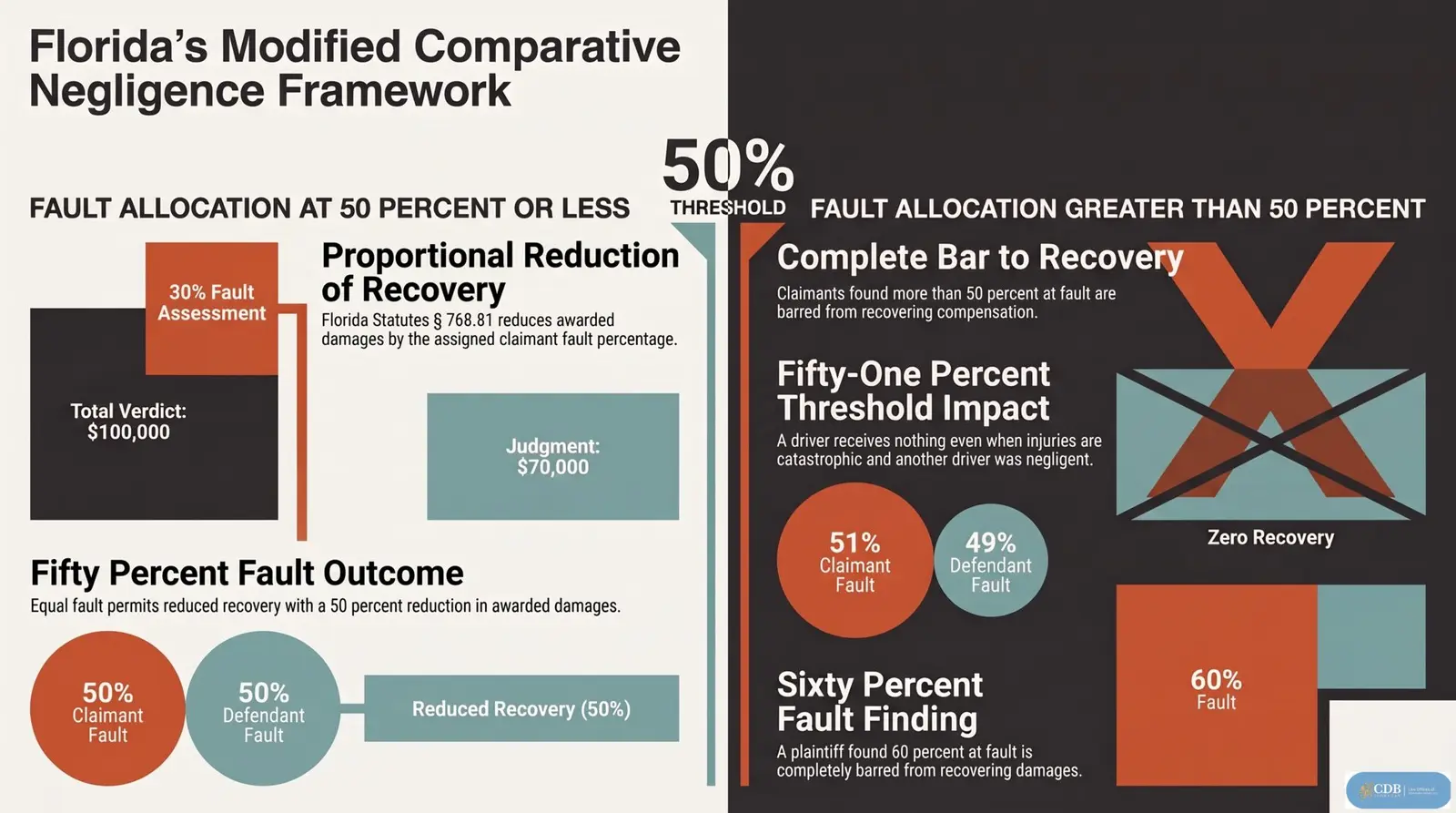
Florida Statutes § 768.81 governs how fault affects recovery in covered negligence actions. The statute requires damages awarded to be reduced by the percentage of fault assigned to the claimant. If a jury determines that an injured party bears 30 percent responsibility for a collision, a $100,000 verdict becomes a $70,000 judgment. The reduction is automatic and non-negotiable.
The statute also establishes a threshold: if the injured party’s fault is greater than 50 percent, no recovery is permitted in covered negligence actions. This modified comparative negligence rule operates as a complete bar. A driver found 51 percent at fault for a crash receives nothing, even when injuries are catastrophic and the other driver was also negligent. The distinction between 50 percent and anything above 50 percent is the difference between partial recovery and total loss.
How Fault Percentages Are Assigned
Insurance adjusters assign initial fault percentages during claim investigation. They review police reports, photographs, witness statements, and medical records. Their conclusions shape early settlement offers and frame the narrative that follows a claim through litigation.
Adjusters are not neutral. Their incentive structure rewards reduced payouts. A fault determination that shifts even 20 percent of blame to the injured party cuts the insurer’s exposure by one-fifth. The calculus is simple: higher claimant fault equals lower settlement cost.
Several factors commonly drive fault allocation:
- Traffic violations: Citations issued at the scene may influence an insurer’s evaluation, especially when supported by the underlying facts, but a citation alone is not a final legal determination of fault.
- Statutory duties: Florida law imposes specific obligations on drivers, pedestrians, and property owners. Violation of a safety statute may support a negligence argument or, in some circumstances, negligence per se.
- Witness credibility: Conflicting accounts invite subjective judgment. Adjusters and juries weigh demeanor, consistency, and corroboration.
- Physical evidence: Skid marks, vehicle damage patterns, and road conditions either support or undermine a party’s account.
- Pre-existing conditions: Medical history unrelated to the incident is not comparative fault, but insurers may use it to dispute causation or reduce the value assigned to damages, particularly when injuries involve soft tissue or chronic pain.
When liability is disputed, the question moves from the adjuster’s desk to a jury. Florida’s standard jury instruction on comparative negligence directs jurors to assign a percentage of fault to each party, and, when properly placed on the verdict form, each nonparty whose negligence contributed to the injury. Jurors receive no mathematical formula. They deliberate, negotiate, and reach a consensus. The resulting percentage may reflect compromise as much as evidence.
How Fault Reduction Reshapes Settlement Value
The practical impact of fault percentages emerges when calculating what a claim is worth. Every category of damage, medical expenses, lost income, pain and suffering,is subject to proportional reduction.
Consider a hypothetical: A pedestrian suffers a fractured femur when struck in a crosswalk. Total damages equal $200,000: $80,000 in medical bills, $40,000 in lost wages, and $80,000 in noneconomic damages. If the pedestrian is found 25 percent at fault for crossing against a signal, the recoverable amount drops to $150,000. The $50,000 reduction does not come from a discretionary fund. It comes directly from the injured party’s ability to pay rent, cover surgery costs, and rebuild stability.
Defense counsel and insurers exploit fault percentages during settlement negotiations, often applying what amounts to a dual discount. First, their internal calculation of a claim’s “full value” may be intentionally conservative. Then, they apply the fault percentage reduction to that already-lowered figure. For example, an insurer might value a claim at $200,000 when a jury might award $300,000. If they also assign the injured party 40% fault, the settlement offer becomes just $120,000, a figure that is drastically reduced from the claim’s true potential.
For individuals navigating car accident claims, the insurer’s initial fault assessment often becomes the ceiling of negotiation unless challenged with competing evidence and expert analysis.
The More-Than-50 Percent Cliff
The modified comparative negligence threshold creates a binary outcome. At 50 percent fault, recovery is reduced but remains possible. Above 50 percent, the claim is barred. This cliff effect drives aggressive defense tactics.
Defense attorneys aim not merely to reduce the plaintiff’s recovery but to push fault assignment past the halfway mark. A liability trial becomes a race to more than 50 percent. Evidence that might contribute only marginally to the overall narrative, a momentary glance at a phone, a failure to wear bright clothing at dusk, gains outsize strategic importance when it can tip the scale past the threshold.
Plaintiffs approaching the 50 percent line face a choice: accept a discounted settlement that reflects high comparative fault, or proceed to trial and risk crossing the threshold into total loss. Insurers leverage this pressure point. Settlement offers made days before trial are deliberately structured to exploit the fear of being found more than 50 percent at fault.
Challenging Fault Determinations
Fault percentages are not immutable. Adjusters make mistakes. Police reports contain errors. Witnesses misremember. The initial fault determination is the opening position, not the final word.
Challenging an unfavorable fault assessment requires evidence that reframes the narrative. Accident reconstruction experts analyze physical evidence to demonstrate speed, point of impact, and visibility. Medical experts distinguish between pre-existing conditions and trauma caused by the incident. Surveillance footage, cell tower records, and vehicle event data recorders provide objective data that override subjective impressions.
Depositions serve a dual function: they lock in the opposing party’s version of events, and they expose inconsistencies. A driver who claims full attention on the road but admits in deposition to adjusting the radio, eating, or disciplining a child in the back seat has just created impeachment material. Comparative negligence defenses weaken when the defendant’s own conduct reveals multiple points of inattention or statutory violation.
Jurisdictional nuances matter. Florida’s comparative negligence framework interacts with doctrines and evidentiary principles such as negligence per se and res ipsa loquitur. A defendant who violated a safety statute may bear a higher percentage of fault even when the plaintiff also acted carelessly. Understanding how fault percentages work within Florida’s broader negligence framework reveals strategic opportunities that a surface review misses.
When Fault Percentages Shift During Litigation
Discovery changes cases. Documents obtained through subpoena, admissions extracted in interrogatories, and testimony given under oath frequently reveal facts that were invisible during initial investigation.
A commercial vehicle collision might begin with an adjuster’s assertion that the injured driver was speeding. Discovery of the truck’s electronic logging device may reveal that the truck driver exceeded hours-of-service limits, falsified logs, and drove through mandatory rest periods. The fault narrative shifts. What appeared to be a shared-fault scenario becomes a case of corporate negligence and regulatory violation. The injured party’s alleged speeding, even if proven, shrinks in proportional significance.
Pre-suit demand letters that document the injured party’s theory of liability and fault allocation serve a strategic function. They establish the narrative early, before the insurer’s version calcifies into accepted fact. A well-supported demand letter forces the adjuster to justify any deviation from the claimant’s fault assessment. It shifts the burden of persuasion in negotiation, even informally, and creates a record that disadvantages the insurer if the case proceeds to litigation.
The Emotional Weight of Fault Allocation
Fault percentages do more than reduce financial recovery. They assign moral blame. To be told that an injury, a shattered pelvis, a traumatic brain injury, a life permanently altered, was partly self-inflicted adds a psychological burden to the physical one.
Insurance defense strategies exploit this dynamic. Adjusters frame settlement offers with language that suggests shared responsibility: “We recognize you were injured, but let’s be realistic about what happened here.” The subtext is clear: accept the reduced offer or be labeled reckless in court.
 This emotional dimension affects settlement negotiations in ways that transcend the arithmetic. An injured party who feels blamed may accept an inadequate offer to avoid the public assignment of fault at trial. Conversely, a party who feels wrongly accused may reject a reasonable settlement out of a need to be vindicated. Both responses are human. Neither serves the goal of financial recovery and forward stability.
The intersection of fault allocation and noneconomic damages creates a compounding effect. Pain, disfigurement, loss of enjoyment, damages already resistant to precise valuation, become further diminished by a comparative fault percentage that may itself rest on subjective interpretation. The result is a recovery that feels doubly discounted: once for intangible harm, and again for contested blame.
Fault percentages determine whether an injury claim covers the full scope of medical treatment, lost earnings, and long-term care needs, or leaves a gap that no amount of resourcefulness can close. The difference between 40 percent fault and 60 percent fault is not a rounding error. It is the difference between stability and financial collapse.
Closing Remarks
If an insurer has assigned a fault percentage that cuts deeply into a claim’s value, if the gap between the offer and actual need feels insurmountable, or if the threat of being found more than 50 percent at fault is being used to pressure acceptance of an inadequate settlement, the stakes are too high to navigate alone. Chris Debari, admitted to the Florida Bar in 1999, challenges flawed fault determinations and restores full accountability to those who caused harm. Contact CDB Injury Law today for a consultation that brings clarity, strategic insight, and the advocacy needed to protect recovery.
Frequently Asked Questions
Can a fault percentage assigned by an insurance adjuster be challenged?
Yes. An adjuster’s fault determination is an opening negotiating position, not a binding legal conclusion. It can be challenged with competing evidence, expert testimony, accident reconstruction, and disclosure of facts the adjuster overlooked or misinterpreted. If settlement negotiations fail, a jury ultimately decides fault percentages at trial.
What happens if both parties are equally at fault in a Florida injury case?
If fault is determined to be exactly 50 percent for each party, the injured party may still recover damages, but the award is reduced by 50 percent. Florida’s modified comparative negligence rule bars recovery only when the injured party is more than 50 percent at fault. Equal fault at 50 percent permits reduced recovery.
Does comparative fault apply to all types of personal injury claims in Florida?
Comparative fault applies broadly in Florida negligence and many tort claims, including car accidents and premises liability cases. It does not apply in the same way to every personal injury case. For example, Florida’s modified comparative negligence bar does not apply to medical negligence actions, and dog-bite claims have their own statutory rules that may reduce damages when the injured person was negligent. The safest approach is to evaluate the specific claim type, statute, and facts before assuming how comparative fault will apply.
How do juries decide fault percentages when evidence is unclear?
Juries receive jury instructions that outline the elements of negligence and the duty to assign percentages based on each party’s contribution to the injury. When evidence is ambiguous or conflicting, jurors deliberate and reach a consensus. The resulting percentage may reflect compromise and subjective interpretation as much as objective fact. This uncertainty underscores the importance of presenting clear, compelling evidence that supports a favorable fault allocation.
Can a plaintiff recover any damages if found 60 percent at fault?
No. In a Florida negligence action governed by the modified comparative negligence statute, a plaintiff who is found 60 percent at fault is completely barred from recovery. That finding eliminates the right to compensation, regardless of the severity of injuries or the defendant’s degree of negligence.
What role does a police report play in determining fault percentages?
Police reports often influence insurance adjusters because they may document citations, witness statements, diagrams, and observable conditions at the scene. However, they are not conclusive, and Florida crash reports and crash-report statements may be subject to statutory limits on use in court. Officers also do not always witness the incident, and their conclusions may be based on incomplete information. A police report can be challenged with independent investigation, expert analysis, and testimony that provides a more complete account of how the injury occurred.
References