


Florida’s modified comparative negligence rule allows recovery in most non-medical negligence actions governed by current law even when an injured person bears some responsibility, but every percentage point of fault assigned reduces the final award by that same amount. Once fault exceeds 50 percent, recovery disappears entirely. Understanding how fault percentages are calculated, contested, and preserved is the difference between meaningful compensation and walking away with nothing.
An accident report arrives. The adjuster calls. Somewhere in the conversation, a number appears: “We’re valuing your claim at 40 percent fault.” The medical bills are real. The lost wages are real. But suddenly, the recovery is no longer tied solely to the harm. It is tied to a percentage, a negotiation, a fight over degrees of responsibility. That percentage is not abstract. It is a multiplier that rewrites the value of every dollar claimed.

Comparative negligence does not ask whether someone was hurt. It asks how much of the harm that person contributed to. In Florida, the answer to that question cuts recovery directly and proportionally, and for many current negligence claims, the 50 percent threshold can decide whether compensation is available at all.
How Florida’s Modified Comparative Negligence System Operates
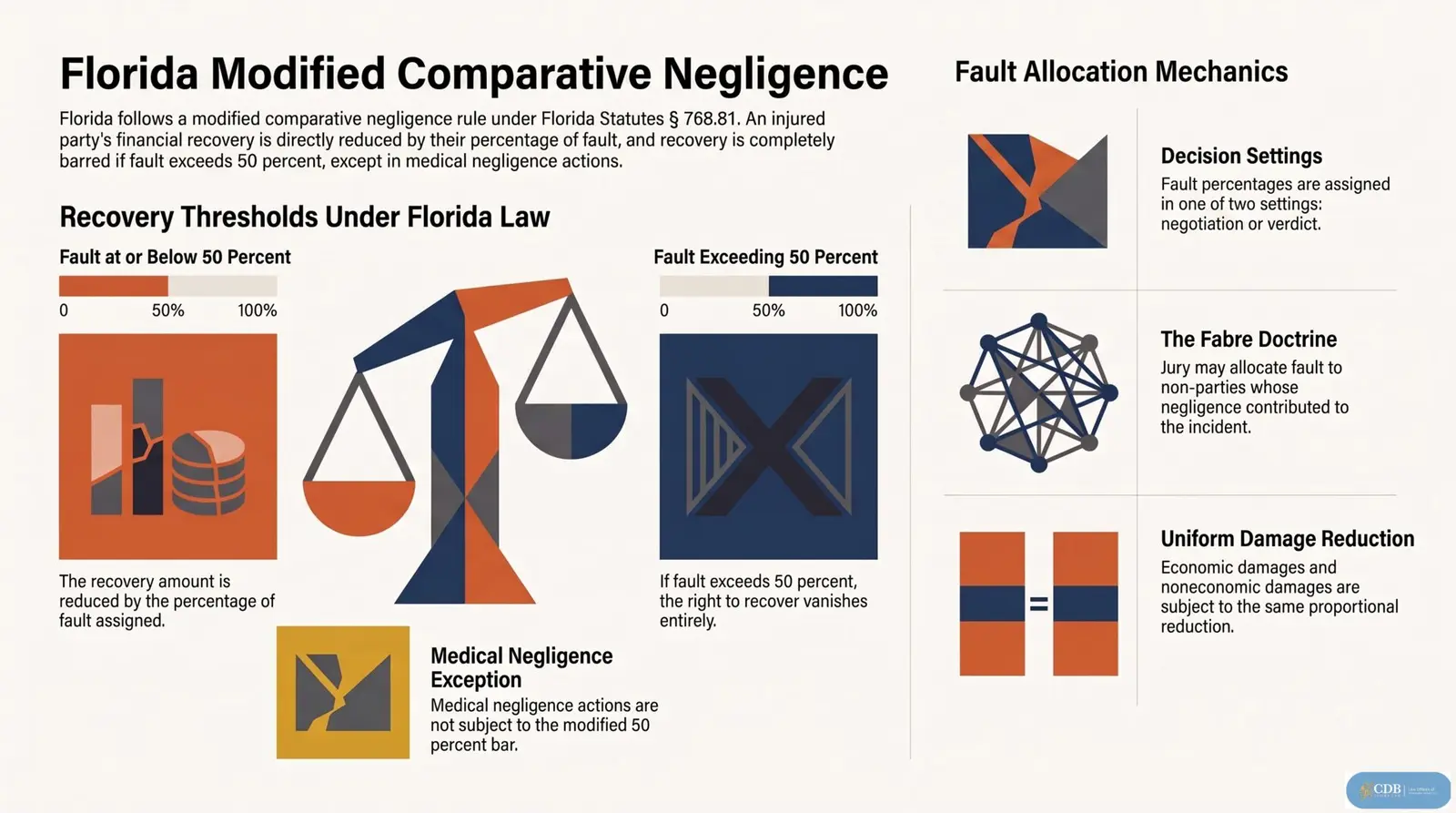
Florida follows a modified comparative negligence rule under Florida Statutes § 768.81. For covered claims, the statute permits an injured party to recover damages even when partially at fault, but only if that fault remains at or below 50 percent. The recovery amount is reduced by the percentage of fault assigned to the claimant. If fault exceeds 50 percent, the right to recover vanishes entirely. The statute contains an important exception for medical negligence actions, which are not subject to the modified 50 percent bar.
Consider a hypothetical in a covered motor vehicle negligence claim: A driver is rear-ended at a stoplight but was later found to have non-functioning brake lights. Total damages are $100,000. If the injured driver is assigned 20 percent fault for the defective lights, recovery is reduced to $80,000. If fault is assigned at 30 percent, recovery drops to $70,000. At 51 percent, recovery becomes zero, not reduced, but eliminated.
This structure creates two pressure points. The first is the reduction itself: every point of fault assigned is a point of value lost. The second is the 51 percent threshold, which functions as a complete bar in covered cases. Defense carriers and adjusters understand both. Fault allocation becomes the battleground, and the fight over percentages begins long before trial.
Where Fault Percentages Are Decided and Who Controls Them
Fault percentages are assigned in one of two settings: negotiation or verdict. During pre-suit settlement discussions, the insurance adjuster proposes a fault allocation as part of the offer. That allocation is not binding, but it frames the negotiation. If the case proceeds to litigation, a jury may determine fault percentages after hearing the evidence. The jury’s allocation then becomes the foundation for the final judgment, subject to the court’s rulings and any appeal.
Before litigation, adjusters use fault allocation as leverage in personal injury negotiations. A carrier may acknowledge liability for the collision but argue that the injured party’s conduct, speeding, failure to wear a seatbelt, distraction,contributed to the severity of harm. The proposed fault percentage becomes a discount applied to the demand. The injured party can accept the framing, counter with evidence, or reject the negotiation and proceed to suit.
At trial, fault becomes a jury question when comparative fault is properly placed at issue. Florida law allows a jury to allocate fault among parties and properly identified non-parties whose negligence contributed to the incident. This is known as the Fabre doctrine, named after Fabre v. Marin, 623 So. 2d 1182 (Fla. 1993). A defendant generally must plead and prove the fault of a non-party before that allocation can reduce the plaintiff’s recovery.
The Role of Evidence in Shaping Allocation
Fault percentages are not arbitrary. They are built from evidence: accident reconstruction, witness testimony, traffic citations, surveillance footage, vehicle data, and conduct immediately before and after the incident. The stronger the documentation of the defendant’s conduct and the weaker the evidence of plaintiff contribution, the lower the plaintiff’s fault percentage is likely to be.
Defense counsel will search for any behavior that can be characterized as contributory: failure to maintain lane position, delayed braking, inattention, violation of traffic statutes, pre-existing mechanical defects. These facts are presented not to absolve the defendant, but to shift a percentage of responsibility. Even a small shift changes the math.
Strategic Implications of Fault Allocation During Settlement
Fault percentages shape settlement value long before a complaint is filed. A carrier’s internal valuation of a claim includes a fault discount. If the adjuster believes a jury would assign 30 percent fault to the claimant, the settlement offer reflects a 30 percent reduction from provable damages. That discount is baked into the reserve, the authority, and the negotiation posture.
Understanding how demand letter timing intersects with fault disputes is critical. A demand sent before liability investigation is complete may invite a fault-based counteroffer that becomes difficult to dislodge. A demand sent after liability is documented and fault evidence is organized shifts the negotiation frame. The goal is not to avoid the fault conversation. It is to control the evidentiary foundation on which that conversation occurs.
Carriers also use fault percentages to justify low offers on high-value claims. When the injury is severe but fault is contested, the adjuster may propose a nuisance-value settlement framed as a compromise: “We believe you’re 60 percent at fault, but we’ll offer you something to avoid litigation.” The offer is designed to extract a release in exchange for a fraction of actual damages. Accepting that offer locks in the fault allocation and forfeits the right to challenge it.
How the 51 Percent Threshold Changes the Litigation Calculus
The 51 percent bar is binary in covered cases. At 50 percent fault, recovery is halved. At 51 percent, it is extinguished. That single percentage point is the difference between walking away with something and walking away with nothing. Defense strategy in comparative fault jurisdictions often aims not to minimize the defendant’s fault, but to push the plaintiff’s fault above the threshold.
This creates asymmetry in settlement negotiation. A plaintiff at 45 percent fault has significant exposure if the case proceeds to trial and the jury assigns just six more points. A defendant facing 80 percent fault has far less to lose from a small shift. The party closer to the threshold bears more risk, and that risk is a lever in negotiation.
Trials in comparative negligence cases are often battles over a handful of percentage points. Jury instructions emphasize that even a slight degree of fault can reduce recovery. Expert testimony on accident reconstruction, human factors, and industry standards can become dispositive. The outcome often hinges not on whether negligence occurred, but on how much negligence is attributable to each party.
Fabre Allocations and the Phantom Defendant Problem
Florida’s Fabre doctrine permits the jury to allocate fault to individuals or entities not named in the lawsuit when the legal requirements are met. A pedestrian struck in a crosswalk may face allocation of fault to the city for inadequate signage if that non-party fault is properly pleaded and proven, even if the city was never sued. A passenger injured in a crash may see fault assigned to another driver who fled the scene if that driver is sufficiently identified or described and placed on the verdict form.
These allocations reduce the plaintiff’s recovery from the named defendant without creating a new source of payment. The result is a gap: fault attributed to a non-party for whom there is no collectible judgment. Fabre allocations are particularly dangerous in cases involving uninsured or underinsured defendants, hit-and-run scenarios, or claims against entities protected by sovereign immunity.
Preserving Recovery When Fault Is Disputed
Fault disputes are won or lost in the evidence-gathering phase. Preservation of physical evidence, prompt witness interviews, reconstruction analysis, and documentation of the scene create the factual foundation that constrains the adjuster’s ability to overstate fault. When liability is clear and well-documented, the fault conversation shifts from “Did you contribute?” to “How do we value this?”
Equally important is recognizing when fault exposure is real. A claimant who ran a red light, drove while impaired, or ignored a known hazard faces legitimate comparative fault. In those cases, the question is not whether fault will be assigned, but whether the allocation is accurate and whether the recovery amount justifies proceeding. Honest evaluation of fault exposure shapes every downstream decision: whether to settle, at what number, and under what terms.
- Secure all physical evidence that demonstrates the defendant’s conduct and the absence of plaintiff contribution
- Obtain independent accident reconstruction analysis before the adjuster frames the narrative
- Identify and interview witnesses while recollection is fresh and before defense counsel makes contact
- Challenge fault allegations with specific evidence, not general denials
- Evaluate Fabre exposure early and consider whether at-fault non-parties should be joined
- Recognize that small fault percentages erode value; large percentages threaten viability
Carriers also attempt to manufacture fault through policy-based arguments: the claimant should have anticipated the hazard, should have taken evasive action, should have been more cautious. These arguments are often grounded in hindsight rather than the evidence available at the time. The legal standard is reasonableness under the circumstances, not perfection. Pushing back against hindsight-based fault requires framing the incident from the perspective of what was knowable at the time, not what became apparent afterward.

Fault percentages do not measure moral responsibility. They measure litigation risk, negotiation leverage, and the distance between full recovery and fractional recovery. Every conversation with an adjuster, every piece of evidence gathered or ignored, every decision about when to demand and when to file shapes the number that ultimately determines how much of the harm gets paid for. The percentage is not fixed until it is accepted or decided. Until then, it remains contested ground.
Closing Remarks
If an adjuster has assigned you a fault percentage that slashes your recovery, if you are approaching the 51 percent threshold and facing total loss of compensation, or if a Fabre allocation threatens to assign blame to a party you cannot collect from, the case requires immediate attention. You do not have to face that uncertainty alone. CDB Injury Law represents injured parties in Florida personal injury claims where fault allocation determines whether recovery is possible. Let us talk about your recovery and the evidence needed to protect it.
Frequently Asked Questions
Can an insurance adjuster assign fault percentages during settlement negotiations?
An adjuster can propose a fault allocation as part of a settlement offer, but that allocation has no legal force unless accepted. The proposal reflects the carrier’s valuation and negotiation posture. Rejecting the offer preserves the right to litigate fault allocation before a jury. Accepting it locks in the reduction and bars further recovery.
What happens if the jury assigns me 50 percent fault?
At exactly 50 percent fault in a covered claim, recovery is reduced by half but not eliminated. A $200,000 verdict becomes a $100,000 judgment. The 51 percent threshold is the bar; anything at or below 50 percent permits recovery, though significantly reduced. One percentage point is the difference between halved recovery and no recovery.
Can fault be assigned to someone who is not part of the lawsuit?
Yes, when the legal requirements are met. Under Florida’s Fabre doctrine and section 768.81, a jury may allocate fault to a non-party whose negligence contributed to the injury if that fault is properly pleaded, supported by evidence, and included for allocation. The allocation reduces the plaintiff’s recovery from the named defendant without creating an additional source of payment. This can result in uncollectible fault percentages that reduce the effective judgment.
Does comparative negligence apply to all types of personal injury claims in Florida?
Comparative fault applies broadly in Florida negligence actions and can also apply to claims that fall within section 768.81’s broad definition of a negligence action, including certain strict liability and products liability claims. It does not apply to intentional torts, and the modified 50 percent bar does not apply to medical negligence actions. Because the statute’s reach depends on the type of claim and timing of the case, the specific facts matter.
How do I challenge an adjuster’s fault allocation before trial?
Fault allocation during settlement is challenged with evidence: accident reconstruction reports, witness statements, traffic citations, photographs, video footage, and expert analysis. The goal is to demonstrate that the defendant’s conduct was the predominant cause and that the claimant’s alleged contribution is overstated or nonexistent. If the evidence does not move the adjuster, the case proceeds to litigation, where a jury makes the final determination.
If I am found partially at fault, can I still recover for all types of damages?
Yes, but every category of damages is reduced by the assigned fault percentage in a covered comparative fault claim. Economic damages such as medical expenses and lost wages, and noneconomic damages such as pain and suffering, are all subject to the same proportional reduction. A claimant assigned 30 percent fault recovers 70 percent of economic damages and 70 percent of noneconomic damages. The reduction is uniform across all categories.
References
- Fla. Stat. § 768.81
- Fabre v. Marin (623 So. 2d 1182 (Fla. 1993)).