


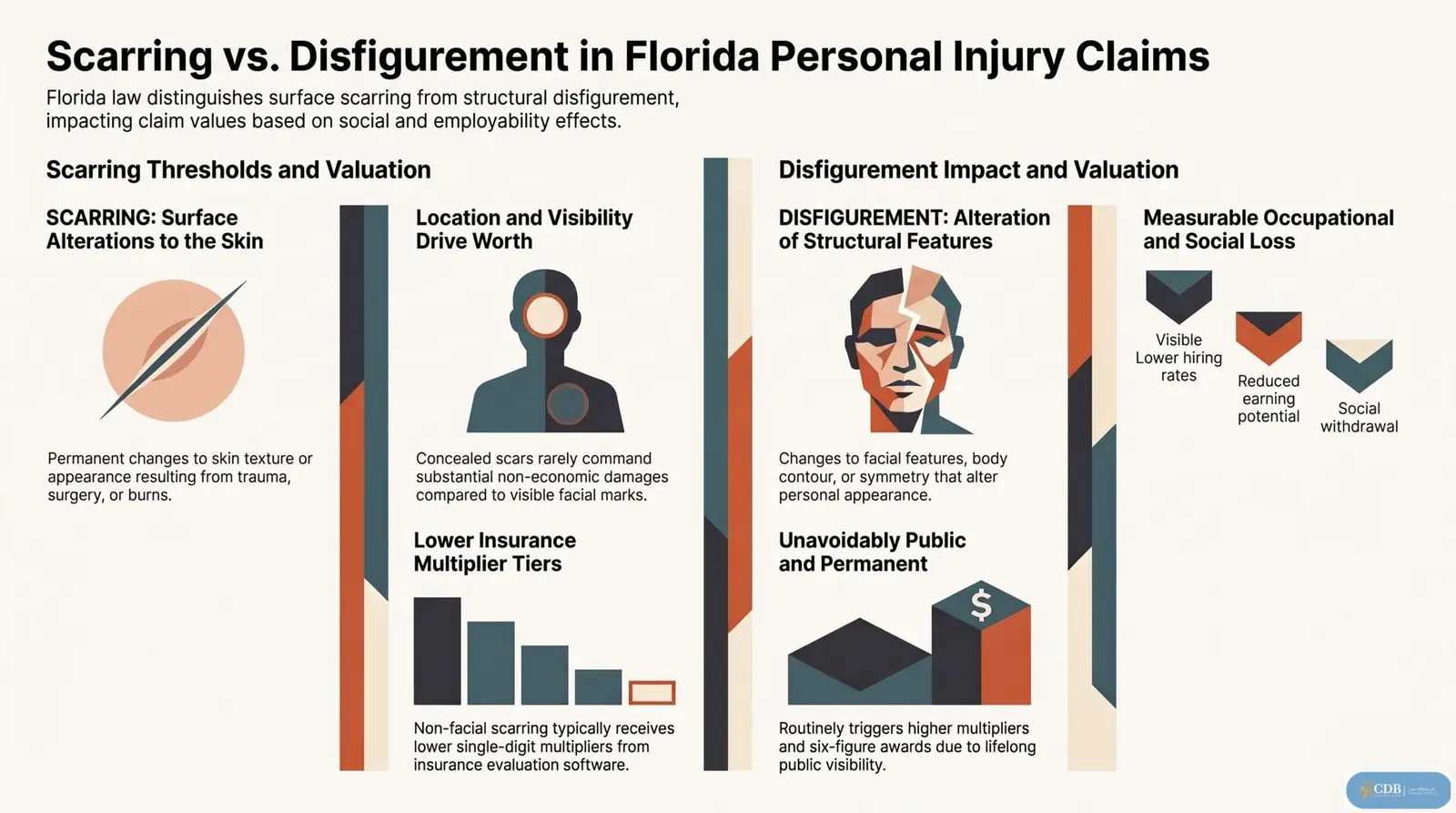
Scarring and disfigurement are distinct categories of injury, and Florida law values them differently. Scarring refers to permanent marks or texture changes on the skin, while disfigurement encompasses broader alterations to appearance that affect facial features, symmetry, or body structure. Disfigurement claims, particularly to visible areas like the face or hands, often command higher settlements and jury awards due to their profound impact on identity, social interaction, and employability.
A permanent scar carries its own weight. It marks a moment, a trauma, a loss of what was. But when that scar reshapes a face, pulls at an eyelid, or distorts a smile, it crosses into something deeper: disfigurement that alters not just appearance but how the world responds. Insurance adjusters know the difference. Defense attorneys argue it in motions. Juries see it in photographs. The line between scarring and disfigurement is not just medical, it is financial, and it matters enormously when calculating what an injury is worth.

Florida does not assign fixed dollar amounts to specific injuries, but decades of verdicts and settlements reveal clear patterns. Scarring, even when permanent, may be valued in the thousands to low tens of thousands when it is small, located on a typically clothed area, or does not disrupt normal tissue function. Disfigurement, especially to the face, neck, or hands, routinely reaches six figures or more. The distinction hinges on visibility, functional impact, and what psychologists and vocational experts describe as “social disability.” A scar that can be covered is one thing. A disfigurement that changes how someone is recognized, hired, or treated is another.
What Florida Law Considers Scarring
Scarring is defined as permanent alteration to the skin’s appearance or texture resulting from trauma, surgery, or burns. It can present as hypertrophic ridges, keloid formations, or discolored patches. Under Florida’s permanent injury threshold, scarring must be demonstrated by medical evidence and may qualify for recovery beyond economic damages when it is significant and permanent. But significance is not measured in square inches alone; location and severity matter.
A two-inch scar on the abdomen, hidden by clothing and causing no functional limitation, rarely drives substantial noneconomic damages. A similar scar crossing the jawline or splitting an eyebrow changes the analysis entirely. Visibility is the first lever. The second is whether the scar distorts underlying structures, whether it pulls at tissue, limits expression, or creates asymmetry. When scarring crosses that line, it begins to approach disfigurement.
Medical records must document not just the presence of the scar but its permanence. Temporary marks, scabs, or discoloration that fades within months do not meet the threshold. Photographs taken at consistent intervals, expert testimony from plastic surgeons or dermatologists, and statements about attempted treatments all contribute to establishing that the scar is a lifelong condition. Without that foundation, even a visible scar may be minimized by defense counsel as temporary or cosmetic.
What Constitutes Disfigurement Under Florida Personal Injury Law
Disfigurement goes beyond surface marking. It involves alteration of facial features, body contour, or limb symmetry that changes how a person is perceived. Florida courts recognize disfigurement as a category of permanent impairment distinct from scarring, and juries are instructed to consider its effect on the injured person’s ability to engage in ordinary social and occupational activities. A flattened cheekbone, a missing ear, a drooping eyelid, burns that obliterate natural skin texture across the face, these are disfigurements.
The law does not require that disfigurement be grotesque or that it render someone unemployable. What matters is whether it is noticeable to others in normal interaction and whether it is permanent. A negligence claim involving facial trauma routinely includes testimony from vocational rehabilitation experts who explain how employers respond to visible differences, even subconsciously. Studies introduced as evidence demonstrate that facial disfigurement correlates with lower hiring rates, reduced earning potential, and social withdrawal. These are not speculative harms, they are measurable and compensable.
Disfigurement claims often require more than photographs. Three-dimensional imaging, testimony about pre-injury appearance, and expert opinions from maxillofacial surgeons or ophthalmologists build the record. When disfigurement affects the hands, critical for gesture, expression, and many occupations, the analysis shifts to functional as well as aesthetic loss. A missing finger is not just a scar; it is a permanent change to capability and identity.
Why Juries Value Disfigurement Higher
Jurors are instructed to award damages for pain, suffering, disability, and loss of capacity for the enjoyment of life. Disfigurement touches all four. It is visible every morning in the mirror. It is present in every job interview, first date, and family photograph. Unlike a broken bone that heals or internal scarring that remains private, disfigurement is on display. Florida juries consistently award more for injuries that are both permanent and unavoidably public.
Defense counsel will argue that modern reconstructive surgery can minimize disfigurement, but that argument has limits. If surgery cannot restore the original appearance, or if it requires multiple procedures with uncertain outcomes, the disfigurement remains compensable at its current state. Future medical costs for revision surgeries are a separate line item; they do not reduce the present value of disfigurement damages. The injury is valued as it exists now, not as it might look after years of additional trauma and expense.
How Insurance Companies Differentiate the Two
Adjusters are trained to categorize injuries by severity tiers, and scarring versus disfigurement is one of the clearest dividing lines. Software used by insurers to evaluate claims assigns multipliers based on injury codes. A scar to a non-facial area may receive a low single-digit multiplier of medical expenses. Facial disfigurement routinely triggers higher multipliers, sometimes double or triple, because historical verdict data shows juries award more.
Early settlement offers often fail to distinguish between the two or deliberately undervalue disfigurement by framing it as mere scarring. An adjuster may describe a facial burn as “cosmetic scarring” to anchor negotiations at a lower range. That language is strategic. Cosmetic implies elective; scarring implies minor. Neither term captures the permanent alteration to identity and social function that disfigurement represents. Pushing back on that framing, with medical testimony, photographic evidence, and expert reports, is essential to preserving value.
Insurance companies also rely on independent medical examinations to downgrade disfigurement claims. A defense expert may testify that scarring is “mild” or that surgical revision is possible, even when the injured person has already undergone multiple procedures with limited success. Countering that testimony requires a thorough record from treating physicians, realistic assessments of surgical outcomes, and, when appropriate, testimony about the psychological toll of repeated interventions.
Factors That Increase Compensation for Disfigurement
Several variables push disfigurement claims into the higher ranges of noneconomic damages. Location is paramount. Injuries to the face, neck, and hands, areas that cannot be concealed in professional or social settings, command more than disfigurement to the torso or legs. Age matters as well. A young person faces a lifetime of living with disfigurement, attending school, entering the workforce, forming relationships. That permanence over decades justifies greater awards than the same injury to someone in their seventies.
- Visibility: Injuries that remain uncovered in normal dress and social interaction increase value.
- Symmetry disruption: Disfigurement that creates facial asymmetry or limb length discrepancy affects both appearance and function.
- Psychological impact: Documented depression, anxiety, or social withdrawal tied to the disfigurement adds a separate layer of compensable harm.
- Occupational effect: When disfigurement limits career options, particularly in client-facing roles, entertainment, or hospitality, vocational experts quantify lost earning capacity.
- Failed corrective attempts: Evidence that surgical revision has been attempted and failed demonstrates permanence and justifies higher awards.
Gender bias exists in the data, though it is rarely acknowledged openly. Historically, juries have awarded more to women for facial disfigurement than to men, reflecting societal assumptions about appearance and value. That disparity is documented in verdict databases but is neither legally justified nor ethically defensible. Advocates must present disfigurement as a human loss, not one contingent on gender or profession.
Proving the Distinction in a Florida Injury Case
Evidence must show more than the existence of a mark. It must demonstrate permanence, visibility, and impact. Photographs are foundational, taken in consistent lighting, from multiple angles, and at intervals that show the injury is not fading. Before-and-after comparisons are powerful, especially when the injured person’s prior appearance is well-documented in family photos, social media, or professional headshots.
Expert testimony from plastic surgeons or dermatologists establishes whether the injury is permanent and whether further improvementis realistic. When disfigurement affects function, a scarred eyelid that limits vision, a burn contracture that restricts neck movement, orthopedic or ophthalmologic experts add another dimension. Psychologists and therapists document the emotional and social toll, and vocational experts translate that into economic terms when disfigurement affects employability.
Day-in-the-life videos and testimony from family members humanize the claim. A spouse describing how their partner no longer makes eye contact in public, a parent explaining how their child refuses to attend school, or a friend recounting the withdrawal from social activities, these narratives make the abstract injury tangible. Juries respond to stories, and disfigurement is, at its core, a story of loss that continues every day.
Comparative negligence does not reduce the nature of the injury, but it does reduce the recovery. If the injured person is found partially at fault, the damage award is reduced proportionally. That makes the initial valuation of disfigurement even more critical; the higher the base figure, the more remains after reduction. Comparative Negligence in Florida: Recovery explains how fault allocation works and why early case development matters.

Distinguishing between scarring and disfigurement is not semantic; it is financial. The difference can mean tens or hundreds of thousands of dollars in a settlement or verdict. Insurance companies know this. Defense attorneys argue it. Juries see it. The injured person lives it. Building a record that proves disfigurement rather than accepting a scarring narrative requires medical evidence, expert testimony, and a clear presentation of how the injury reshapes a life. The law allows for that recovery, but only when the claim is structured to support it.
Closing Remarks
If a visible scar has been minimized as cosmetic, if an insurance adjuster has offered far less than what facial or hand disfigurement warrants, or if medical records document permanent alteration but the value offered ignores its lifelong impact, the framing of the claim may be costing more than the injury itself. CDB Injury Law builds disfigurement cases with the medical experts, photographic evidence, and vocational analysis that insurance companies respect and juries believe. Contact us to discuss how the injury should be valued, and what it will take to prove it.
Frequently Asked Questions
Can a scar become classified as disfigurement over time?
Scarring is evaluated based on its permanent state once healing is complete, typically twelve to eighteen months after the injury. If the scar contracts, darkens, or distorts surrounding tissue in ways that alter facial symmetry or body contour, it may meet the criteria for disfigurement. Medical reassessment and updated photographic evidence can support a revised classification, but the change must be documented by a qualified expert and shown to be permanent rather than temporary.
Does disfigurement to a child increase the value of a claim?
Yes. A child faces decades of living with disfigurement, attending school, entering the workforce, and forming relationships. Juries and insurers recognize that permanence over a lifetime justifies higher awards. Expert testimony about developmental impact, social challenges, and long-term psychological effects strengthens the claim. Florida law allows recovery for the full scope of harm, and age is a factor that extends the time horizon of suffering and loss.
What if reconstructive surgery is possible but not guaranteed to work?
Disfigurement is valued in its current state. The possibility of future surgery does not reduce present damages unless the surgery is likely to restore the original appearance with minimal risk and cost. If multiple procedures are required, outcomes are uncertain, or significant scarring will remain even after surgery, the disfigurement remains compensable at its existing severity. Future medical costs for those procedures are calculated separately and do not offset noneconomic damages for the injury as it stands now.
Can disfigurement claims include psychological damages separately?
Yes. While disfigurement itself is a category of noneconomic damages, the psychological harm it causes, depression,anxiety, social withdrawal, post-traumatic stress, can be presented as additional injury. Mental health records, testimony from treating psychologists or psychiatrists, and evidence of how disfigurement disrupts daily life all support a separate claim for emotional distress. The two categories are distinct but often intertwined, and both are compensable under Florida law when properly documented.
How does permanent impairment differ from disfigurement?
Permanent impairment refers to lasting loss of bodily function, reduced range of motion, diminished sensation, or loss of organ capacity. Disfigurement refers to permanent alteration of appearance. The two can overlap, as when a burn causes both visible scarring and restricted joint movement, but they are evaluated separately. Florida juries are instructed to consider both, and a claim can include damages for impairment, disfigurement, and the distinct psychological and social effects each produces. Documentation of both functional and aesthetic loss maximizes recovery.
References