

Florida law sets strict deadlines for filing injury claims, typically two years for negligence claims accruing under current law and four years for many intentional acts, but exceptions, discovery rules, accrual dates, and tolling provisions can shift those deadlines in ways that are not always obvious. Missing a deadline usually means losing the right to recover, no matter how strong the case. Understanding when the clock starts, what pauses it, and which claims carry different time limits can mean the difference between full recovery and no remedy at all.
The calendar often starts running the moment an injury occurs, but most people do not realize it until weeks or months later, after the shock fades, after the medical bills arrive, after the insurance company sends its first denial letter. By then, the window to file a claim may have already narrowed. Florida’s statute of limitations operates silently in the background, indifferent to whether someone knew their rights or understood the deadline. It does not announce itself. It simply closes.
The statute of limitations is not a technicality; it is the boundary that separates a viable claim from one that no court will hear. Once the deadline passes, the right to seek compensation may vanish, even if liability is clear and damages are severe. This is not a question of fault or fairness. It is a matter of timing, and the law enforces it strictly in most cases.
What the Statute of Limitations Actually Means
A statute of limitations is a law that sets the maximum time frame within which a lawsuit must be filed. In personal injury cases, the clock typically begins on the date of the injury or the date the injured party discovers, or reasonably should have discovered, the harm. Florida Statutes Section 95.11 governs most injury claims, and the time limits vary depending on the nature of the case.
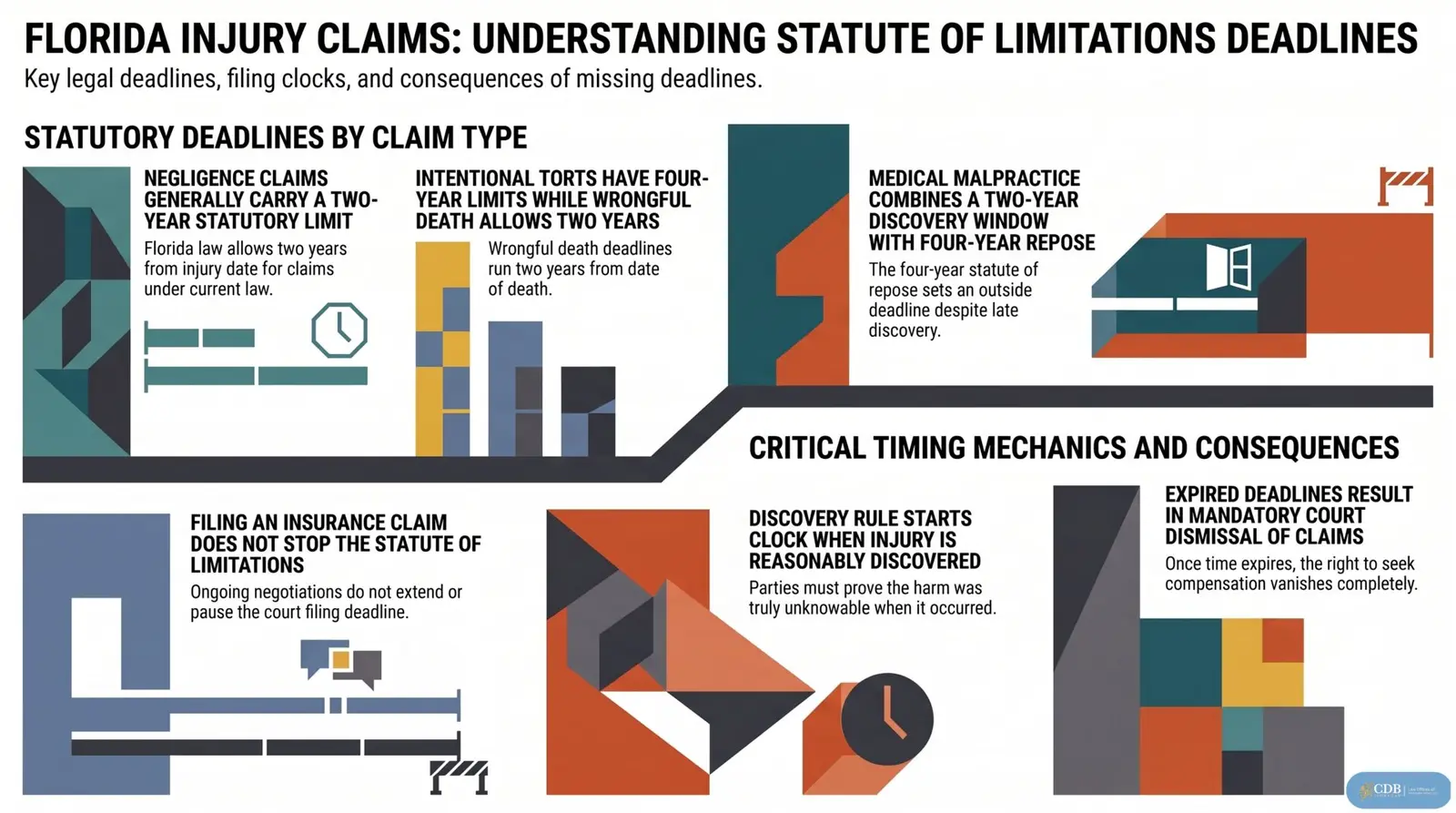
For ordinary negligence claims, such as car accidents or slip-and-falls, Florida law generally allows two years from the date of injury for claims accruing under current law. Claims that accrued before Florida’s 2023 tort reform changes may be subject to different timing rules, so the accident date matters. Medical malpractice has its own two-year discovery-based deadline and additional repose rules under Florida Statutes Section 95.11(4)(c). Intentional torts, like assault or battery, carry a four-year limit under Florida Statutes Section 95.11(3)(o). Wrongful death claims are governed by Florida Statutes Section 95.11(4)(d), which imposes a two-year deadline from the date of death, not the date of the underlying injury.
The distinction matters. A person injured in a car crash on January 1, 2024, must file suit by January 1, 2026, in most circumstances. If that person dies from unrelated causes in 2025, the statute of limitations does not reset. If the injuries lead to death in 2025, a new wrongful death claim arises, but it carries its own two-year limit from the date of death. Each claim type operates on its own timeline.
When the Clock Starts and When It Does Not
The general rule is straightforward: the statute of limitations begins when the injury occurs. But Florida law recognizes that some injuries are not immediately apparent. The discovery rule allows the clock to start later if the injured party could not have reasonably known about the harm when it happened.
Consider a hypothetical: A surgeon leaves a sponge inside a patient during an operation in 2020. The patient experiences no symptoms until 2023, when imaging reveals the retained object. Under the discovery rule, the statute of limitations may begin in 2023, when the injury became known, rather than in 2020, when the surgery occurred. However, Florida law also imposes a statute of repose in medical malpractice cases; generally four years from the date of the incident, with limited statutory exceptions, so even a late discovery may not extend the filing window indefinitely.
The discovery rule does not apply automatically. The injured party must show that the injury was truly unknowable at the time it occurred, not merely unnoticed. Courts scrutinize these claims carefully. A delayed diagnosis is not the same as a hidden injury. The distinction determines whether the claim survives.
Tolling: When the Countdown Pauses
Certain circumstances pause the statute of limitations. Florida law allows tolling in specific situations, including some circumstances involving a minor or a person with a previously adjudicated incapacity. Under Florida Statutes Section 95.051, minority or incapacity does not always pause the deadline automatically; tolling depends on whether an appropriate parent, guardian, guardian ad litem, or other representative exists and whether that representative’s interests are adverse. Even when this tolling applies, it generally cannot extend the deadline by more than seven years. The final deadline depends on the child’s age, representation, claim type, and the specific facts of the case.
Mental incapacity can also toll the statute in limited circumstances. If a person has been legally adjudicated incapacitated and lacks an appropriate representative, the limitations period may be extended. But this is not a blanket extension. The incapacity must be formally established, and the tolling may end when competency is restored or an appropriate guardian or representative is in place.
Fraud and concealment by the defendant can also extend the deadline. If the at-fault party actively hides the injury or misleads the injured party, Florida courts may allow the statute of limitations to be tolled until the concealment is discovered. But proving fraudulent concealment requires clear evidence of intentional deception, not just a failure to disclose.
Different Claims, Different Deadlines
Not all injury claims follow the same timeline. Florida law treats different types of harm differently, and the applicable statute of limitations depends on the legal theory underlying the claim.
- Negligence (car accidents, premises liability, general personal injury): Generally two years under Florida Statutes Section 95.11(4)(a) for claims accruing under current law.
- Intentional torts (assault, battery, false imprisonment): Four years under Florida Statutes Section 95.11(3)(o).
- Medical malpractice: Generally two years from discovery, but no more than four years from the date of the incident under Florida Statutes Section 95.11(4)(c), with narrow exceptions for fraud, concealment, intentional misrepresentation, and certain claims involving minors.
- Wrongful death: Two years from the date of death under Florida Statutes Section 95.11(4)(d).
- Product liability: Often four years under Florida Statutes Section 95.11(3), though the precise deadline can depend on the theory pleaded, the date of accrual, and any applicable repose period.
- Claims against government entities: Special rules apply under Florida Statutes Section 768.28. Written notice is generally required within three years of the incident, with shorter notice rules for wrongful death claims, and lawsuits must comply with both the pre-suit waiting period and the applicable statute of limitations.
The choice of legal theory is not academic. A claim framed as negligence may expire while an intentional tort claim based on the same facts remains viable. The statute of limitations is not flexible. It is a gate, and the law decides which key fits.
What Happens When the Deadline Passes
Once the statute of limitations expires, the defendant can ask the court to dismiss the case on those grounds. If the court agrees, the case may end before the merits are ever reached. The strength of the evidence, the severity of the injury, and the clarity of liability can become irrelevant. The claim is time-barred.
There are rare exceptions. Equitable tolling, a judge’s discretion to extend a deadline in extraordinary circumstances, exists in theory but is granted sparingly. Courts have allowed it in limited situations involving active concealment by the defendant or circumstances where the injured party was prevented from filing through no fault of their own. But reliance on equitable tolling is a last resort, not a strategy.
Insurance claims operate on different timelines than lawsuits. A claim filed with an insurer does not stop the statute of limitations clock. Negotiations, delays, and settlement discussions do not extend the deadline to file in court. Many injury victims assume that as long as they are “working with” the insurance company, they are protected. They are not. The statute of limitations continues to run regardless of what the insurance adjuster says or does.
Pre-Suit Settlements and Statute Considerations
Settling a claim before filing a lawsuit is common, and it does not require court involvement. But the statute of limitations remains relevant even in pre-suit negotiations. If settlement talks fail after the deadline has passed, the injured party loses the leverage to file suit. The insurance company knows this. The closer the statute of limitations gets, the less reason the insurer has to offer a fair settlement. The deadline shifts bargaining power, often invisibly.
For that reason, many personal injury cases are filed strategically before the statute of limitations expires, even if settlement is likely. Filing preserves the right to litigate and maintains negotiating strength. It signals that the claim is serious and that the injured party is prepared to pursue it fully.
Why Timing Matters More Than Most Realize
The statute of limitations does more than set a deadline; it shapes the entire arc of a claim. Evidence degrades over time. Witnesses forget. Surveillance footage is overwritten. Medical records are archived. Physical evidence deteriorates. The longer a case waits, the harder it becomes to prove, even if the statute of limitations has not yet expired.
Defense attorneys know this. Delay is a tactic. If an insurance company can push a claim close to the statute of limitations, it gains leverage. If key evidence disappears or witnesses become unavailable, the claim weakens. Even if the case is filed in time, the practical ability to win it may have eroded.
Understanding comparative negligence in Florida adds another layer. Florida’s modified comparative negligence rule allows recovery even when the injured party shares some fault, as long as their share of blame does not exceed 50 percent under recent tort reform changes. But that calculation depends on evidence, evidence that fades with time. A claim that could have succeeded within months of the injury may fail if delayed until the final weeks before the statute of limitations expires.
The statute of limitations is not the only clock that matters, but it is the one that can end the case permanently. Other deadlines may also affect the claim, but this one deserves immediate attention.
Closing Remarks
If the injury happened more than a year ago, if the insurance company has been stalling, or if there is any uncertainty about when the statute of limitations began, the window to act may be narrower than it appears. CDB Injury Law helps injured people reclaim control when the system feels designed to outlast them. Contact us today to talk about your recovery, and to make sure the law’s deadlines do not become barriers to the justice you deserve.
Frequently Asked Questions
Does filing an insurance claim stop the statute of limitations?
No. Filing a claim with an insurance company does not pause or extend the statute of limitations for filing a lawsuit. The deadline to file in court continues to run regardless of whether settlement negotiations are ongoing. An insurance claim and a lawsuit are two separate processes, and only filing suit within the statutory period preserves the legal right to recover.
What happens if the person who caused the injury leaves Florida?
Under Florida Statutes Section 95.051, if the defendant is absent from Florida during the time when the cause of action accrues, the statute of limitations may be tolled during the period of absence. However, this tolling provision is limited. It does not apply if the defendant was never a Florida resident or if service of process can be accomplished through other means, such as long-arm jurisdiction. Absence alone does not automatically extend the deadline.
Can the statute of limitations be extended if new injuries appear later?
It depends. If the new injury is a worsening or continuation of the original harm, the statute of limitations generally runs from the date of the initial injury. If the later injury is truly separate and distinct, caused by a different incident or a new act of negligence, it may trigger a new limitations period. Courts examine whether the harm is part of the same occurrence or a new cause of action. Medical malpractice cases involving delayed complications are especially fact-specific and often require expert testimony to establish the timeline.
Does the statute of limitations apply differently to minors?
Yes, but not always in the way families expect. Under Florida Statutes Section 95.051, minority can toll, or pause, the limitations period in specific circumstances, especially when no appropriate parent, guardian, guardian ad litem, or other representative exists, or when that representative’s interests are adverse to the child. The law also imposes a seven-year cap on this tolling in many situations. Medical malpractice claims involving minors have additional rules, including provisions tied to the child’s eighth birthday. Because these rules are highly fact-specific, a child’s claim should be reviewed as early as possible.
What is the statute of repose, and how does it differ from the statute of limitations?
A statute of repose sets an outside deadline that may bar a claim regardless of when the injury is discovered. In Florida medical malpractice cases, for example, the statute of repose under Florida Statutes Section 95.11(4)(c) is generally four years from the date of the alleged malpractice, even if the injury is not discovered until later. There are narrow statutory exceptions for fraud, concealment, intentional misrepresentation, and certain claims involving minors, but the repose period often operates as a hard cutoff. The statute of limitations may be extended by discovery; the statute of repose typically cannot.
Can a settlement agreement extend the statute of limitations?
Not automatically. If a written settlement or tolling agreement explicitly tolls the statute of limitations, and both parties consent, the deadline may be extended or the defense may be contractually waived for an agreed period. But informal settlement discussions, verbal agreements, or general negotiations do not stop the clock. Any tolling agreement must be clear, mutual, and in writing. Without such an agreement, the statute of limitations continues to run during all settlement talks.
References
- Florida Statutes Section 95.051 (When limitations tolled).
- Florida Statutes Section 95.11 (Limitations of actions; periods of limitation).
- Florida Statutes Section 768.28 (Waiver of sovereign immunity in tort actions).