

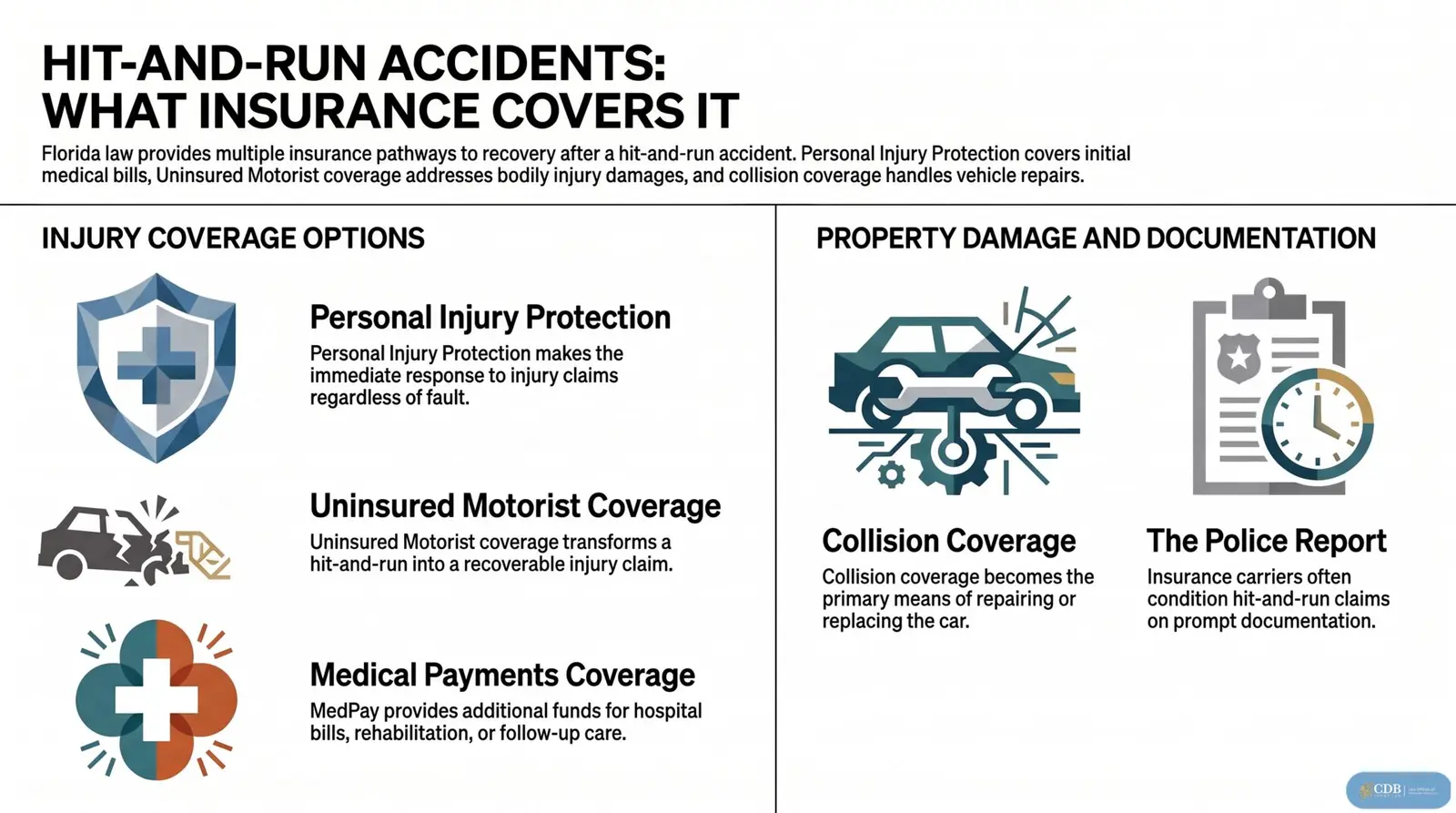
Hit-and-run accidents leave victims without an at-fault driver to pursue, but Florida law provides multiple insurance pathways to recovery. Personal Injury Protection (PIP) covers initial medical bills and lost wages, Uninsured Motorist (UM)Uninsured Motorist (UM) bodily injury coverage may step in when the fleeing driver cannot be identified or lacks insurance, and collision coverage addresses vehicle damage, each with distinct limits, conditions, and claim procedures that determine whether recovery is possible.
A collision happens in seconds. The other vehicle flees. No plates, no witness, no certainty. What remains is damage, injury, and the unsettling realization that the person responsible is gone. Hit-and-run accidents strip away the usual pathway to compensation, the at-fault driver’s liability policy, and leave victims navigating a fragmented insurance landscape where coverage depends on policies already in place, not the driver who caused the harm.

Understanding which insurance responds, in what order, and under what conditions transforms confusion into a navigable claim. Florida’s insurance framework anticipates scenarios where the responsible party cannot be located, but only certain coverages apply, and each carries thresholds, exclusions, and procedural requirements that can mean the difference between full recovery and out-of-pocket loss.
Personal Injury Protection: The First Layer of Coverage
Florida’s no-fault insurance system makes Personal Injury Protection the immediate response to most motor vehicle accident injury claims, regardless of who caused the crash. PIP generally pays 80% of reasonable medical expenses and 60% of lost wages up to the available policy limit, typically the $10,000 statutory minimum. To preserve PIP medical benefits, the injured person must receive initial services and care within 14 days of the accident; without an emergency medical condition, medical benefits may be limited to $2,500.
PIP does not ask who was at fault. It does not wait for a police investigation. It exists to cover initial treatment and wage loss while other questions resolve. But the $10,000 statutory minimum often falls short in serious injury cases, fractures, internal injuries, traumatic brain injuries, where medical costs accumulate quickly and long-term care becomes necessary. Once available PIP benefits exhaust, the gap between what the policy pays and what the injury demands becomes the victim’s problem unless other coverage exists.
PIP also excludes certain damages. It does not compensate for pain and suffering, permanent scarring, or the full scope of losses that a personal injury claim might recover in a traditional liability case. In a hit-and-run scenario, where the at-fault driver’s liability policy is unavailable, that exclusion matters. The victim must look elsewhere for compensation beyond the PIP limit.
Uninsured Motorist Coverage: The Primary Path to Full Recovery
Uninsured Motorist coverage can transform a hit-and-run from an uncompensated loss into a recoverable claim for bodily injury damages. Florida law treats certain hit-and-run vehicles as uninsured motor vehicles, including unidentified vehicles that make physical contact with the insured or the insured’s vehicle. If the victim carries UM coverage, which is optional in Florida and must be affirmatively selected or rejected in writing, that policy becomes the substitute for the absent driver’s liability insurance.
UM coverage applies when the qualifying hit-and-run driver cannot be identified, when the driver is identified but lacks insurance, or when the driver’s policy limits are insufficient to cover the victim’s damages. It pays for medical expenses beyond PIP limits, lost wages, future medical costs, pain and suffering, and permanent impairment. The policy limit chosen at the time of purchase, often matching the liability limits, such as $25,000, $50,000, or $100,000, sets the ceiling for recovery.
Filing a UM claim, however, is not automatic. The insurer typically requires prompt notice, a police report documenting the hit-and-run, a sworn statement from the victim, and evidence that reasonable efforts were made to identify the fleeing driver. The claim is then evaluated as if the victim were pursuing the phantom driver directly. The insurer may dispute liability, causation, or the extent of damages, even though its own policyholder is the claimant. This adversarial posture, where the victim’s own carrier resists payment, often surprises those unfamiliar with how UM claims function after PIP benefits exhaust.
What Uninsured Motorist Coverage Does Not Cover
Florida UM coverage addresses bodily injury. It does not repair vehicles. Damage to the vehicle is usually handled through collision coverage, if the victim purchased it, or through the at-fault driver’s property damage liability coverage if the driver is later identified and insured. Some policy endorsements can change the analysis, but a standard Florida UM bodily injury claim should not be treated as vehicle-repair coverage.
Collision Coverage: Addressing Vehicle Damage
When a hit-and-run damages a vehicle and the at-fault driver cannot be located, collision coverage becomes the primary means of repairing or replacing the car. Collision is optional coverage that pays for damage to the policyholder’s vehicle regardless of fault, subject to the policy’s deductible, commonly $500 or $1,000.
The claim process is straightforward: the victim reports the accident, provides documentation, and the insurer assesses the damage. The deductible is subtracted from the payout, and repair or replacement proceeds. Unlike UM coverage, collision does not require proof that another driver was at fault or that efforts were made to locate the fleeing party. The coverage simply responds to the fact of the collision.
But collision coverage does not address bodily injury, medical bills, or lost wages. It is a property-damage solution in a scenario that often involves both vehicle damage and personal harm. Victims may have to coordinate multiple policies, PIP for initial medical costs and wage loss, UM for qualifying injury damages, and collision for vehicle repair, each with separate deductibles, limits, and claim procedures.
Medical Payments Coverage: A Supplemental Option
Medical Payments (MedPay) coverage is an optional, lesser-known layer that some policyholders carry. It pays medical expenses resulting from a motor vehicle accident, regardless of fault, up to the policy limit, often $1,000, $5,000, or $10,000. MedPay functions similarly to PIP but without PIP’s wage-loss component. It can fill gaps when PIP exhausts or when out-of-pocket medical costs exceed PIP reimbursement rates.
In a hit-and-run scenario, MedPay provides additional funds for hospital bills, rehabilitation, or follow-up care without requiring identification of the fleeing driver. It is not a substitute for UM coverage, as it does not compensate for pain, suffering, or permanent injury, but it reduces the financial pressure in the immediate aftermath of the collision.
The Investigative Requirement: Why the Police Report Matters
Insurance carriers often condition hit-and-run claims on prompt documentation, including a police report when the policy requires one. Florida law does not strictly require a police report for all accidents, but insurers routinely scrutinize hit-and-run claims when no official report exists. The report serves as contemporaneous evidence that the accident occurred, that the other driver fled, and that the victim made a good-faith effort to document the incident.
Delayed reporting raises red flags. A claim filed days after the accident, with no police documentation, invites suspicion of fraud or staging. Insurers scrutinize hit-and-run claims more closely than standard collision claims because the absence of an identifiable defendant removes a key check on false reporting. Prompt reporting to law enforcement, even when the fleeing vehicle cannot be described in detail, protects the claim’s credibility.
The police report also initiates the investigative process. Law enforcement may locate the vehicle through surveillance footage, witness statements, or debris left at the scene. If the driver is identified and found to carry liability insurance, the victim’s claim shifts from UM coverage to a third-party liability claim against the at-fault driver’s policy. That shift can expand recovery beyond UM limits if the at-fault driver carries higher coverage.
When the Fleeing Driver Is Later Identified
Identification of the hit-and-run driver after a UM claim has been filed or paid changes the claim’s structure. If the driver is found and carries liability insurance, that policy becomes the primary source of recovery. The victim’s UM carrier may seek reimbursement for benefits already paid, a process known as subrogation, and any additional damages may be pursued directly against the at-fault driver’s insurer.
If the driver is found but uninsured, the UM claim continues unaffected. The identification simply confirms that the driver lacked coverage, which is the condition UM coverage was designed to address. The victim does not lose UM benefits because the phantom driver became known; the coverage responds to the absence of liability insurance, not the absence of identity.
Criminal prosecution of the fleeing driver proceeds separately from the insurance claim. A conviction for leaving the scene of an accident does not automatically trigger insurance coverage, nor does it compensate the victim. The criminal case and the civil insurance claim run on parallel tracks, each with distinct purposes and outcomes.
Closing Remarks
If PIP benefits have exhausted before treatment is complete, if a UM carrier is disputing the severity of injuries documented by treating physicians, or if questions arise about collision coverage for vehicle damage caused by a fleeing driver, the insurance response often diverges from what the policy language seems to promise. CDB Injury Law handles hit-and-run claims where insurance carriers resist payment despite clear coverage. You do not have to face this alone. Contact us to talk about your recovery.
Frequently Asked Questions
Does PIP coverage apply even if the other driver is never found?
Yes. Personal Injury Protection is no-fault coverage, meaning it pays regardless of who caused the accident or whether the other driver is identified. To preserve PIP medical benefits, the injured person must receive initial services and care within 14 days of the accident, and benefits are paid according to the policy’s terms and Florida’s PIP statute without waiting for the outcome of any investigation into the fleeing driver’s identity.
Can a victim recover damages for pain and suffering in a hit-and-run accident?
Pain and suffering damages are not covered by PIP, but they may be recoverable under Uninsured Motorist bodily injury coverage if the victim carries that optional coverage and the claim meets the policy and statutory requirements for a hit-and-run. UM can allow the victim to pursue the full range of injury damages: medical expenses beyond PIP limits, lost wages, future medical costs, pain, suffering, and permanent impairment, up to the UM policy limit.
What happens if the hit-and-run driver is identified after a UM claim is paid?
If the fleeing driver is later identified and found to carry liability insurance, the victim’s UM carrier may seek subrogation, reimbursement for benefits it paid, from the at-fault driver’s insurer. Any damages exceeding the UM payment may be pursued directly against the at-fault driver’s liability policy. If the driver is found but uninsured, the UM claim remains the primary source of recovery, and identification does not diminish the victim’s right to UM benefits already received or pending.
Is collision coverage required to recover vehicle damage in a hit-and-run?
Collision coverage is optional in Florida but is usually the primary means of recovering vehicle damage when the at-fault driver cannot be located. Florida UM coverage is bodily injury coverage, not standard vehicle-repair coverage. Without collision coverage, the victim may bear the cost of vehicle repairs unless the fleeing driver is later identified and carries property damage liability insurance or another applicable policy endorsement applies.
Does filing a UM claim raise insurance premiums?
Filing a UM claim involves seeking benefits from the policyholder’s own insurer, but the claim is based on another party’s fault, the uninsured or unidentified driver. Florida law generally prohibits insurers from increasing premiums solely because the insured was involved in an accident unless the insurer determines in good faith that the insured was substantially at fault. Review the policy’s terms and consult with the carrier or an attorney if premium impact is a concern, as policy language and claim circumstances can still matter.
References
- Fla. Stat. § 627.727 (Uninsured and Underinsured Motorist Coverage).
- Fla. Stat. § 627.736 (Personal Injury Protection).
- Fla. Stat. § 626.9541(1) (o)3 (Unfair methods of competition and unfair or deceptive acts or practices; premium surcharge limitations).