
TL;DR: Recorded statements given to insurance adjusters carry less legal weight than sworn testimony but can still damage a claim if inconsistencies emerge later. Florida law does not require claimants to provide recorded statements to a liability carrier, yet adjusters often present them as mandatory. Understanding the difference between these two evidentiary tools, and the strategic risks each presents, shapes how injury claims unfold from first contact through litigation.
The call comes within days of the crash. An adjuster introduces herself, expresses concern, and asks for “just a quick recorded statement to get the claim moving.” The request sounds routine. The tone is helpful. But the recording device is already running, and every answer becomes a data point the carrier will mine for inconsistency, minimization, or omission when the claim reaches its critical stage months later.
Recorded statements and sworn testimony serve overlapping but distinct roles in Florida injury claims. One happens early, informally, and without procedural safeguards. The other occurs under oath, with a court reporter present, and carries the weight of perjury liability. Both capture words. Both create records. But the legal consequences, timing, and strategic implications diverge in ways that often determine whether a claim settles for fair value or collapses under manufactured inconsistencies.
What a Recorded Statement Is and What It Is Not

A recorded statement is an audio or video recording of a claimant’s account, taken by an insurance adjuster during the investigation phase of a claim. It is not sworn. No court reporter transcribes it. No oath precedes it. Florida law does not require a claimant to give a recorded statement to the at-fault party’s liability carrier, though adjusters rarely volunteer that fact. The tone is conversational. The adjuster may frame the call as a procedural necessity or as a step that accelerates payment. Neither characterization is accurate.
The statement typically covers the accident narrative, injuries sustained, treatment received, prior medical history, and current symptoms. Adjusters ask open-ended questions designed to elicit detail, then follow with narrow clarifications that lock in specifics. The recording is date-stamped, indexed, and archived. Months or years later, when the claim enters settlement negotiations or litigation, the statement resurfaces, not as helpful documentation, but as impeachment material.
Inconsistencies between the recorded statement and later deposition testimony become leverage. A claimant who describes pain as “sore” in week one and “debilitating” in month six has handed the carrier a narrative weapon, even when the progression reflects worsening injury rather than exaggeration. The recorded statement does not have the evidentiary weight of sworn testimony, but it does not need to. Its power lies in casting doubt.
Sworn Testimony: Deposition and Trial Evidence
Sworn testimony occurs during depositions, hearings, and trials. The witness takes an oath. A court reporter transcribes every word. The transcript becomes part of the litigation record, usable as evidence and subject to cross-examination. Perjury liability attaches. False statements can carry criminal consequences. These procedural safeguards create a formal environment absent from the recorded-statement call.
Depositions in Florida injury cases typically occur after the complaint is filed and discovery begins. Defense counsel asks detailed questions about the accident, injuries, treatment, daily limitations, prior medical history, and damages claimed. The claimant testifies under oath, with their own attorney present. The transcript is later used to prepare for trial, support or oppose summary judgment motions, and evaluate settlement value. Unlike a recorded statement, deposition testimony is prepared for. Counsel reviews medical records, incident reports, and prior statements. Preparation reduces ambiguity and aligns testimony with documentary evidence.
At trial, sworn testimony becomes the primary vehicle for presenting the claimant’s case. Direct examination establishes the narrative. Cross-examination tests consistency. Impeachment with prior inconsistent statements, including recorded statements, becomes a standard defense tactic. The jury assesses credibility. A single contradictory detail, even one rooted in confusion rather than dishonesty, can erode the entire claim.
Strategic Risks When Both Records Exist
The danger lies not in either record alone, but in the comparison. Defense counsel places the recorded statement transcript beside the deposition transcript and searches for divergence. Pain levels described differently. Accident details rearranged. Treatment timelines compressed or expanded. Prior injuries mentioned in one record but not the other. Each variance becomes a cross-examination target.
Consider a hypothetical: A motorcyclist gives a recorded statement three days post-collision, stating he “felt okay at the scene” and went to urgent care “just to be safe.” Six months later, during his deposition, he testifies that he experienced immediate neck pain and knew something was wrong. Both statements may be truthful, adrenaline masks injury, and symptoms clarify over time, but the inconsistency creates an impeachment opportunity. Defense counsel argues the claimant is embellishing. The jury hears two versions and doubts both.
The recorded statement was given without legal guidance. No attorney reviewed the medical timeline. No one explained that initial shock often delays symptom recognition. The deposition, by contrast, occurred after months of treatment and record review. Context reconciles the variance, but juries do not always receive that context. The recorded statement strips nuance and freezes an early, incomplete snapshot of the injury.
Common Impeachment Scenarios
- Pain severity described as “minor discomfort” in the recorded statement and “constant, severe pain” in deposition testimony.
- Accident sequence rearranged: the recorded statement places the claimant’s vehicle in the left lane; the deposition places it in the right.
- Prior injury omitted in the recorded statement but disclosed under oath when asked directly about medical history.
- Treatment gaps rationalized differently: the recorded statement attributes the gap to schedule conflicts; deposition testimony cites financial barriers.
- Witness presence mentioned in the deposition but not in the recorded statement, creating the appearance of a fabricated corroborator.
These inconsistencies, whether innocent or strategic, can degrade claim value. Carriers reduce settlement offers. Juries discount testimony. Comparative fault percentages shift when credibility falters. The recorded statement becomes the anchor that drags down every subsequent representation of the claim.
What Florida Law Requires, and What It Does Not
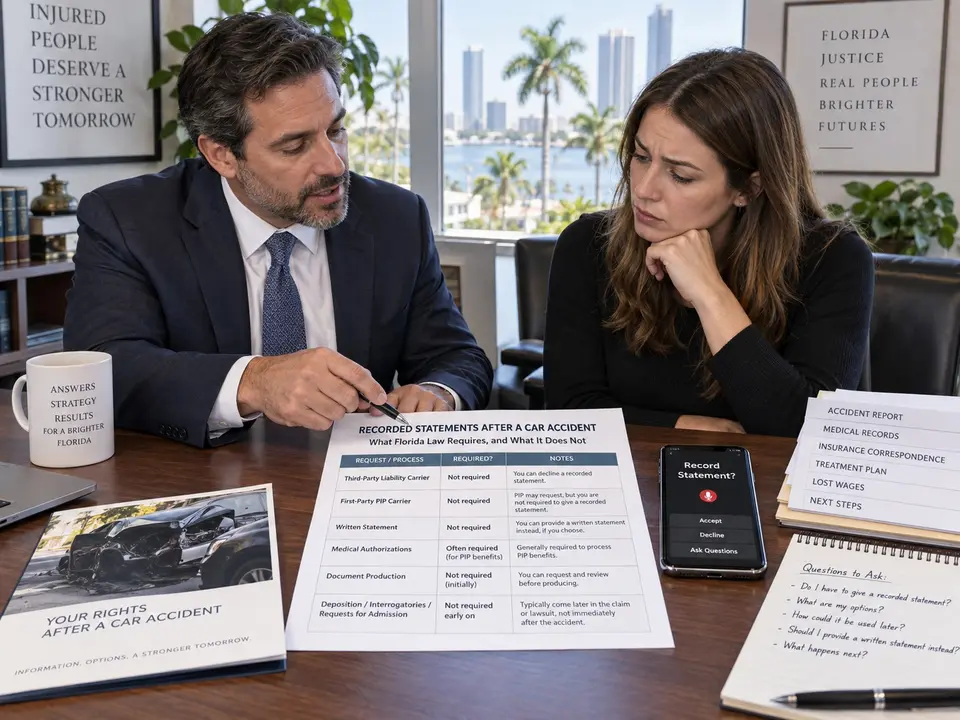
Florida Statutes do not mandate that injury claimants provide recorded statements to liability carriers. Third-party carriers, those insuring the at-fault party, have no contractual relationship with the claimant and cannot compel cooperation beyond what the discovery rules allow once litigation begins. First-party carriers, such as those administering personal injury protection benefits under Florida Statutes § 627.736, may condition benefits on the insured’s compliance with policy duties, and that statute expressly contemplates that an injured person submit to examination under oath when required by the policy. Even so, “cooperation” is defined by the policy language and the statute, not by the adjuster’s preference for an informal recorded call. Written statements, medical authorizations, and document production often satisfy the obligation.
Adjusters rarely clarify this distinction. The request for a recorded statement is presented as a procedural requirement rather than a voluntary submission. The pressure is subtle but effective. Claimants fear that refusal will delay payment or signal dishonesty. In a third-party liability claim, neither consequence follows: declining a recorded statement does not waive coverage or supply a lawful basis for denial. Declining preserves the claimant’s ability to present testimony thoughtfully, with legal guidance, after the full scope of injury is known. Where a first-party policy imposes cooperation duties, an attorney can determine what the policy and statute actually require before anything is recorded.
Once litigation begins, Florida’s civil procedure rules govern what testimony the defense can obtain. Depositions occur on notice, with time to prepare. Interrogatories require written answers under oath but allow attorney review before submission. Requests for admission narrow disputed facts without the spontaneity that produces damaging misstatements. Each tool serves the adversarial process, but none carries the informal, unguarded risk of the early recorded statement.
How Timing Shapes the Record
Injuries evolve. Symptoms that seem minor in the first seventy-two hours can intensify as inflammation peaks, soft tissue damage manifests, and psychological trauma surfaces. Medical diagnoses change as imaging reveals injuries missed in the emergency room. Treatment plans expand when initial conservative measures fail. The narrative told in week one is incomplete by design, not because the claimant is dishonest, but because the full picture has not yet developed.
Recorded statements capture this incomplete stage. Adjusters often call before the claimant has seen a specialist, before MRI results return, before physical therapy begins. The early statement reflects limited knowledge and optimistic assumptions. “I’m sure I’ll be fine in a few weeks” becomes the baseline. When recovery takes months and residual limitations persist, the carrier points to the recorded statement as evidence of exaggeration. The claimant’s words become the carrier’s best defense.
Deposition testimony, by contrast, often occurs after maximum medical improvement or near the end of treatment. The claimant has lived with the injury. Doctors have issued permanency opinions. The impact on work, family, and daily function is documented. That testimony reflects the fuller reality, but the recorded statement can poison its credibility. The jury hears two accounts separated by time and knowledge, and the defense frames the gap as deception rather than progression.
Measured restraint in the early weeks preserves the option to present a cohesive, accurate narrative once the full medical picture emerges. Written communication, reviewed by counsel, avoids the pitfalls of spontaneous verbal accounts. The claim remains viable without handing the carrier a tool designed to undermine it.
Closing Remarks
The days after an accident are disorienting, and the pressure from an insurance adjuster to give a recorded statement only adds to the uncertainty. You may lie awake worrying that one wrong word will be used against you later. That worry is reasonable, and it is not something you should have to carry by yourself. You do not have to face this alone. At CDB Injury Law, Chris Debari has spent his career standing between injured people and the tactics that quietly shrink their claims. We handle the communication with the insurance company so your story is preserved accurately and told at the right time. Let us talk about your recovery.
Frequently Asked Questions
Can an insurance company deny a claim if a recorded statement is refused?
Third-party liability carriers have no contractual basis to demand recorded statements from claimants and cannot deny claims simply because a claimant declines. First-party carriers may require reasonable cooperation under policy terms, and Florida’s no-fault statute contemplates an examination under oath in some circumstances, but routine cooperation can often be satisfied through written statements, medical authorizations, and document production. A denial based solely on refusal to give an informal recorded statement, where the claimant has otherwise cooperated, is unusual and may expose the carrier to a bad faith claim. Whether that is so depends on the policy language and the facts, which is why counsel should review the demand first.
What happens if testimony at deposition contradicts a recorded statement given weeks earlier?
Defense counsel will use the inconsistency to challenge credibility during cross-examination. The prior statement becomes a prior inconsistent statement under the Florida Evidence Code, usable for impeachment. Juries may interpret the variance as dishonesty, even when the change reflects evolving injury rather than fabrication. The damage is often greater than the actual discrepancy warrants, because impeachment casts doubt on all testimony, not just the inconsistent detail.
Are recorded statements admissible in Florida injury trials?
A claimant’s own recorded statement offered against them by the defense is generally treated as a party admission rather than excluded hearsay, and a prior inconsistent statement may also be used to impeach the claimant’s trial testimony. Recorded statements are not sworn and do not carry the same evidentiary weight as deposition transcripts, but their impeachment value is substantial. Once the jury hears both versions, it must decide which account is credible.
How soon after an accident do adjusters typically request recorded statements?
Adjusters often contact claimants within twenty-four to seventy-two hours of the incident, before medical evaluations are complete and while the claimant is still processing the event. That timing increases the likelihood of an incomplete or imprecise account. Pain levels are uncertain. Memory is fragmented. Medical causation has not been established. The early statement locks in an incomplete narrative that later becomes difficult to reconcile with objective medical findings.
Can a claimant revise or retract a recorded statement once it is given?
A recorded statement, once made, cannot be unrecorded. A claimant can provide clarifications, supplements, or corrections in writing or through later testimony, but the original recording remains part of the claim file. Defense counsel will often characterize the correction as further evidence of inconsistency. Damage control is possible, but prevention, declining the recorded statement at the outset and letting counsel respond, is far more effective than attempting a later fix.
Do Florida claimants have the right to have an attorney present during a recorded statement?
Claimants have the right to consult with or be represented by an attorney at any stage, including during a recorded statement. A carrier cannot bar your attorney from the conversation, though it may decline to conduct an informal interview at all and instead rely on written discovery or a formal examination once litigation or the policy process requires it. Many adjusters discourage attorney involvement by framing the statement as informal and non-adversarial. That characterization is misleading. Legal guidance before and during any statement protects against the subtle traps embedded in seemingly benign questions.
This article is general information about Florida law and is not legal advice. Every claim turns on its own facts and policy language.
References
- Florida Statutes § 627.736 (Florida Motor Vehicle No-Fault Law: Personal Injury Protection Benefits).
- Florida Statutes § 90.608 (Who May Impeach) and § 90.803(18) (Admissions).
- Florida Rules of Civil Procedure 1.280, 1.310, 1.340, 1.370 (Discovery, Depositions, Interrogatories, Requests for Admission)