
TL;DR: Witness statements can make or break a car accident claim. When witnesses describe what they saw, speed, traffic signals, driver behavior, their accounts often fill gaps that photos and police reports leave open. Independent, consistent witness testimony frequently determines fault when both drivers tell competing stories.
Two drivers. Two versions of how the light changed. No video. No skid marks clear enough to resolve it. The claim stalls. Then a bystander who stopped for coffee mentions she was crossing the intersection when it happened. She remembers which car entered first. Suddenly the stalemate breaks. Witness statements do not always appear when needed, but when they do, and when they are credible, they carry weight that physical evidence alone cannot provide.
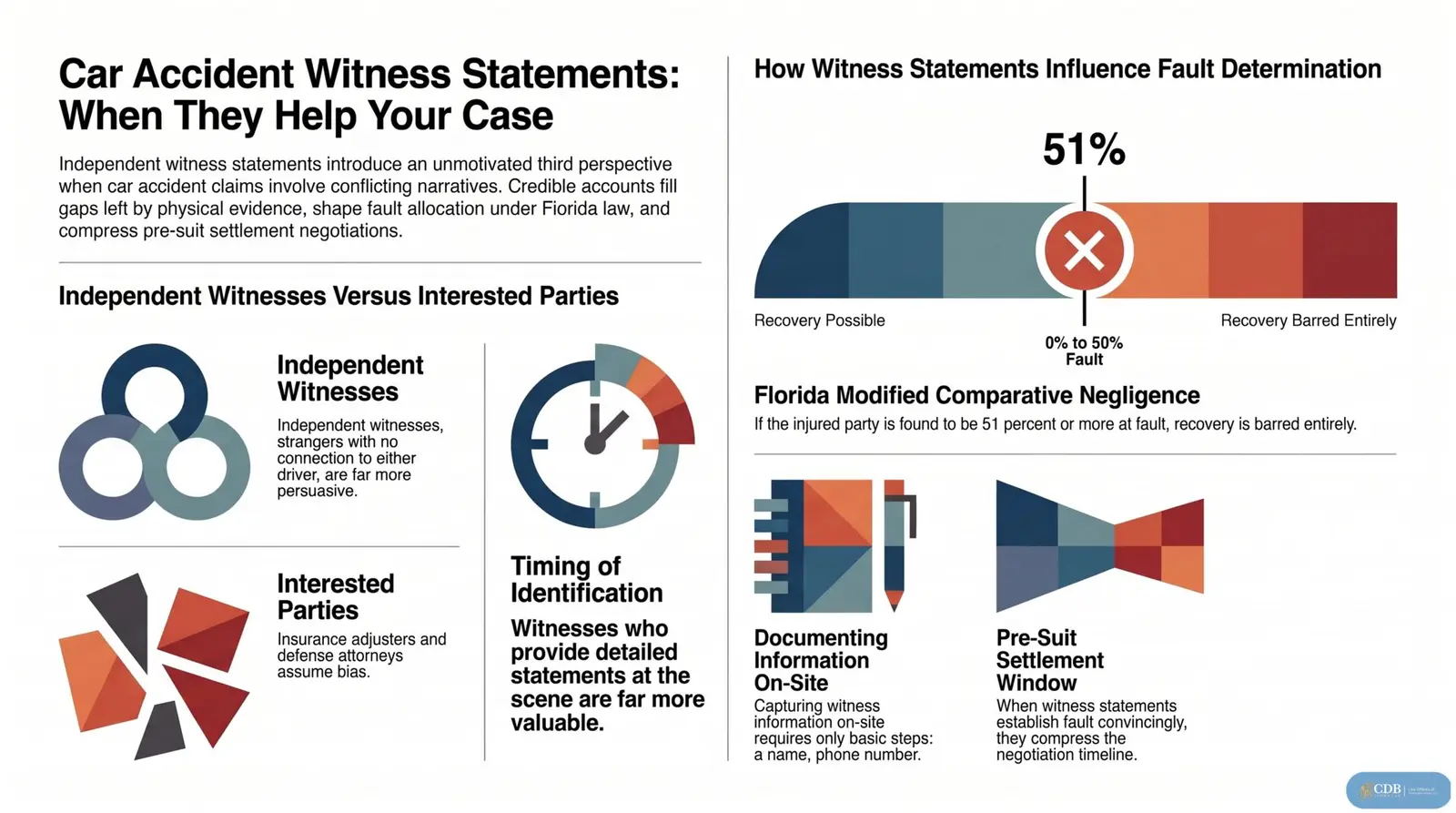
Car accident claims often hinge on conflicting narratives. The at-fault driver insists the light was yellow. The injured driver remembers green. The police report notes “both parties claim right of way” and assigns no citation. Without independent corroboration, the insurance carrier may deny liability outright or assign equal fault under Florida’s modified comparative negligence framework, cutting recovery in half or eliminating it entirely if the injured party is found 51 percent or more at fault.
Witness statements introduce a third perspective, one not motivated by the outcome. A passenger in a trailing vehicle. A pedestrian waiting at the crosswalk. A business owner who heard the impact and looked up in time to see the aftermath. These accounts, when documented early and preserved properly, often become the evidence that insurers and juries trust most.
When Witness Statements Fill Evidentiary Gaps
Physical evidence has limits. Tire marks fade. Surveillance cameras capture angles that miss the critical moment. Vehicle damage confirms impact but not sequence. Police officers arrive after the fact and rely on driver statements, environmental clues, and their own training to reconstruct what happened. When those clues conflict or remain ambiguous, the report reflects uncertainty: “Unable to determine” or “Parties dispute.” That ambiguity shifts risk onto the injured party.
Witness statements address that gap. A driver who was two cars back and saw brake lights before impact. A cyclist who watched one vehicle drift across the center line. A homeowner who heard squealing tires and saw a car run the stop sign. These observations provide detail that the physical scene cannot: timing, behavior, awareness. They answer whether the driver was looking at a phone, whether the turn signal activated, whether the car was speeding or slowing in the seconds before collision.
The value of a witness depends on what they actually saw and how clearly they can describe it. A statement that “I heard a crash and came outside” offers little. A statement that “I was facing south at the red light when the northbound pickup entered the intersection while the signal was still red for him” provides a factual anchor. Specificity, consistency, and a clear vantage point make a witness credible. Vague recollections or second-hand accounts do not.
Independent Witnesses Versus Interested Parties
Not all witness statements carry the same weight. Passengers in the at-fault vehicle, friends of the driver, or family members riding along are “interested parties.” Their statements are not inadmissible, but they are scrutinized more carefully. Insurance adjusters and defense attorneys assume bias. That assumption is often correct. Even when a passenger tells the truth, the fact of their relationship undermines their credibility in the eyes of a jury.
Independent witnesses, strangers with no connection to either driver, are far more persuasive. They have no financial stake in the claim. They gain nothing by shading their account. Their willingness to stop, provide contact information, and later testify if needed signals reliability. Adjusters know this. When an independent witness corroborates the injured driver’s version of events, the calculus shifts. Liability becomes harder to contest. Settlement offers rise. Cases that might have required litigation settle pre-suit.
The timing of witness identification matters. Memories fade. People move. Phone numbers change. Witnesses who provide detailed statements at the scene are far more valuable than witnesses tracked down weeks later who can only say “I think I remember something.” The best witness is one who saw the critical moment, stayed long enough to speak with police or the injured driver, and agreed to be contacted again. Without that early documentation, the witness may be lost entirely.
Warning Signs That a Witness May Not Help
- The witness did not see the actual impact; only the aftermath.
- The witness’s location or angle of view was obstructed.
- The witness offers conclusions (“He was driving recklessly”) without describing specific behavior.
- The witness changes their account between the scene and a later recorded statement.
- The witness has a relationship with one of the drivers that was not initially disclosed.
Inconsistent or speculative statements can do more harm than good. If a witness’s credibility collapses under cross-examination, the defense uses that collapse to cast doubt on the entire claim. Better to rely on strong physical evidence and a clear narrative than to introduce a witness whose testimony invites skepticism.
Documenting Witness Information at the Scene
The moments after a collision are chaotic. Adrenaline surges. Pain may not register fully. But those moments are also when witnesses are present and willing to help. Drivers who leave the scene to go home, to work, or simply to avoid involvement are gone. Once they drive away, finding them again becomes difficult or impossible.
Capturing witness information on-site requires only basic steps: a name, phone number, and a brief description of what they saw. Most people will provide this willingly if asked. Some will volunteer. Others need a prompt. A simple request, “Did you see what happened? Would you be willing to share your contact information?” is often enough. Police officers typically seek out witnesses and include their information in the crash report, but not always. If the officer is focused on clearing the roadway or managing injuries, bystanders may slip away unnoticed.
Florida law generally requires all parties to consent to the recording of private conversations, but a public accident scene typically does not carry the same expectation of privacy. Even so, it is wise to ask permission before recording when circumstances allow and to avoid capturing private medical discussions or conversations away from public view. A short audio or video clip of a witness’s immediate public recollection can preserve details that written notes may miss, before memory fades or outside influence enters. It can also preserve nuances like tone, certainty, and specific phrasing. A witness who says “I know the light was red” sounds different from one who says “I think it might have been red.” That distinction becomes critical when evaluating whether to rely on the statement in settlement negotiations or at trial.
How Witness Statements Influence Fault Determination
Florida applies a modified comparative negligence standard. If the injured party is found to be 51 percent or more at fault, recovery is barred entirely. Below that threshold, damages are reduced by the percentage of fault assigned to the injured party. A driver found 30 percent at fault for a $100,000 injury recovers $70,000. A driver found 51 percent at fault recovers nothing. Fault allocation is not abstract; it directly determines the financial outcome.
Witness statements shape that allocation. When an independent witness confirms that the at-fault driver ran a red light, ignored a yield sign, or crossed the center line, the insurer’s ability to shift fault onto the injured driver evaporates. Conversely, when a witness describes the injured driver as distracted, speeding, or failing to brake, the adjuster will seize on that testimony to inflate the fault percentage and reduce the payout. Witness accounts do not merely support a claim, they often define it.
Adjusters weigh witness credibility carefully. A statement from a postal worker who was delivering mail and had an unobstructed view carries more weight than a statement from a teenager who was texting and glanced up only after hearing the crash. The adjuster will compare the witness’s description against the physical evidence: does the claimed point of impact match the damage? Does the described speed align with the crush profile? Does the sequence of events fit the final resting positions? When the witness account and the physical evidence converge, the claim becomes difficult to dispute. When they diverge, the witness’s credibility suffers.
Some witnesses provide statements that are double-edged. They confirm fault for the primary collision but also describe contributing behavior by the injured driver, failure to signal, hesitation at an intersection, abrupt braking. Defense counsel will exploit these details to argue shared fault. Even a sympathetic witness can introduce facts that complicate the claim. This is why early review of witness statements by experienced counsel matters. An attorney can evaluate how and when to address each statement consistent with legal and ethical obligations. Some accounts require further investigation before they are shared with an insurer or relied upon in negotiations.
Witness Statements and the Pre-Suit Settlement Window
Most car accident claims settle before a lawsuit is filed. Litigation is expensive, time-consuming, and uncertain for both sides. Insurers prefer to resolve clear-liability cases quickly when the cost of defense exceeds the likely payout. But clarity requires evidence. When witness statements establish fault convincingly, they compress the negotiation timeline and increase the settlement offer.
A well-documented witness account submitted early in the claim can shift the adjuster’s evaluation from contested liability to damages-only negotiation. Instead of arguing over who caused the crash, the discussion moves to medical causation, future treatment needs, and appropriate compensation for noneconomic losses like pain and suffering. That shift is significant. It removes the 51 percent bar from the table and focuses the negotiation on fair compensation rather than fault avoidance.
Conversely, when witness statements are delayed, inconsistent, or poorly documented, they lose impact. Adjusters discount late statements as rehearsed or influenced. They question why the witness did not come forward sooner. They highlight discrepancies between the witness’s initial informal comments and their later written account. Timing and consistency are everything. The strongest witness statements are obtained within hours of the collision, recorded clearly, and preserved without alteration. For more on how early documentation and strategic presentation influence pre-suit outcomes, see Demand Letters Before Suit: What Triggers Settlement.
Not every claim has a cooperative witness. Not every witness is credible. Not every account helps. But when a reliable independent witness provides a clear, consistent description of the collision, and when that description aligns with the physical evidence and the injured party’s own narrative, the statement becomes one of the most powerful tools in the claim. It transforms “he said, she said” into documented fact. It removes the insurer’s ability to hide behind ambiguity. And it creates the leverage needed to secure fair compensation without the expense and risk of trial.

Witness statements are not a guaranteed asset, but they are rarely neutral. They either strengthen the claim or expose vulnerabilities. Knowing which witnesses to document, when to present their statements, and how to use their testimony strategically makes the difference between a claim that stalls and one that resolves favorably. The moment to identify and preserve those witnesses is not later. It is now, while they are still at the scene and still remember what they saw.
Closing Remarks
If an independent witness saw the collision but left before giving a statement, if the police report lists witness names but no details of what they observed, or if the insurance carrier is denying liability despite credible eyewitness accounts, the window to preserve that evidence is closing. CDB Injury Law investigates car accident claims in Florida with the urgency and care they demand. Contact us to discuss your case and protect your recovery.
Frequently Asked Questions
Can a passenger in my car serve as a witness?
Yes, but the insurance adjuster and any opposing counsel will scrutinize the testimony more carefully because of the relationship. Passengers are not neutral. They may be family, friends, or romantic partners. Courts do not automatically disqualify their statements, but juries and adjusters often discount them. Independent witnesses who have no connection to either driver carry far more weight. If a passenger is the only witness, their account still matters, but it will not be accepted at face value.
What if the witness I spoke to at the scene is now unreachable?
Witnesses sometimes disappear. Phone numbers change. People move. If the only record of their statement is a name scribbled on a scrap of paper, reconstructing their testimony may be impossible. This is why capturing detailed contact information and recording a brief statement on-site is so important. If the witness is truly unreachable, any notes or recordings made at the time may still be useful, especially if the police report includes their information. An attorney can sometimes locate witnesses through skip-tracing or public records, but success is not guaranteed.
Does a witness have to testify in court if the case goes to trial?
Not always. Many cases settle before trial. If the case does proceed to litigation, witnesses may be subpoenaed to testify at a deposition or at trial. Witnesses who gave statements voluntarily are not legally obligated to participate unless formally served with a subpoena. Some witnesses cooperate willingly. Others become unresponsive or hostile once they realize the time commitment involved. This unpredictability is one reason witness statements are most valuable when documented early and thoroughly, so the account may still be useful for investigation, negotiation, or later evidentiary analysis if the witness becomes unavailable. Whether any out-of-court statement can be used in court depends on the rules of evidence and the facts of the case.
Can surveillance video replace a witness statement?
Sometimes, but not always. Video from nearby businesses, traffic cameras, or dashboard cameras can provide objective evidence of what happened. However, video has limitations: poor angles, obstructions, low resolution, or short retention periods. Many businesses overwrite footage within days. If video exists, it must be requested and preserved immediately. When video and witness statements both exist, they reinforce each other. Video shows the sequence of events; witnesses explain what drivers were doing in the moments leading up to impact, texting, looking away, accelerating aggressively. Together, they create a fuller picture than either source alone.
What if the witness’s statement contradicts my version of events?
That complicates the claim. A witness who supports the other driver’s narrative gives the insurer ammunition to deny liability or assign majority fault. This does not mean the claim is lost, but it shifts the burden. Other evidence, video, vehicle damage, expert reconstruction, may contradict the witness or reveal errors in their perception. Witnesses are not infallible. They may have been distracted, positioned poorly, or mistaken about what they saw. An experienced attorney will evaluate the witness’s credibility, cross-check their account against physical evidence, and determine whether the statement is reliable or flawed. Not every witness who speaks is worth believing.
References
- Fla. Stat. § 768.81 ((2023). ComparAative fault).
- Fla. Stat. § 934.03 ((2023). Interception and disclosure of wire, oral, or electronic communications prohibited).