
An effective demand letter settles a personal injury claim when it clearly proves who was at fault, meticulously documents all your damages with evidence, and is timed to pressure the insurance company before a lawsuit becomes necessary. Settlement is triggered when the insurer sees that fighting your claim is riskier and more expensive than paying what you are rightfully owed.
After an accident, you are left to navigate a world of uncertainty. You are in pain, medical bills are piling up, and the insurance adjuster on the phone seems to see you as a claim number, not a person. It can feel like your story doesn’t matter. A demand letter is a critical tool to change that narrative. It’s your first, best chance to formally present your case and compel the insurance company to see the true cost of your injuries. A well-crafted letter can lead to a fair settlement without ever stepping foot in a courtroom; a weak one can be dismissed, forcing you into a long legal battle.

Understanding what makes a demand letter successful transforms it from a procedural formality into your most powerful pre-suit weapon. The letter that secures a settlement isn’t the one that shouts the loudest. It’s the one that makes fighting you in court a worse option for the insurance company than resolving your claim fairly and promptly.
Making Liability Undeniable: Leaving No Room for Doubt
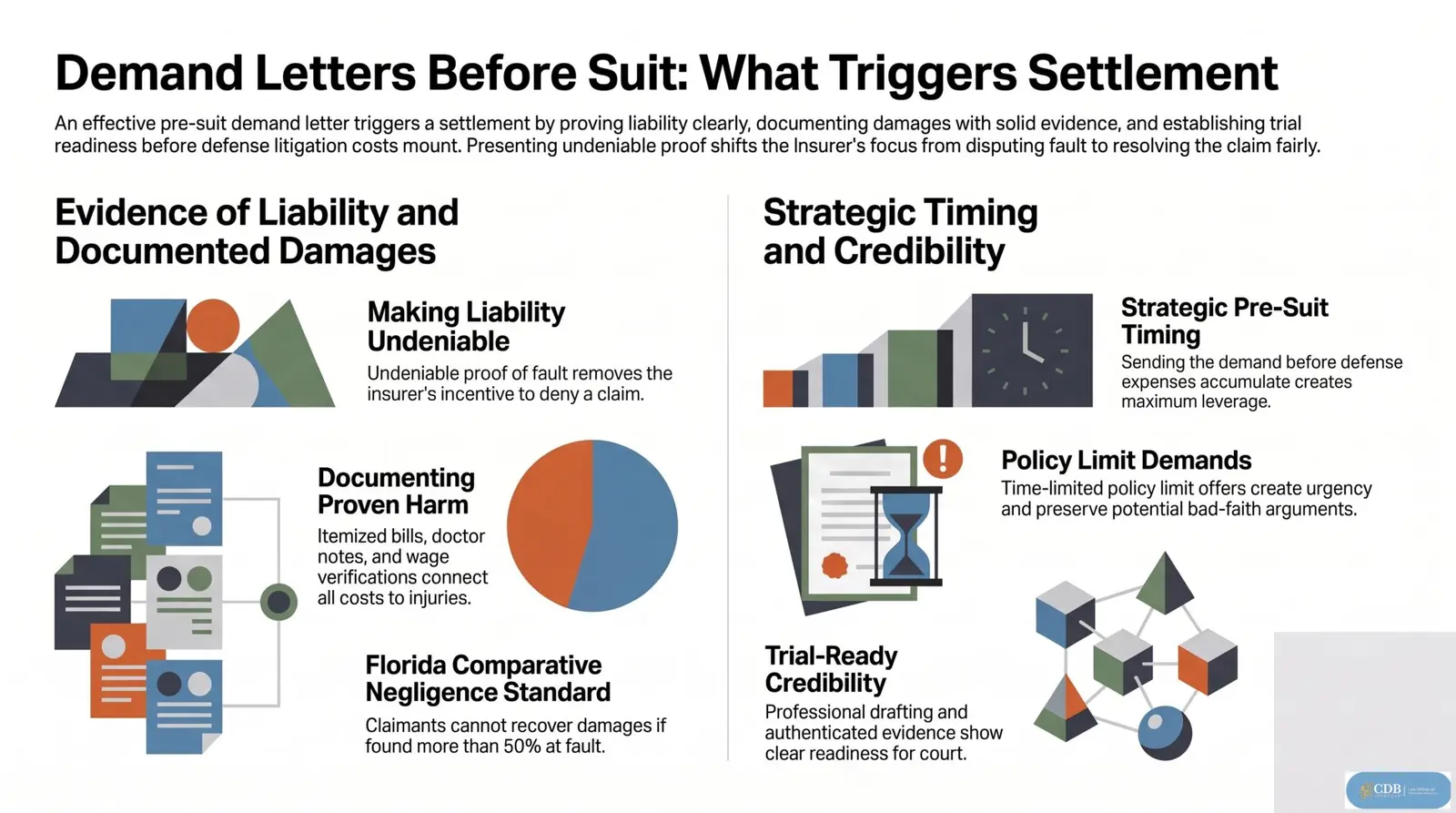
Insurance companies are more likely to settle when the cost of defending a claim is higher than the potential payout. If it’s unclear who was at fault, they have an incentive to deny your claim and fight. But when you present undeniable proof, that incentive disappears. A police report that cites the other driver for careless driving, combined with dash-cam footage and witness statements, can effectively end the debate over liability before it even begins. When fault is not in question, the adjuster’s focus must shift from arguing about the cause of the accident to calculating the value of your damages.
Florida’s comparative negligence law makes this even more critical. Under Florida Statutes § 768.81, if you are found to be more than 50% at fault for the accident, you cannot recover damages in most negligence claims. An insurance company facing indisputable evidence of their policyholder’s fault can’t risk going to trial hoping a jury will assign you most of the blame. The possibility of a jury finding the injured person had zero fault, and awarding full compensation, pushes them to settle before legal costs begin to mount.
Consider this scenario: You were rear-ended while stopped at a red light. The at-fault driver admitted they were distracted. A traffic camera captured the entire event. Your demand letter includes the video, the police citation, and the driver’s admission. The insurance company’s lawyer knows they would spend $30,000 on depositions, experts, and legal motions to fight a claim a jury would likely decide in minutes. Settling based on your demand saves them that expense, and that’s before even considering the risk of a large verdict against them.
Documenting Your Damages and Proving Medical Causation
Proving fault opens the door to a settlement; documenting your damages determines its size. Insurers pay for proven harm, not just claims of pain. The demand letter that triggers a payout connects every single cost to your injuries, provides a clear timeline of your medical treatment, and projects the need for future care with professional support.
An effective demand package includes:
- Itemized medical bills with treatment notes that show how your injuries have progressed since the accident.
- Letters from your doctors that explicitly state your diagnosed conditions were caused by the collision, not a pre-existing issue.
- Wage-loss verification from your employer, detailing missed hours, lost overtime opportunities, and any reduction in your ability to earn a living due to permanent injuries.
- Life-care plans or future treatment cost estimates from specialists when a permanent injury is diagnosed.
- Details about your non-economic damages, not just saying you’re in pain, but giving concrete examples of how the injury has limited your life, from being unable to pick up your child to losing the ability to enjoy hobbies.
Any gaps, like a three-month break in treatment or vague predictions about future needs, give adjusters an excuse to make a low offer or deny the claim. When your documentation is airtight, settlement becomes the most logical path for the insurer. A car accident claim supported by thorough medical evidence changes the conversation from “if we will pay” to “how much we will pay.”
Strategic Timing: Knowing When to Send Your Demand
Sending a demand letter too soon, before your medical condition has stabilized, means you can’t justify the full value of your claim. Sending it too late, as the deadline to file a lawsuit approaches, gives up leverage because the insurer knows you’ll have to sue anyway. The demand letter that triggers a settlement arrives when the insurer has the most to lose and has not yet spent significant money preparing for a lawsuit.
While Florida law doesn’t require a pre-suit demand letter in most personal injury cases, the financial realities do. The moment a lawsuit is filed, defense costs begin to climb. Before that happens, the insurance company can resolve your claim for its value alone. After filing, every dollar they consider for settlement is weighed against the money they are already spending on lawyers. A smart adjuster will want to settle before that clock starts ticking.
Timing is also key when your injuries are severe and may exceed the at-fault driver’s insurance policy limits. A careful early resolution may allow you to pursue your own underinsured motorist coverage or other sources of recovery without the delay and cost of a trial. A well-timed demand signals that you are ready for trial but prefer a reasonable settlement, a stance that encourages fair offers, not delay tactics.
For more on strategic timing considerations, see Demand Letter Timing: When to Send Before Suit Filing.
When Your Injuries Exceed the Policy Limits: Creating Urgency
Insurance companies have a legal duty to protect their customers by acting in good faith when handling claims. When your damages clearly exceed the at-fault driver’s policy limits, and you offer to settle for those limits, the insurer faces serious pressure to evaluate the claim promptly and fairly. If an insurer unreasonably refuses a reasonable opportunity to settle within policy limits, its insured may face personal exposure for any verdict above the coverage amount, and the insurer may later face a bad-faith claim.
A time-limited demand to pay the policy limits brings this issue to a head, but the deadline must be drafted with care. The letter should give the insurer a reasonable period to investigate the claim, provide the records needed to evaluate liability and damages, and set a firm response date. In Florida, bad-faith issues are fact-specific, and current law gives insurers important claim-handling protections, including a 90-day tender provision in certain circumstances under Florida Statutes § 624.155. That is why policy-limit demands should be precise, well-documented, and tailored to the facts, not copied from a template.
Imagine a pedestrian suffers a traumatic brain injury after being hit in a crosswalk. The driver’s policy limit is $100,000. The documented medical bills and lost wages alone are higher than that amount. The demand letter offers to settle for the $100,000 policy limit and includes the records the insurer needs to evaluate the claim. The insurance company knows a jury could award far more. Refusing to resolve the claim may expose its driver to a personal judgment and create the foundation for a later bad-faith argument. Settling for the policy limit may become the only responsible choice.
The Power of Credibility: Showing You’re Prepared for a Fight
Adjusters see hundreds of demand letters. The ones that get taken seriously are those that signal the claimant has a skilled attorney who is ready and willing to go to trial. A letter that is professionally drafted, supported by solid evidence, and written in a calm, confident tone commands respect. Letters that use templates, exaggerated language, or lack supporting documents are often ignored.
Credibility is built through:
- Accurate legal knowledge, showing a firm grasp of Florida law.
- Authenticated evidence, like sworn witness statements, certified medical records, and official billing documents, not screenshots from a patient portal.
- A reasonable valuation that is grounded in your actual economic losses and supported by examples of verdicts in similar cases.
- Honesty about potential weaknesses in the case, which demonstrates confidence that they can be overcome.
- A professional tone that conveys determination without aggression.
A settlement offer is triggered when the adjuster believes you and your attorney will follow through on the threat of a lawsuit. A demand package that looks like it’s already prepared for trial is not a bluff, it’s a clear signal that the next step is the courthouse.

Demand letters lead to settlements when they prove that litigation would be more costly and risky for the insurance company than paying you fairly. When your damages are undeniable, liability is clear, and your credibility is established, the insurer is left with no rational choice but to resolve the claim. Your power in this process comes not from yelling, but from precision. Every piece of evidence either builds your case for a fair settlement or weakens it. What triggers a settlement is not just what you ask for, it’s the undeniable proof that you deserve it.
Closing Remarks
If liability is clear but the carrier is stalling, if damages are documented but the offer insults the harm, or if the statute of limitations is closing in and settlement talks have stalled, the demand letter becomes the last pre-suit lever before the courtroom. CDB Injury Law drafts demand letters that settle, backed by trial-ready advocacy and a personal commitment to restoring clarity when everything feels uncertain. Contact us for a consultation that moves your recovery forward.
Frequently Asked Questions
How long does an insurance carrier typically have to respond to a demand letter in Florida?
Florida law does not impose a universal statutory deadline for insurer responses to pre-suit demand letters in personal injury claims. However, the demand letter itself can, and often should, impose a reasonable deadline, often 15 to 30 days or longer depending on claim complexity and the records provided. The deadline creates urgency and memorializes the carrier’s opportunity to settle before litigation costs accrue. Silence past the deadline does not waive the claim, but it often signals that suit filing is the only path forward.
Can a demand letter hurt a personal injury claim if it asks for too much or too little?
An inflated demand unsupported by documentation gives the adjuster justification to dismiss the entire claim as frivolous, damaging credibility for any subsequent negotiation or litigation. An undervalued demand, conversely, can anchor settlement negotiations below fair value or suggest the claimant lacks confidence in the claim’s merit. The settlement-triggering demand is neither; it is a figure justified by evidence, scaled to injury severity, and reasonable within the range of comparable verdicts. Precision in valuation preserves credibility and maximizes recovery.
What happens if the insurance carrier rejects the demand letter entirely?
Outright rejection typically signals one of three dynamics: disputed liability, contested causation, or a strategic decision to force litigation in hopes the claimant will abandon or settle low. Rejection does not end the claim; it clarifies that resolution will require either renewed negotiation with additional evidence or a lawsuit filed within the statute of limitations. In cases involving policy-limit demands, rejection may also support later bad-faith analysis if the claim results in an excess verdict and the insurer lacked a reasonable basis for refusing to settle. Rejection is a data point, not a conclusion.
Does sending a demand letter start the statute of limitations clock in Florida?
No. The statute of limitations clock starts running on the date of the injury, not the date a demand letter is sent. For negligence claims in Florida, the period was recently shortened. Under Florida Statutes § 95.11(4)(a), the statute of limitations is now two years for negligence causes of action accruing on or after March 24, 2023. For incidents occurring before that date, the prior four-year statute may apply. The demand letter is a step in pre-lawsuit negotiations; it does not pause or restart this critical filing deadline. Failing to file a lawsuit within the statutory window will permanently bar your claim, regardless of any negotiations.
Can a demand letter include a claim for bad faith if the carrier has been unreasonably delaying?
A first-party bad-faith claim against your own insurer, such as in an uninsured or underinsured motorist context, has specific statutory requirements and usually depends on the insurer’s conduct after you’ve made your claim. A third-party bad-faith claim against the at-fault party’s insurer typically arises only after the carrier fails to settle within policy limits, exposing its insured to a judgment for a higher amount. While a pre-suit demand letter generally doesn’t assert a formal bad-faith action, it can lay the groundwork by referencing the insurer’s duty to act in good faith, providing the evidence needed to evaluate the claim, and preserving the issue for potential future litigation.
What role do medical experts or accident reconstruction experts play in demand letter settlement leverage?
Expert reports add significant leverage when key facts are in dispute. An accident reconstruction expert can be crucial in a contested intersection crash, for example. A report from an engineer or reconstruction specialist that definitively establishes fault or impact severity can reduce the insurer’s ability to argue ambiguity, forcing them to focus on damages. Similarly, if the insurer questions whether your injuries were caused by the accident, a sworn opinion from a medical expert linking the crash to your diagnosed condition closes a gap they might otherwise try to exploit. Including these expert reports with your demand letter signals you are prepared for trial and increases the claim’s credibility, often triggering a settlement to avoid a costly battle of experts in court.
References
- Fla. Stat. § 768.81
- Fla. Stat. § 624.155
- Fla. Stat. § 95.11(4) (a).