
When you’ve been injured in an accident, you expect the at-fault party’s insurance company to do the right thing. But instead of providing support, they often create roadblocks. The adjuster might say the accident was your fault, or they might question the severity of your injuries and the medical care you received. It can feel deeply unfair, leaving you confused and wondering how to move forward.
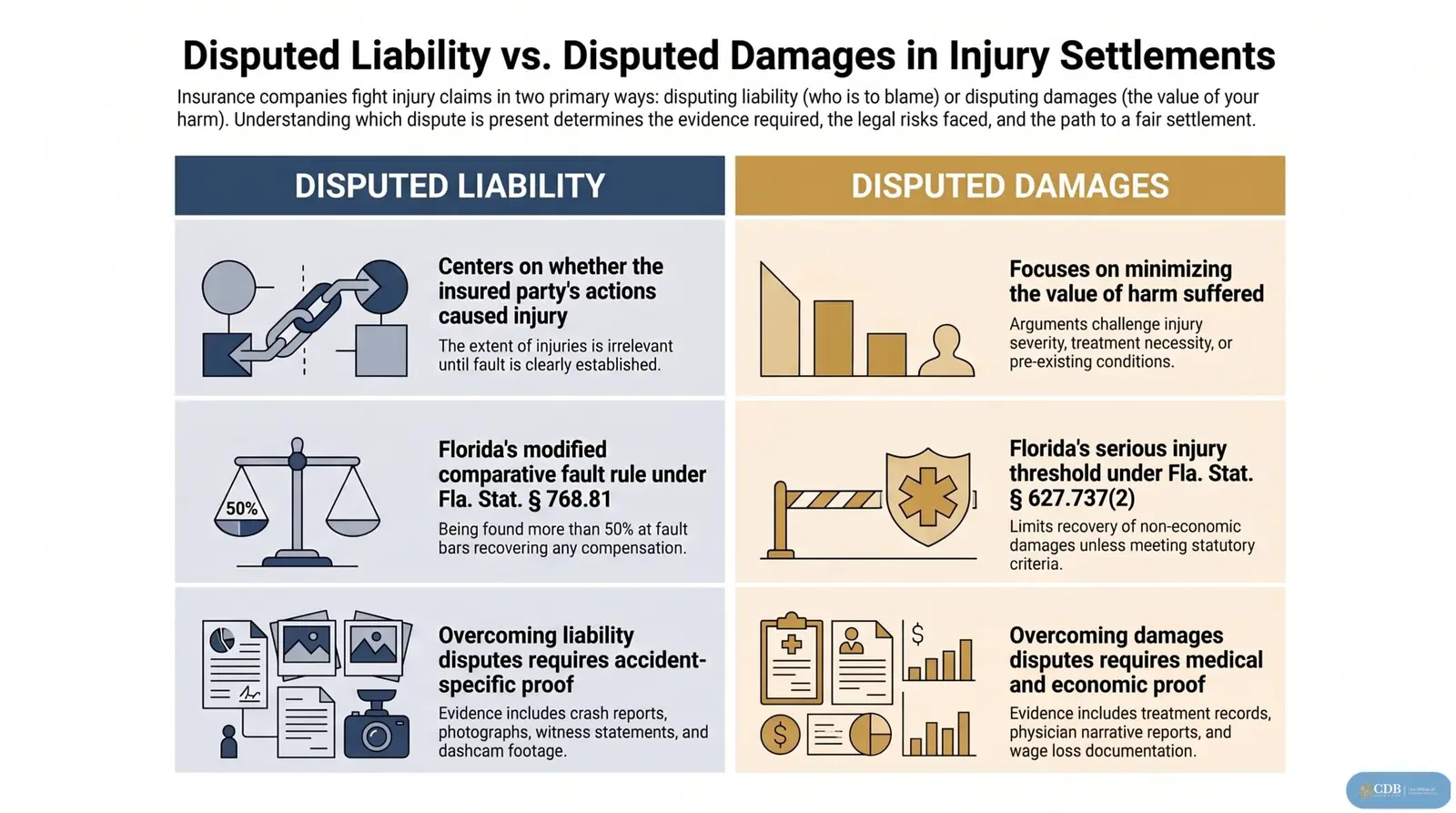
This isn’t just a negotiation tactic; it’s a specific strategy. Insurance companies fight claims in two primary ways: by disputing liability (who is to blame) or by disputing damages (the value of your harm). Understanding which battle you are facing is critical, as it determines the evidence you need, the risks you face, and the path to a fair settlement. Confusing the two can weaken your position before you even receive an offer.

Disputed liability and disputed damages represent the two pillars on which every injury settlement negotiation rests. Knowing which pillar is bearing the weight of the dispute determines what evidence matters, what risks each side faces, and where a just resolution becomes possible.
What It Means When Liability Is Disputed
A liability dispute centers on one fundamental question: did the insured party’s actions cause your injury? The insurance carrier may argue their driver had a green light, that you changed lanes unsafely, or that no one was truly negligent. In these situations, the extent of your injuries is irrelevant until fault is clearly established.
This is especially critical in Florida, which follows a modified comparative fault rule under Fla. Stat. § 768.81 for most negligence claims, including auto negligence claims. Following a 2023 change in the law, if you are found to be more than 50% at fault for the accident, you are barred from recovering any compensation at all. It is no longer just a simple reduction. An insurance carrier knows that if they can convince a jury to assign you 51% of the blame, their legal obligation to pay vanishes completely. This gives them immense leverage to make low offers or deny a claim outright when fault is even slightly in question.
Consider a rear-end collision at a stoplight. The striking driver claims you reversed into them. There is no dashcam footage, and witness statements conflict. Liability is no longer automatic. Even with significant medical treatment and a strong permanency opinion, the settlement stalls because the value of your case is held hostage not by your injury, but by accident reconstruction, witness credibility, and traffic evidence.
To overcome a liability dispute, you need accident-specific proof:
- Police crash reports for basic crash data, diagrams, listed witnesses, and citations, while recognizing that some report contents or compelled crash-report statements may not be admissible in court
- Photographs of vehicle damage, road conditions, and scene geometry
- Non-privileged witness affidavits or recorded statements
- Surveillance or dashcam video
- Expert testimony on accident reconstruction, if the case proceeds to litigation
- Traffic citation records, citation dispositions, and non-privileged admissions made outside the crash-report process
Because Florida’s crash report privilege can limit the use of statements made for crash-report purposes under Fla. Stat. § 316.066(4), liability evidence must be gathered and framed carefully. For resolving fault, your medical records play a limited role in a pure liability dispute. The injury could be catastrophic, but if fault cannot be proven, the claim may fail entirely. Settlement negotiations in liability-contested cases revolve around building a strong car accident claim by marshaling admissible liability evidence before the statute of limitations compels a filing decision.
What It Means When Damages Are Disputed
In these cases, the insurance c ompany isn’t arguing about who caused the accident; they are focused on minimizing the harm you suffered. The argument shifts from “our insured didn’t cause this” to “your injuries aren’t that serious,” “the treatment was excessive,” or “that condition was pre-existing.” This can feel like a personal attack on your credibility and your pain.
Florida’s serious injury threshold, codified in Fla. Stat. § 627.737(2), limits recovery of non-economic damages in certain auto cases unless the injury meets statutory criteria: significant and permanent loss of an important bodily function, permanent injury within a reasonable degree of medical probability, significant and permanent scarring or disfigurement, or death. When a carrier disputes permanency, it is disputing not just the amount owed, but whether non-economic damages are recoverable at all.
Overcoming a damages dispute requires compelling medical and economic proof:
- Treatment records establishing causation and continuity of care
- Narrative reports from treating physicians linking injuries to the accident
- Permanency opinions, preferably supported by objective diagnostic findings
- Life care plans or future medical cost projections, when warranted
- Wage loss documentation, tax returns, and employer verification
- Evidence rebutting claims of pre-existing conditions or treatment gaps
Unlike liability disputes, damages disputes are battles of degree. The carrier may offer twenty percent of the demand, arguing that half the treatment was unrelated or that the permanency opinion lacks foundation. Here, a settlement becomes a negotiation over valuation, medical evidence, and the credibility of expert opinions. The adjuster’s authority to settle often hinges on their assessment of the risk of a substantial jury award for your pain and suffering.
A T-bone collision with clear traffic-light evidence illustrates the distinction. Liability is undisputed. You undergo three months of physical therapy, then eight months of chiropractic care, followed by an MRI showing disc bulges and a permanency rating. The carrier accepts fault but disputes whether the treatment after month four was related, whether the bulges were degenerative, and whether the permanency opinion satisfies Florida’s threshold. This is a pure damages dispute. The accident reconstruction is irrelevant. Settlement turns entirely on medical causation and the strength of the permanency evidence.
How Your Settlement Strategy Must Adapt
In a liability dispute, the negotiation is almost binary: prove fault or risk losing the entire claim. Carriers oft en deny these claims or make nuisance-value offers, settlements so low they only acknowledge the cost of defending the case. Your leverage comes from the strength of your liability evidence and the carrier’s fear of losing at trial. A fair settlement may not be possible until depositions are taken or key evidence is uncovered.
In damages disputes, settlement often remains possible; the question is usually for how much. Carriers in these cases make lowball offers but remain engaged. They know they may owe something. Your leverage comes from strong medical evidence, a credible permanency opinion, and the risk that a jury will fully appreciate the non-economic impact of the injury. Demand letters in damages cases emphasize treatment chronology and physician narratives. Demands in liability cases emphasize police reports and witness statements.
The risk you face also differs. In a liability dispute, you face the possibility of zero recov ery. In a damages dispute, you face under-recovery, settling for less than your claim’s full value because of treatment gaps or a pre-existing condition that muddies causation. A carrier that denies a claim based on a legitimate liability dispute faces little risk. But a carrier that lowballs a claim when liability is clear and damages are well-documented may create bad-faith exposure in appropriate circumstances, especially if its actions expose its own insured to a personal judgment.
When Both Liability and Damages Are Disputed
Some claims present a two-front challenge: the carrier contests both who was at fault and the value of your injuries. These are the most difficult cases to settle without filing a lawsuit. You must first prove fault to unlock any recovery, then prove the full extent of your damages to pursue the claim’s full value. It’s a battle that often cannot be won until the discovery process forces the insurer to confront the facts.
In these dual-dispute cases, early and thorough case development is crucial. A strong report from an accident reconstructionist might resolve the liability dispute, turning the case into a straightforward damages negotiation. Likewise, objective medical findi ngs can solidify a permanency opinion, forcing the carrier to focus only on comparative fault. Your claim’s value remains suppressed until one of the two disputes is resolved.
Meaningful offers in dual-dispute cases rarely arrive until after depositions, medical examinations, and expert reports narrow the range of possible outcomes at trial. Demanding the policy limits is unlikely to succeed unless the liability evidence becomes overwhelming and the medical proof is unassailable.
Settlement is not a single conversation. It is a sequence of proof, risk assessment, and leverage that changes shape depending on what the carrier is willing to concede and what it is determine d to contest. Knowing which battle is being fought, and what evidence wins it, is the difference between a fair settlement and a years-long fight over a claim that could have been resolved with the right proof at the right time.
Closing Remarks
If an insurance carrier is denying fault despite clear evidence, dismissing your doctor’s permanency opinion, or making offers that ignore the true scope of your injuries, you are on disputed ground. Prevailing requires legal strategy and evidentiary precision. At CDB Injury Law, we stand with injured people in Florida, helping them build the proof needed to resolve liability disputes, establish permanent injury, and demand full value. You do not have to fight this battle by yourself. Let us talk about your recovery, your settlement options, and the path forward.
Frequently Asked Questions
Can a claim settle if liability is disputed?
Yes, but the settlement offer will be discounted to reflect the insurance company’s perceived chance of winning at trial. If the carrier believes there is a strong liability dispute, they may offer only a small nuisance value or deny the claim completely. A settlement becomes more likely as you present stronger evidence that dismantles their arguments. You and your attorney must weigh the certainty of a reduced settlement against the all-or-nothing risk of a jury trial.
What happens if I accept a settlement in a damages dispute and later discover my injury is worse?
Once you sign a settlement release, the claim is permanently closed. That agreement bars all future claims related to the accident, even for injuries discovered later. In Florida, a settlement generally cannot be reopened because an injury worsens, unless there was fraud or a specific mutual mistake. This is why it is vital to have a clear diagnosis, prognosis, and permanency opinion before you settle. Settling too early, before reaching what doctors call maximum medical improvement, can mean forfeiting compensation for future needs.
Does the insurance carrier have to tell me whether they are disputing liability or damages?
No, they generally do not have to reveal their internal strategy. A denial letter may not explain every reason behind the carrier’s position. An adjuster might raise questions about liability at first, then shift to questioning your medical treatment once you provide a crash report. This ambiguity can allow them to keep defensive options open. It is up to you and your attorney to analyze their communications and actions to infer the true nature of their dispute.
If the carrier disputes damages but not liability, does that mean they will eventually pay the full claim?
No. Conceding fault is not the same as conceding the value of your claim. An insurer can fully accept their driver was at fault but still fight you on every dollar of damages, arguing your medical care was unnecessary, your injuries were pre-existing, or your pain and suffering is worth very little. Accepting liability is just the first step; it does not guarantee fair compensation. Proving the full value of your damages is a separate, and often harder, battle.
References