
After an injury, the insurance company watches everything: the timing of your doctor visits, gaps in your care, and what you say. Sending a demand letter too early can undervalue your claim, but waiting too long can make it seem weak. Understanding what they’re looking for helps us protect the true value of your case before a lawsuit is ever necessary.
Months after the accident, you’re still healing, and the path forward feels uncertain. Your attorney sends a demand letter to the insurance company, outlining your medical journey and asking for fair compensation. But the adjuster’s decision isn’t just about that letter. They’ve been building a file on you since day one, tracking your every move, from treatment gaps and delayed doctor’s visits to inconsistencies in what was said. By the time you consider a lawsuit, the insurance company has already decided what they think your story is worth based on this silent observation.

The timeline that matters most to you is your recovery. But the insurance company follows a different clock. They track milestones that they believe predict a claim’s value and the risk of a lawsuit. The time between the crash and your first doctor visit, the consistency of your follow-up care, and the gap between when your treatment ends and when the demand is sent all feed into their evaluation. A demand that arrives before the full picture of your injuries is clear may be dismissed. One that arrives after a long, unexplained delay may be viewed as a sign of a weak case.
What the Insurance Company Tracks After Your Injury
From the moment you report an accident, the insurance company starts building a file. They use early documents, like police reports and initial medical records, to create a baseline. Any deviation from this initial story can be used against you later. Adjusters specifically look for:
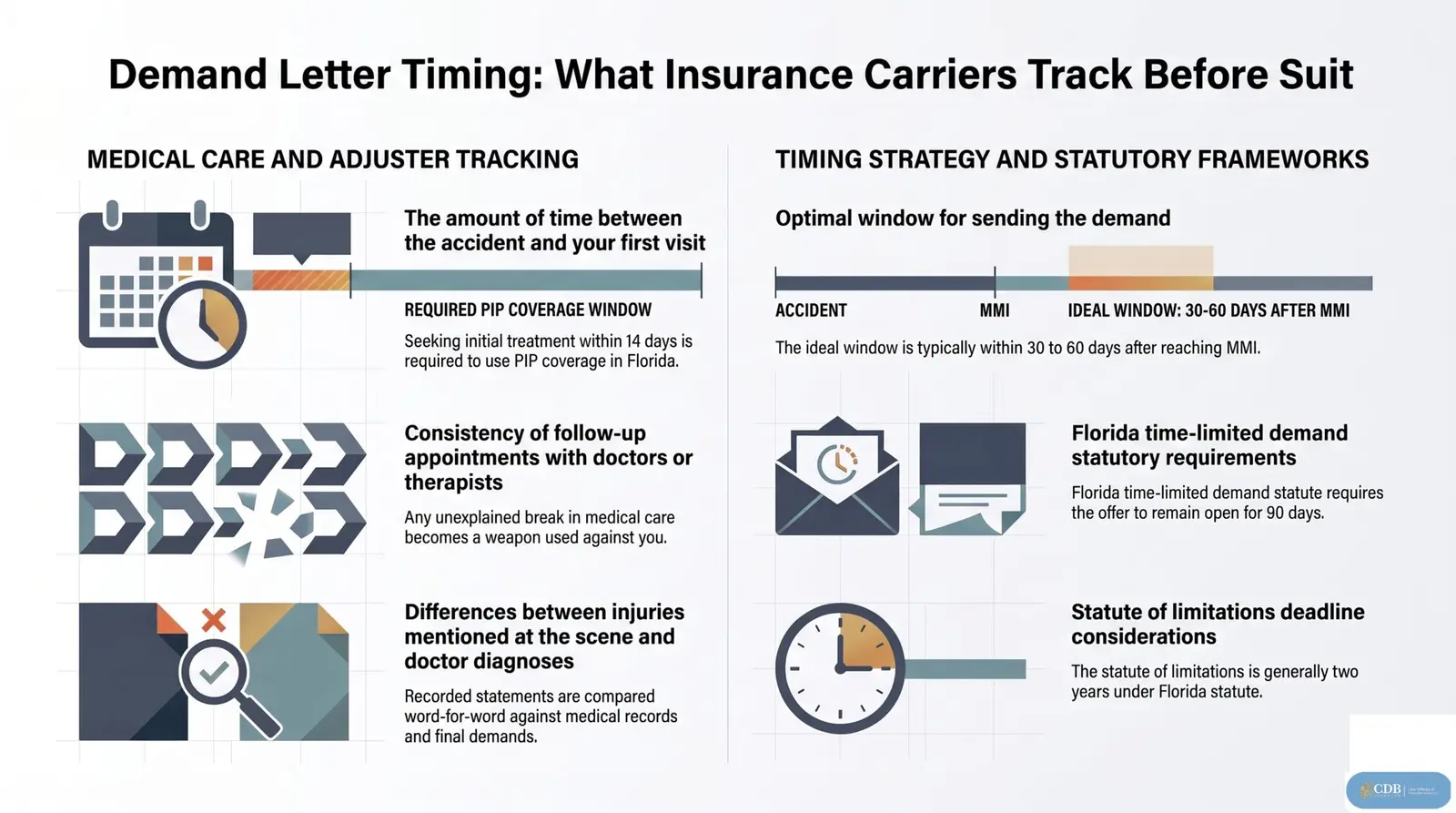
- The amount of time between the accident and your first visit to an ER or urgent care
- Whether you sought initial treatment within 14 days, which is required to use your PIP coverage in Florida under Fla. Stat. § 627.736
- Differences between the injuries you mentioned at the scene and those your doctor first diagnosed
- Whether you had imaging tests like an X-ray or MRI within the first month
- The consistency of your follow-up appointments with doctors or therapists
- New complaints or injuries that appear weeks or months after the accident
This isn’t just about figuring out who was at fault. It’s about building a case against your credibility. For example, if you wait three weeks to see a doctor after a rear-end collision, the insurance company will question the severity of your injuries, even if your pain is real. When your demand letter arrives six months later asking for fair compensation for a serious injury, the adjuster will point to that delay as a reason to offer you less.
Medical Treatment Patterns and Maximum Medical Improvement
Insurance companies know that a claim’s value is strongest when your medical care is consistent and well-documented. Sending a demand before you reach what’s called Maximum Medical Improvement (MMI), the point where your doctor says your condition has stabilized as much as reasonably expected, can be premature. For many Florida motor vehicle claims involving pain and suffering, a doctor’s opinion about permanency can be important to meeting the injury threshold under Fla. Stat. § 627.737 and to evaluating future care. A demand letter without a clear medical picture will likely be denied or met with an insultingly low offer meant to just make the claim go away.
On the other hand, waiting too long after reaching MMI can also hurt your case. If your treatment ends in January but the demand isn’t sent until September, the insurance company will assume your injury wasn’t that serious or that you’re struggling to build a case. Both assumptions lead to lower settlement offers.There is an optimal window for sending the demand, when your treatment is done, all records are in, and the doctor’s opinion on permanency is recent. The carrier watches this timing closely.
Treatment Gaps and Discontinued Care
Life gets in the way of recovery. But any unexplained break in your medical care can become a weapon the insurance company uses against you. A two-month gap between physical therapy appointments suggests to them that you either felt better or weren’t committed to your recovery. When the demand letter later describes ongoing pain, the adjuster will point to that gap as a contradiction. Notes in your file like “patient missed appointment” only make their argument stronger.
Even if you have a good reason for a delay, like financial struggles or trouble getting an appointment, it needs to be documented at that time. A note from your doctor explaining the reason for the delay can neutralize this defense. Without that proof in your medical records, the carrier will assume the worst, and your demand will be valued lower.
Communication and Silence as Signals
Everything you say to an adjuster can, and will, be used to evaluate your claim. A recorded statement you give a few days after the accident is compared word-for-word against your medical records and the final demand. If on day three you told the adjuster, “I feel fine, just a little sore,” they will use that quote to challenge a demand six months later describing debilitating pain.
Silence also sends a message. Long periods with no contact can make the carrier think the claim has been forgotten or abandoned. An experienced attorney knows how to use strategic silence, waiting until your medical treatment is complete before opening negotiations. This planned approach commands more respect than a demand that appears after months of disorganized communication.
Pre-Suit Posture and Litigation Leverage
Sending a demand letter before filing a lawsuit tells the insurance company you are open to a fair settlement. But it also shows them you are prepared to fight if they refuse to be reasonable. The carrier assesses whether this is a credible threat based on the facts they’ve gathered and the timing of your demand.
A demand sent too soon, before your medi cal situation is clear or all evidence is gathered, gives the carrier an excuse to make a low offer. They may assume you are desperate for a quick check. A demand sent too late, with the deadline to file a lawsuit (the statute of limitations) approaching, also signals desperation. They will be less willing to negotiate fairly if they know your time to act is running out.
The ideal time is when your medical story is complete, the other party’s fault is well-documented, and you have plenty of time to file a lawsuit if needed. The carrier knows that litigation is a real possibility and that you have the resolve to see it through. This knowledge is what brings them to the table with a fair offer. For a deeper look at how evidence of fault can impact negotiations, understanding Florida’s comparative fault rules is key.
Policy Limits and Protecting Your Rights
When your injuries are severe and the costs clearly exceed the at-fault driver’s insurance policy, timing becomes critical for another reason. Florida law r equires insurance companies to act in “good faith,” to treat you fairly when a reasonable settlement is possible. If they refuse to pay a valid claim for the policy limits, they can sometimes be held responsible for the entire jury verdict, even if it’s much higher than the original policy. This is called a “bad faith” claim, and it gives you powerful leverage.
 A properly prepared demand letter that gives the carrier a legally reasonable deadline to pay the policy limits puts them on notice. In many pre-suit bodily injury claims, Florida’s time-limited demand statute requires the offer to remain open for at least 90 days and to include specific information (Fla. Stat. § 624.155(4)). If the insurer ignores a compliant demand or rejects it without a good reason, they may open themselves up to a potential bad faith case. For people with devastating injuries caused by a driver with low insurance limits, this strategy can be the key to securing the full compensation you need.
The months between your injury and a settlement demand are not just waiting time. It is a period where the story of your case is being written, and the insurance company is watching every word. The consistency of your medical care, your communication, and strategic timing all determine whether the carrier sees your claim as a serious case or just another file to close for cheap. Understanding what they look for allows you to control the narrative. When you’re ready to protect the full value of your claim, The Path Forward can provide clarity and guidance.
Closing Remarks
If your medical treatment is complete but you feel uncertain about the next step, or if the insurance company has gone silent after making a low offer, your timing and strategy from here are critical. CDB Injury Law helps injured people in Florida build strong cases that stand up to insurance company scrutiny and preserve their right to fair compensation. You do not have to face this alone. Let us talk about your recovery.
Frequently Asked Questions
How soon after reaching maximum medical improvement should a demand letter be sent?
The ideal window is typically within 30 to 60 days after you reach MMI and your doctor provides an opinion on the permanency of your injuries. This timing ensures all your records are complete while the medical findings are still current. Waiting longer can give the carrier the impression that your injury has resolved or that your case isn’t strong.
What happens if there was a gap in medical treatment due to financial reasons?
Insurance companies will use any gap in treatment as a reason to lower their offer, unless the gap is well-explained. It is crucial to have documentation from your doctor, written at the time of the delay, explaining that you faced financial barriers, couldn’t afford co-pays, or were on a waitlist for a specialist. Without this proof in your medical records, the adjuster will argue you either recovered or chose not to get care.
Can a demand letter be revised or supplemented after it is sent?
Yes, but it’s not ideal because it can signal that the first demand was sent too early. This can sometimes weaken your negotiating position. However, if new medical information comes to light, like a new diagnosis or a recommendation for surgery, a supplemental demand is necessary and appropriate. It should always be sent with the updated medical records and a clear explanation for the revised value.
Does the carrier track social media activity before the demand is sent?
Yes, absolutely. Adjusters often look at public social media profiles for photos or posts that contradict the injuries you’ve claimed. A picture of you playing a sport or on vacation while you are supposed to be recovering from a serious injury can severely damage your case. It is wise to be cautious about what you post online from the moment you are injured until your case is fully resolved.
If the statute of limitations is approaching, should a demand still be sent before filing suit?
When the legal deadline to file a lawsuit is near, filing the lawsuit often becomes the priority. For many Florida negligence claims arising on or after March 24, 2023, the statute of limitations is generally two years under Fla. Stat. § 95.11(4)(a), though older claims and certain special circumstances may have different deadlines. A last-minute demand can signal weakness and may not be taken seriously. If there is enough time for the carrier to reasonably respond, a demand can still be effective. However, to protect your rights, the safest course is often to file the suit and then continue negotiating. This prevents your claim from being dismissed for missing the deadline.
References
- Fla. Stat. § 627.736
- Fla. Stat. § 627.737
- Fla. Stat. § 624.155(4)
- Fla. Stat. § 95.11(4) (a) (2023).