TL;DR: After an injury, you need a path to recovery, not a fight with an insurance company. A settlement demand letter is a crucial tool to resolve your claim fairly and without a lawsuit, but only if it is done right. A strong demand, backed by complete medical records, a clear narrative of fault, and an accurate accounting of all your losses, forces an insurance carrier to take your claim seriously and negotiate in good faith.
The time after a serious injury is filled with uncertainty. Medical bills are piling up, you may be unable to work, and the future feels unclear. The settlement demand letter is a critical step toward regaining control. It is our opportunity to present the full story of what you have been through: your injuries, your expenses, and your pain, and to ask the insurance company to make it right. This is often the best chance to resolve your claim on your terms before the long, stressful process of a lawsuit begins. A thoughtfully prepared demand leaves an insurer little room to delay, deny, or undervalue what you are owed.
Insurance adjusters are trained to control payouts. They look for any weakness, a missing medical record, an unsupported claim for lost wages, or an unclear story of how the accident happened, as a reason to offer less than your claim is worth. Your demand letter must be more than just a request for money; it must be a comprehensive, evidence-based case for why the amount being demanded is fair and just. It is your story, presented with the strength and clarity needed to get the attention of people whose job is to say no.
Your Medical Story: Documentation and Doctor’s Opinions
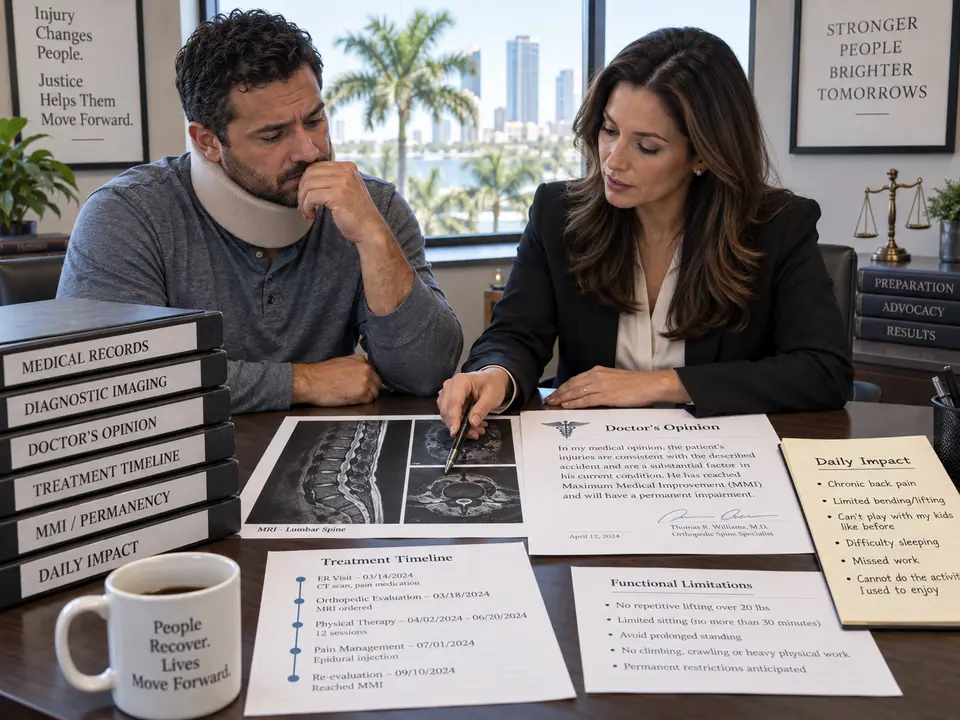
The foundation of any personal injury claim is the medical evidence. To understand what your case may be worth, we must tell the complete story of your injuries. This story is told through your doctor’s records, diagnostic imaging like MRIs, and medical opinions that connect your injuries to the incident. A demand letter without complete medical records is an invitation for a low offer. Gaps in your treatment history or missing reports give the adjuster an excuse to argue that your injuries are not as serious as you say, or that they came from something else entirely.
In Florida, a key moment in your recovery is reaching what is often called maximum medical improvement (MMI). This is the point where your doctor determines that your condition is unlikely to improve further with additional treatment. Sending a demand before you reach MMI is risky, because the full extent of your future medical needs may still be unknown. A doctor’s opinion on “permanency,” whether your injury will cause lasting limitations, chronic pain, or require future surgery, is critical. That opinion turns your medical diagnosis into a documented basis for legal damages, grounding your demand in objective findings, not just your personal account of pain.
Damages for pain and suffering are real, but they need context. While medical records show the physical harm, we also need to show the human impact. The demand must connect the clinical findings to your daily life, your inability to work, your struggle to sleep, or the loss of activities you once enjoyed. We work to paint a clear picture for the adjuster of how the injury has changed your life, supported by the medical evidence that shows your struggle is real and lasting.
Tallying the Costs: Economic Losses and Supporting Proof
The financial toll of an injury goes far beyond the first hospital visit. We carefully document every cost to show the insurance company the full extent of your economic losses. This includes not just hospital bills and surgical invoices, but also pharmacy receipts, physical therapy costs, and travel expenses for appointments. Every expense should be backed by a receipt or invoice. Simply stating a total is not enough; we provide the proof for every dollar you have lost.
Lost wages are a major part of this calculation. We prove your lost income with employment verification letters, pay stubs, and notes from your doctor confirming you were unable to work. For self-employed individuals, this can be more complex, requiring tax returns and business records to show lost income and opportunities. You must be able to show reasonable proof that the income you lost was a direct result of the injury, and we work to gather all the necessary documents to make that showing as strong as possible.
If your injuries will require future medical care, such as another surgery or long-term therapy, we must account for those costs as well. This often involves working with experts, like life-care planners or vocational specialists, who can review your medical records and provide a professional opinion on the cost of future care or your diminished ability to earn a living. A demand seeking future damages without this expert support gives the carrier an easy reason to reject it.
Proving Fault: The Liability Narrative

Proving your injuries and losses is only half the battle. We also have to show the other party was responsible. Your demand letter must clearly and persuasively explain how the at-fault party’s actions caused your injuries, supported by hard evidence. This can include crash reports, witness statements, photos from the scene, surveillance video, or expert analysis. We cite and summarize every piece of evidence that builds the case for liability.
Insurance companies will often try to shift blame to reduce what they have to pay. It is important to understand Florida’s comparative fault statute, Fla. Stat. § 768.81, which was amended in 2023. For most negligence claims filed after that change, a person found to be more than 50% at fault for their own harm is barred from recovering damages, and any recovery is otherwise reduced by the person’s percentage of fault. That makes it more important than ever for your demand letter to build a strong narrative that confronts and answers any attempt to unfairly blame you for what happened.
The demand must also draw a clear line from the at-fault party’s conduct to your harm. Medical records should show that your injuries appeared right after the incident or within a medically reasonable timeframe. Even if your symptoms were delayed, that connection can often be established with a proper clinical explanation from your doctors. Without this clear link, the insurance company will argue your injuries were caused by something else entirely.
Protecting Evidence for Your Case
Our demand letter also serves as a formal notice to the other side: we know what evidence exists, and they are expected to preserve it. If relevant evidence such as security camera footage or internal company records is lost or destroyed after that notice, a court may be asked to address it. This protects the integrity of your claim and puts the other side on notice that we are prepared to fight for the evidence needed to prove your case.
Accounting for Liens and Other Payback Claims
After a settlement is reached, certain parties often have a right to be paid back for costs they covered related to your injury. These are commonly called liens or subrogation claims. They can come from health insurance providers (including employer-sponsored ERISA plans), government programs like Medicare and Medicaid, or in some circumstances hospitals. Failing to account for these payback obligations can delay your settlement and cause legal problems down the road.
- Medicare and Medicaid payback claims
- Health insurance reimbursement claims (including ERISA plans)
- Hospital liens, where authorized by law
- PIP (Personal Injury Protection) carrier reimbursement claims
- Med Pay coverage payback
- Child support and other government claims
We work to identify and address these potential payback obligations before the demand is ever sent. We request official statements from each lienholder and address them directly in the letter. This shows the insurance adjuster that we are thorough and credible, which helps build trust and can speed up the resolution process.
Your attorney’s fees and costs are also accounted for in the final settlement distribution. We believe that the path forward requires total clarity. You should understand where every dollar from a settlement goes, to medical providers, to lienholders, to attorney’s fees, before you ever agree to it. That transparency means no surprises and no guessing about what to expect.
Insurance Coverage, Policy Limits, and Bad Faith
A demand letter must be realistic, which means understanding the at-fault party’s insurance policy limits. Sending a demand for an amount far beyond the available coverage is rarely effective. Before we send a demand, we work to confirm the available insurance coverage. Under Florida law, an insurer can be required to disclose certain coverage information upon proper request, and a failure to do so can carry consequences for the carrier.
In the right case, a time-limited demand for the full policy limits can be a powerful tool. It offers the insurance company a chance to resolve the case within its coverage and within a set timeframe, such as 30 days. If the insurer unreasonably refuses a reasonable opportunity to settle within limits and a jury later returns a verdict that exceeds those limits, the insurer may be exposed to liability for the excess amount. That is the general idea behind a Florida “bad faith” claim, and the possibility of that exposure creates real pressure on a carrier to settle when the demand is complete, credible, and fair.
If the at-fault driver’s insurance is not enough to cover your damages, you may be able to turn to your own uninsured or underinsured motorist (UM/UIM) coverage. The demand letter should note whether you intend to make a UM/UIM claim, because that claim requires careful coordination, including notice and consent requirements, to protect your rights under your own policy.
The settlement demand letter is our chance to show the insurance company that we are prepared, organized, and ready to go to trial if necessary. It translates your entire experience, the pain, the medical journey, the financial stress, into a clear and compelling case for fair compensation. Every missing record or unsupported number gives the adjuster a reason to undervalue your claim. Our job is to leave them no reason at all. When pain starts days after a Florida car crash, the demand must explain why. When complex liens are involved, the demand must show that every dollar is accounted for. We build a demand letter that is complete, credible, and ready to stand up to scrutiny.
Closing Remarks
If you feel like the insurance company is not listening, you do not have to face this alone. When adjusters ignore medical evidence or refuse to negotiate fairly, it is time to show them you are serious. At CDB Injury Law, we prepare settlement demands that create accountability. If a carrier still refuses to do the right thing, we are prepared to file suit and stand with you in court. Let us talk about your recovery and the path forward.
Frequently Asked Questions
What happens if the insurance carrier does not respond to the demand letter?
Silence is a common delay tactic. If the carrier does not respond within the time we specify, the next step is generally to file a lawsuit. Florida law does not require a carrier to respond before suit is filed, but its silence in the face of a reasonable, well-documented demand may become relevant later when a court or jury evaluates how the carrier handled the claim. Often, filing suit is what it takes to get an insurer’s full attention.
Can a demand letter be revised or supplemented after it is sent?
Yes, and it is often necessary. If your medical condition worsens, you require more treatment, or new evidence comes to light, we can send a supplemental demand. This is common when the first demand was sent before you reached maximum medical improvement. Each supplement should be based on new, concrete information and documentation that supports the revised number.
Does sending a demand letter waive the right to file a lawsuit?
No. A demand letter is an invitation to settle your claim without going to court. If the insurance company rejects the demand or makes an unreasonably low counteroffer, you retain your right to file a lawsuit at any point before the statute of limitations expires. The demand is a tool for resolution, not a waiver of your rights.
How do Florida’s PIP and bodily injury coverage rules affect the demand letter?
Florida is a “no-fault” state, meaning your own Personal Injury Protection (PIP) coverage is generally the first source of payment for medical bills and lost wages, up to your policy limit. A demand to the at-fault party’s bodily injury (BI) insurer in a motor vehicle case must address Florida’s injury threshold. Under Fla. Stat. § 627.737, damages for pain, suffering, mental anguish, and inconvenience are available only if the injury meets one of the statutory categories, such as permanent injury within a reasonable degree of medical probability, significant and permanent loss of an important bodily function, significant and permanent scarring or disfigurement, or death. A key part of the demand letter is supporting that threshold with a physician’s opinion.
What role does the statute of limitations play in demand letter timing?
This is a critical and recently changed area of Florida law. Under Fla. Stat. § 95.11, general negligence causes of action accruing on or after March 24, 2023 must generally be filed within two years. For causes of action that accrued before that date, the deadline was generally four years. Other claim types and defendants can carry different deadlines, so the exact date should always be confirmed for your case. Because these deadlines are unforgiving, timing matters. We send a demand with enough time left for meaningful negotiation, while making clear that we will file suit without hesitation if the deadline nears and the case is not resolved.
Can a settlement demand include claims for family members?
Yes. If your injuries are severe, your spouse may have a claim for “loss of consortium,” which is compensation for the impact your injury has had on your marital relationship. The demand should clearly state this separate claim, explain its basis, and allocate a portion of the total demand to it. Including these derivative claims helps ensure the full scope of your family’s loss is addressed in the settlement.
References
- Fla. Stat. § 768.81. (Comparative fault).
- Fla. Stat. § 627.737. (Tort exemption; limitation on right to damages; punitive damages).
- Fla. Stat. § 95.11. (Limitations other than for the recovery of real property).
- Fla. Stat. § 627.4137. (Disclosure of certain information required).
- Fla. Stat. § 624.155. (Civil remedy (statutory bad faith)).