


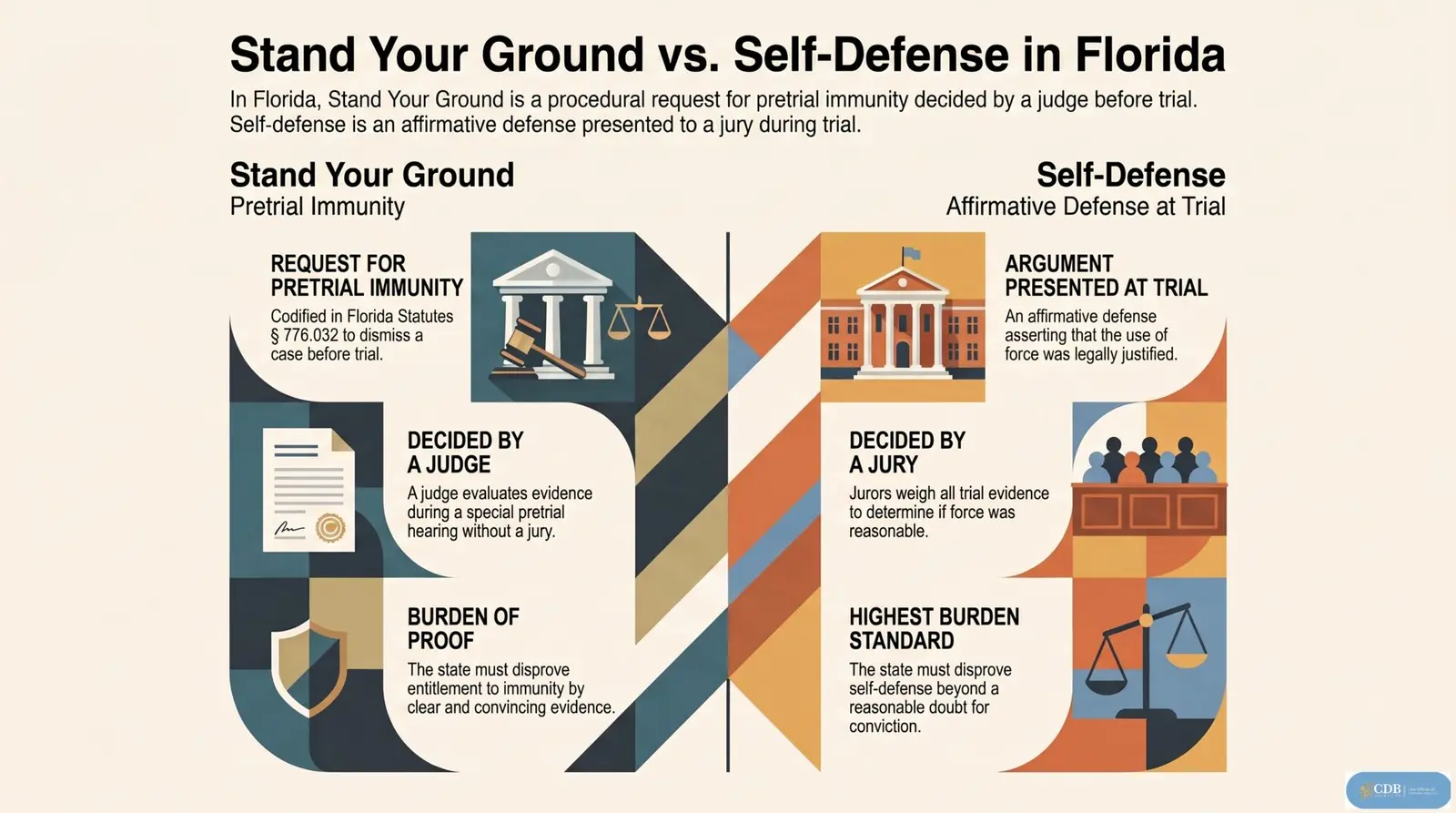
TL;DR: In Florida, “Stand Your Ground” is a request for pretrial immunity that can stop a case before it ever goes to a jury. Traditional self-defense is an argument you make to a jury at trial to show your actions were justified. While both rest on the same principles, they are used at different times, involve different standards of proof, and carry vastly different consequences for your future.
An act of self-defense can happen in an instant, but the legal aftermath can feel like a lifetime. You believed you had no choice but to use force to protect yourself or your family. Now you find yourself caught in a legal system that feels confusing and hostile. You hear terms like “Stand Your Ground” and “self-defense,” but the distinction is unclear, and the stakes could not be higher. That uncertainty is terrifying when your freedom is on the line.
Understanding these two legal paths is the first step toward reclaiming control. One path can stop a prosecution in its tracks, shielding you from the trauma and expense of a trial. The other requires convincing a jury that your actions were lawful. At CDB Injury Law, we do not just see a case; we see a person in crisis. We are here to bring clarity to the chaos and guard your rights at every turn.
Stand Your Ground: Seeking Pretrial Immunity Under Florida Law
Think of Florida’s Stand Your Ground law as a shield you can raise before the trial ever begins. Codified in Florida Statutes § 776.032, it provides a way to seek immunity from both criminal prosecution and civil lawsuits. It is not only about the right to stand your ground; it is a powerful legal tool that, if successful, can end the entire case before a jury is ever selected. The goal is to show a judge that the use of force was justified, making a trial unnecessary.
To do this, we file a motion asking for a special pretrial hearing. At that hearing, we must first present evidence that your actions were justified. Once that initial showing is made, the burden shifts to the prosecutor. Under Florida Statutes § 776.032(4), the state must then prove by “clear and convincing evidence” that you are not entitled to immunity. That is a significant hurdle for the state to clear, especially early in the case.
If the judge grants immunity, the case is over. The charges are dismissed, and you can begin to move forward with your life. This protection is one of the most important safeguards for people who have acted in lawful self-defense in Florida. If the judge denies immunity, the case proceeds toward trial, adding another layer of difficulty to your criminal defense.
What Is Required for Immunity?
To succeed on a Stand Your Ground immunity claim, the evidence at your pretrial hearing must show that your use of force was justified under Florida law. Depending on the facts, that generally means showing one of the following:
- You reasonably believed deadly force was necessary to prevent imminent death or great bodily harm to yourself or another, or to prevent the imminent commission of a forcible felony.
- You reasonably believed non-deadly force was necessary to defend against another person’s imminent use of unlawful force.
- You used force against someone who was unlawfully and forcefully entering, or had unlawfully and forcibly entered, your dwelling, residence, or occupied vehicle, which under Florida Statutes § 776.013 can create a presumption that your fear of death or great bodily harm was reasonable.
This hearing works something like a mini-trial, but a judge—not a jury—makes the decision. The strategic advantage can be immense. It offers a chance to end the legal nightmare without the risk, cost, and public scrutiny of a full trial.
Self-Defense: An Affirmative Defense at Trial
If Stand Your Ground immunity is not sought, or is denied by a judge, self-defense becomes a central issue for a jury to decide at trial. As an affirmative defense, it is a legal position that essentially says, “Yes, I used force, but I was legally justified in doing so.” The prosecution still carries the burden of proving you guilty beyond a reasonable doubt, and that includes disproving your claim of justified force.
At trial, the jury hears instructions on the same self-defense laws that apply in an immunity hearing. Jurors weigh all the evidence to decide whether your belief that force was necessary was reasonable under the circumstances. Florida’s rule that you have no duty to retreat before using force—if you are in a place you have a right to be and are not engaged in criminal activity—applies just as strongly at trial as it does in an immunity hearing.
Unlike the narrower immunity hearing, a trial involves the state presenting its entire case against you. Witnesses are cross-examined, evidence is challenged, and every detail is scrutinized. A “not guilty” verdict based on self-defense is a full acquittal, but it comes only after you have endured the emotional and financial toll of a complete criminal trial.
Different Burdens of Proof
The strategic choice between an immunity hearing and a trial defense often comes down to the different standards of proof. At an immunity hearing, once you present your initial evidence, the state must show by clear and convincing evidence that you are not entitled to immunity. That is a demanding standard for the prosecution to satisfy before trial.
At trial, the standard is higher still. Once self-defense is properly raised, the prosecutor must disprove it beyond a reasonable doubt as part of proving guilt. You do not have to prove that you acted in self-defense; the state has to prove that you did not. If reasonable doubt remains about whether your actions were justified, the jury must find you not guilty.
While the clear and convincing standard at an immunity hearing may look favorable to the defense, the process carries its own risks. A judge decides alone, without a jury’s perspective, and the evidence presented is often more limited than it would be at a full trial.
Making the Right Strategic Choice
You are not required to seek Stand Your Ground immunity. Filing for an immunity hearing is a major strategic decision. It generally requires showing your hand—revealing your theory of defense, your evidence, and sometimes your witnesses to the prosecution well before trial. If the judge denies immunity, the state may then have a roadmap of your defense. The denial itself is not evidence of guilt, but information disclosed during the hearing can shape how the state tries the case.
On the other hand, choosing not to request an immunity hearing preserves more of your strategy for trial and avoids the risk of an unfavorable pretrial ruling. Self-defense remains available at trial whether or not immunity was sought. The two paths are not mutually exclusive, but starting down the immunity path can affect your tactical options later.
Imagine you confronted an intruder in your home. If the evidence is clear—witnesses support your account, the physical evidence aligns, and your statements have been consistent—an immunity hearing could bring the case to an early end. But if the facts are murky, if the case turns on your word against another person’s, or if the evidence conflicts, taking the case to a jury may be the stronger course.
The right choice depends entirely on the specific facts of your case, the evidence available, and the risks of each path. There is no one-size-fits-all answer, which is why having an experienced guide matters so much.
Closing Remarks
Neither Stand Your Ground immunity nor a self-defense claim at trial gives anyone license to use force without justification. Both require that your actions were reasonable and that you were not the initial aggressor or engaged in criminal activity. The difference is not in the right to defend yourself, but in the legal process used to establish it. One path can stop the fight before it begins. The other asks a jury to make the final call. Your future depends on understanding which path fits your situation.
If you have been involved in a use-of-force incident, the hours and days that follow are filled with fear and uncertainty. Whether an immunity hearing is the right move or a trial is unavoidable, you deserve a defender who will stand beside you. At CDB Injury Law, Chris Debari has spent his career protecting people who felt powerless against a system stacked against them, including those facing charges involving claims of justified force in Florida. You do not have to face this alone. Contact us for a confidential consultation.
Frequently Asked Questions
Can I seek Stand Your Ground immunity after a trial has already started?
Generally, no. A Stand Your Ground immunity motion is a pretrial request and should be filed and heard before trial begins. Once the trial is underway, the opportunity for that pretrial hearing is ordinarily lost. Self-defense can still be argued to the jury, but the chance to have the case dismissed beforehand is gone.
If my immunity motion is denied, can I still argue self-defense at trial?
Yes. A denial of Stand Your Ground immunity does not prevent you from raising self-defense at trial. The standards are different. A judge deciding immunity applies a clear and convincing evidence standard to the state’s showing, while a jury must acquit if reasonable doubt remains about whether you acted in lawful self-defense. The judge’s pretrial ruling does not bind the jury.
What happens if the state challenges a judge’s decision to grant me immunity?
If a judge grants immunity and dismisses the charges, the state may seek appellate review of that ruling. While the appeal is pending, the dismissal stands. You remain free from prosecution unless a higher court reverses the judge’s decision and returns the case for further proceedings.
Is “no duty to retreat” the same as Stand Your Ground immunity?
No, they are related but different. The no-duty-to-retreat rule is part of Florida’s substantive self-defense law: if you are somewhere you have a lawful right to be and are not engaged in criminal activity, you are not required to retreat before using force. That rule applies both in immunity hearings and at trial. Stand Your Ground immunity is the separate legal procedure that lets you ask a judge to dismiss the case before trial based on a justified use of force.
Can I claim immunity for using non-deadly force?
Yes. Florida’s immunity statute applies to the justified use or threatened use of both deadly and non-deadly force. If the force you used was legally justified under Florida’s statutes, you may seek pretrial immunity from prosecution regardless of the level of force involved.
References
-
- Florida Statutes § 776.012. Use or threatened use of force in defense of person
- Florida Statutes § 776.013. Home protection; use or threatened use of deadly force; presumption of fear of death or great bodily harm
- Florida Statutes § 776.031. Use or threatened use of force in defense of property
- Florida Statutes § 776.032. Immunity from criminal prosecution and civil action for justifiable use or threatened use of force