
- Florida Statutes § 921.0024 (Criminal Punishment Code; worksheet computations): Available at The 2023 Florida Statutes.
- Florida Statutes § 921.0026 (Mitigating circumstances): Available at The 2023 Florida Statutes.
References - Florida Statutes § 921.0026
Florida’s Criminal Punishment Code is not always the final word. A judge may impose a sentence below the lowest pe rmissible sentence if specific, compelling reasons, known as grounds for departure, are proven and properly recorded. Securing this kind of relief requires a strong, well-documented legal argument, and understanding the process can make a significant difference in the outcome of a case.
While our name, CDB Injury Law, reflects our deep roots in helping those harmed by negligence, our founding mission has always been broader: to stand up for people facing overwhelming legal challenges. Attorney Chris Debari has dedicated his career to protecting the rights of individuals in crisis, whether they are navigating a personal injury claim or the complexities of the criminal justice system. Our approach is the same, to restore control and peace of mind when everything feels uncertain.
When a sentencing scoresheet produces a number that feels disconnected from the human reality of a situation, it can be deeply unsettling. The scoresheet is a starting point, but it was never intended to erase critical context. A downward departure exists for cases that don’t fit the mold, where cooperation helped resolve a case, a mental health condition influenced behavior, or the circumstances are so unusual that a standard sentence would be unjust. The challenge isn’t just knowing these options exist; it’s about building the factual and legal foundation to support them. Many opportunities for a reduced sentence are lost simply because the facts weren’t properly documented or argued in a way the law recognizes.

Florida’s criminal sentencing system uses a scoresheet to calculate the lowest permissible sentence. This calculation is based on the seriousness of the offense, any victim injury, prior convictions, and other legal factors. To go below that calculated sentence, a judge needs a valid legal reason. The court cannot simply disagree with the outcome; it must identify a legally recognized mitigating circumstance and make a record of the facts supporting that decision. Without both, the reduced sentence can be vulnerable on appeal.
Grounds for a Downward Sentencing Departure
Florida Statutes § 921.0026 lists mitigating circumstances that may allow a court to sentence someone below the lowest permissible sentence. A judge can’t lower a sentence just because they feel sympathetic; the reasons must be legally valid and supported by evidence presented to the court.
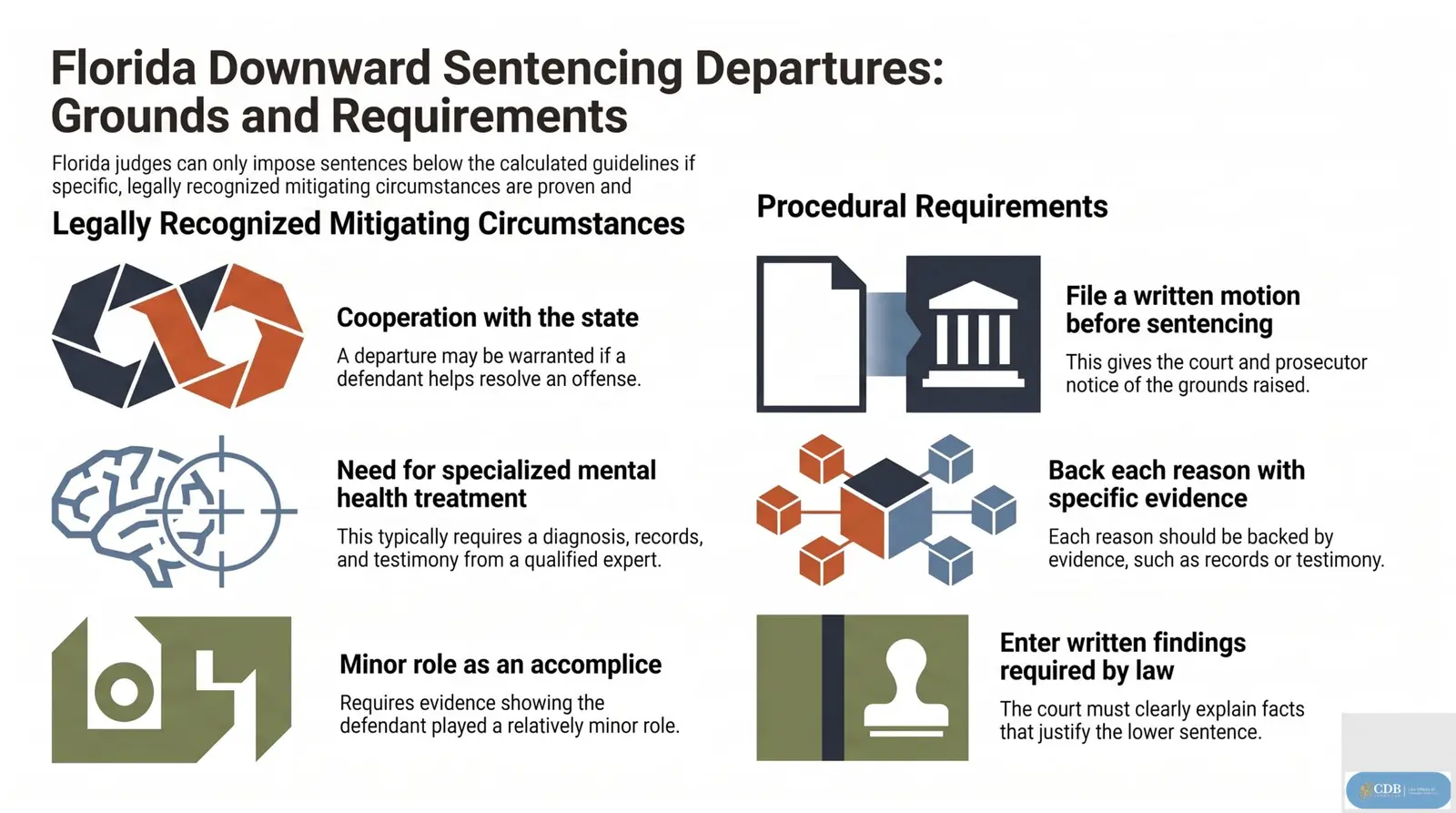
- Cooperation with the state: If a defendant helps resolve the current offense or another offense, a departure may be warranted. Prosecutor support is often very important, but the key issue is whether the cooperation is real, documented, and meaningful.
- Need for specialized mental health or disability-related treatment: A court can depart if the defendant requires specialized treatment for a mental disorder unrelated to substance abuse or addiction, or for a physical disability, and is amenable to treatment. This typically requires a diagnosis, records, and testimony from a qualified expert.
- Legitimate plea bargain: If the prosecutor and defense agree on a sentence below the calculated sentence as part of a legitimate, uncoerced plea bargain, the court may approve it.
- Minor role as an accomplice: If the defendant was an accomplice and played a relatively minor role in the crime, a departure may be appropriate. This requires more than just the defendant’s word for it; there must be evidence of their limited involvement.
- Impaired capacity: This ground applies when the defendant’s ability to appreciate the criminal nature of the conduct or conform their conduct to the requirements of the law was substantially impaired.
- Need for substance abuse treatment: While addiction alone does not automatically justify a lower sentence, a departure may be possible if the defendant is amenable to treatment and a structured program can be made part of the sentence.
- Age, physical condition, or unusual hardship: A departure may be supported when age, serious illness, disability, or another unusual circumstance makes the standard sentence disproportionate and a safe treatment or supervision plan is available. This requires solid evidence, not general hardship alone.
For any of these grounds, the court must clearly explain the facts that justify the lower sentence and enter the written reasons required by Florida sentencing law. Vague or unsupported reasons will not hold up on appeal.
Substantial Assistance and Cooperation Departures
Departures based on cooperation with law enforcement or the prosecution are common, but they must be handled carefully. Florida law recognizes cooperation as a potential mitigating circumstance when the defendant helps resolve the current offense or another offense. In practice, the prosecutor’s acknowledgment of that help can carry significant weight because the state is usually in the best position to explain what the cooperation accomplished.
Meaningful cooperation means more than sharing a few names or making vague claims. The help should have practical value, such as confirming facts, identifying another participant, recovering property, preventing further harm, or helping resolve another case. A defense attorney should document every instance of cooperation and make sure its value is presented clearly before the sentencing hearing.
Even when the state supports a cooperation-based departure, the amount of any sentence reduction is not guaranteed. The judge decides how much weight the cooperation deserves. The court may consider how important the information was, whether the defendant faced any risk in providing it, and how much it helped the investigation or prosecution. A defendant who masterminded a crime will be viewed differently than a minor participant who came forward with information early on.
Mental Health and Capacity-Based Departures
To receive a departure based on mental health or impaired capacity, there must be proof that clearly connects the condition to the legal ground being argued. A simple diagnosis of anxiety or depression is not enough. The law is focused on serious circumstances where specialized treatment is needed, where a physical disability requires a different sentencing approach, or where the defendant’s ability to appreciate the criminal nature of the conduct or conform their conduct to the law was substantially affected.
Expert testimony from a qualified clinician is almost always essential. The expert should review the facts of the case, the defendant’s history, and available treatment options. They need to explain to the court whether the condition was active at the relevant time, how it affected the defendant’s judgment or needs, and whether treatment in the community is a safe and viable alternative to prison.
The law makes a clear distinction between mental disorders and substance abuse. An addiction alone will not qualify as a mental health departure, though it may support a different departure based on substance abuse treatment if the facts meet the legal standard. If a defendant has both a mental health condition and an addiction, a departure may still be possible if the mental health issue is a significant, independent factor.
Youthful Offender and Age-Related Departures
A defendant’s age can matter in different ways. For young people, the argument often centers on immaturity, reduced judgment, vulnerability to peer pressure, and greater potential for rehabilitation. For older or medically fragile defendants, the argument may focus on whether the standard sentence would be unusually harsh and whether public safety can be protected through treatment, supervision, or another lawful sentence.
For younger defendants, the law may consider whether the person was too young to appreciate the consequences of their conduct. This doesn’t excuse the conduct, but it views the case through the lens of age and development. A 19-year-old who planned a complex fraud is seen differently than one who got caught up in a group assault under pressure from others.
For older or physically ill defendants, the argument is based on individualized facts. A terminal illness or severe disability can make a prison sentence especially harsh and may serve little purpose if a safe, medically supported alternative exists. This requires medical records and evidence showing what care the person needs, what the prison system can or cannot realistically provide, and how the person could be supervised in the community.
Understanding how different legal tools intersect, such as the role of a criminal defense strategy in preserving mitigating evidence early, is often the difference between a successful departure motion and one that fails for lack of record support. Similarly, defendants who are weighing plea offers and considering whether to proceed to trial should understand how early case resolution through plea negotiations can sometimes unlock departure options that may be harder to pursue after a conviction at trial.
Procedural Requirements and Preserving Your Rights
A request for a downward departure should be made clearly and supported with specific legal and factual reasons. In most cases, the safest practice is to file a written motion before sentencing so the court and prosecutor have notice of the grounds being raised. Vague requests that list multiple grounds without supporting details are likely to fail. Each reason should be backed by evidence, such as affidavits, medical records, expert reports, treatment plans, or witness testimony.
The prosecutor has a right to respond, and the judge may hold a hearing if there are factual disputes. During the hearing, witnesses can testify and be cross-examined. While a defendant’s own testimony about remorse or personal history may be relevant, it is much stronger when supported by evidence from family members, employers, treatment providers, or other reliable sources.
If the judge grants the departure, the court must identify the valid ground and make the written findings required by Florida law. If the motion is denied, the record should show that the court understood its authority, considered the request, and made a ruling. That record matters because appellate review is limited, especially when the judge had discretion and simply chose not to depart.

Arguing for a sentencing departure is not a last-minute plea for mercy. It is a structured legal process that demands thorough investigation, careful documentation, and strategic presentation. The grounds for a lower sentence exist in the law, but they are only as powerful as the evidence that supports them. When that evidence is built carefully and presented clearly, a departure can change the course of a person’s life.
Closing Remarks
Facing a sentencing hearing can feel like the final, frightening step in a long process. But if your situation involve s circumstances the scoresheet doesn’t account for, like a mental health struggle, cooperation with aut horities, treatment needs, or other unique factors, there may still be a path toward a better outcome. You do not have to face this alone. At CDB Injury Law, we are here to ensure your full story is heard and fight for a just result. Contact us to talk about your case and explore every available option.
Frequently Asked Questions
Can a judge depart downward from the sentencing guidelines without a motion?
Florida law focuses on whether a valid departure ground exists, whether the facts support it, and whether the court makes the required record. Still, the defense should not rely on the judge to raise the issue alone. A clear written motion is the best way to give the prosecutor notice, preserve the argument, and make sure the court has the evidence it needs to consider a lawful downward departure.
Does cooperation with law enforcement guarantee a sentencing departure?
No, cooperation does not guarantee a departure, it only creates a possible basis for one. Even when the prosecutor acknowledges your assistance, the judge still has the final say on whether to grant a departure and how far to reduce the sentence. The court will weigh the importance of your help, the seriousness of your own offense, your criminal history, and whether the cooperation produced meaningful value. Providing minor information may result in little or no benefit.
What happens if the court denies a departure motion?
If the court considers and denies a departure motion, the defendant will generally be sentenced at or above the lowest permissible sentence unless another lawful sentencing option applies. Appealing a denial can be difficult because appellate courts usually do not second-guess a judge’s discretionary refusal to depart. An appeal is more realistic when the judge misunderstood the law, believed incorrectly that departure was unavailable, or failed to rule on a properly raised issue.
Can multiple departure grounds be raised in the same motion?
Yes, and it is often a good strategy to assert every ground that the facts support. However, each ground should be argued separately with its own evidence and legal support. Simply listing many potential reasons without backing them up can weaken the overall argument. A focused motion with two well-supported grounds is usually more effective than one with six grounds that are not fully developed.
Is a departure different from a withhold of adjudication?
Yes, they are two different legal tools. A departure reduces the length or severity of a sentence below the lowest permissible sentence. A withhold of adjudication means the court does not issue a formal conviction, which can help a person avoid some collateral consequences of a criminal record. A judge can grant a departure and still enter a conviction, or they can withhold adjudication while imposing a lawful sentence. They address different aspects of the case’s final outcome.
References
- Florida Statutes § 921.0024 ((Criminal Punishment Code; worksheet computations): 2023 Florida Statutes).
- Florida Statutes § 921.0026 ((Mitigating circumstances): 2023 Florida Statutes. References).