

Florida’s Criminal Punishment Code assigns point values to offenses and aggravating factors that mathematically determine the minimum permissible prison sentence. Prior convictions, victim injury, firearm possession, legal status violations, sentencing multipliers, and other statutory factors each add points or increase the total in ways that can transform what might have been probation into mandatory incarceration. Understanding which points apply, and which can be challenged, shapes the entire trajectory of a criminal case.
The scoresheet arrives before sentencing, a grid of numbers that reduces months and years of liberty to arithmetic. Each line represents a statutory factor: the primary offense, prior record, victim injury, legal status violations. The total drives the minimum sentence the court must impose unless extraordinary circumstances justify departure. By the time most defendants see the calculation, the points have already accumulated beyond the threshold that mandates prison time. The moment to contest the math, or the facts feeding it, closes quickly.

How the Criminal Punishment Code Calculates Sentence Recommendations
Florida Statutes § 921.0024 establishes the Criminal Punishment Code, a point-based system that assigns numerical values to offenses and circumstances. Each felony conviction or pending charge receives points corresponding to its offense severity level, a ranking from 1 to 10. The primary offense, the most serious charge in the current case, anchors the scoresheet. Additional charges, prior convictions, and statutory enhancements add layers of points that compound quickly.
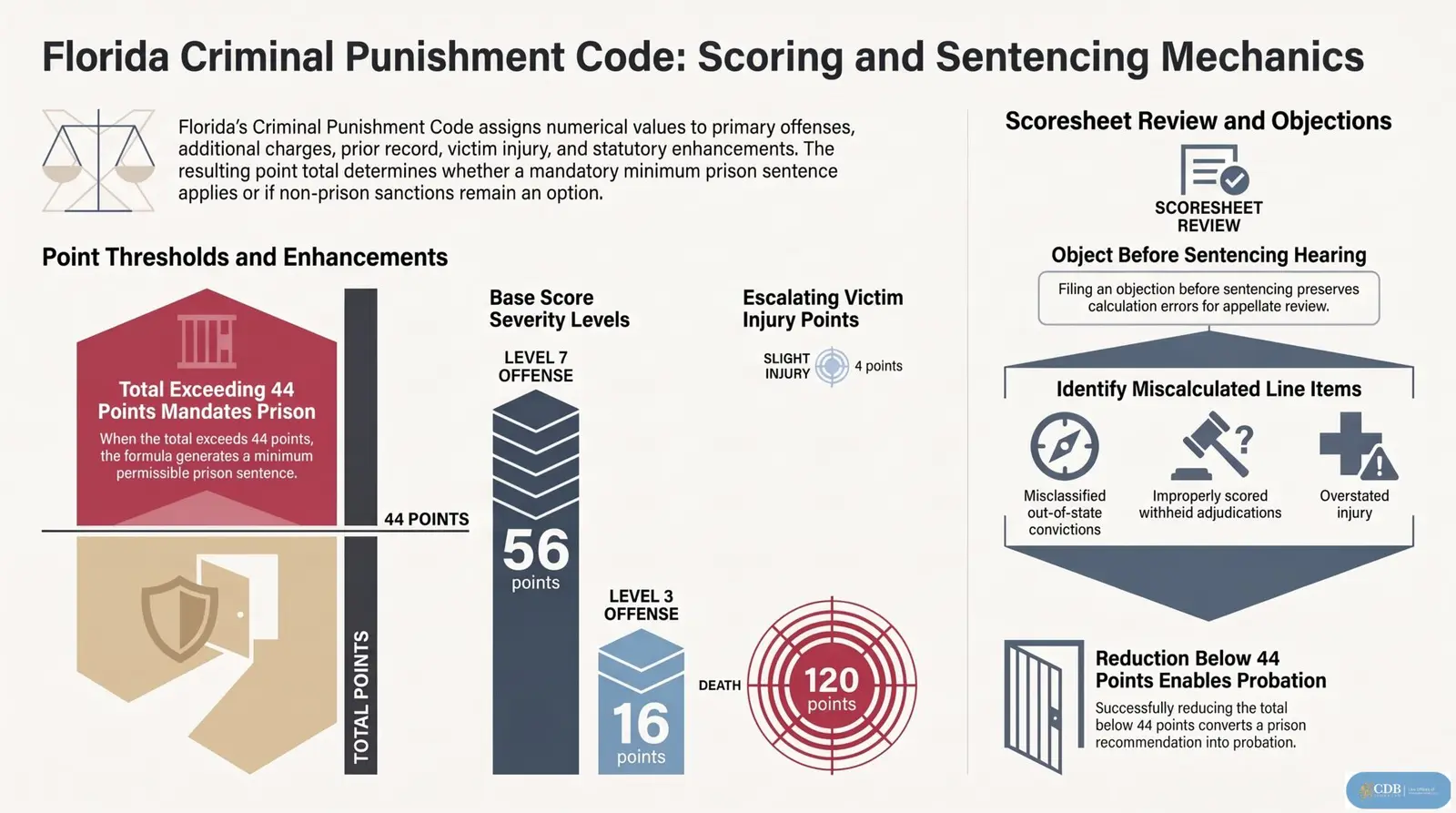
When the total exceeds 44 points, the formula generates a minimum permissible prison sentence measured in months. Below that threshold, non-prison sanctions remain available. A defendant with a single third-degree felony and no prior record typically falls below the mandatory incarceration line. Add a prior conviction, victim injury, or firearm, and the calculation crosses into prison territory. The mathematics are unforgiving: each point category either applies or it does not, and once applied, the points rarely disappear without a fight.
Primary Offense and Additional Offense Points
The primary offense drives the base score. A level 7 offense (such as aggravated battery) might carry 56 points. A level 3 offense (such as grand theft in the third degree) carries 16. Additional offenses charged in the same case, or otherwise pending before the court for sentencing, also add points, though at a lower multiplier. Each additional count compounds the total, converting what appears on paper as multiple incidents into a cumulative sentence calculation that often surprises defendants who believed each charge would be addressed separately.
Prosecutors control which charges to file and which to drop. A negotiated reduction from a level 8 to a level 5 offense can subtract dozens of points and pull the total beneath the incarceration threshold. The decision to pursue multiple counts versus a single consolidated charge directly affects the scoresheet, which is why criminal defense strategy begins long before sentencing. It starts at charging.
Victim Injury Points and Their Escalation
Victim injury points trigger when the offense results in physical harm. The statute distinguishes between injury categories:
- No injury: zero additional points
- Slight injury: 4 points
- Moderate injury: 18 points
- Severe injury: 40 points
- Death: 120 points
- Sexual penetration or contact: 80 points for penetration, 40 for contact
The definitions rest on medical evidence and witness testimony. A bruise may qualify as slight; a broken bone as moderate; permanent impairment or disfigurement as severe. The State need not prove injury beyond a reasonable doubt at trial if the defendant pleads; the court determines injury level at sentencing based on a preponderance of evidence. A contested injury classification can shift the total by 36 points, the difference between probation and years in prison.
Medical records, photographs, and victim statements shape the injury determination. Challenges to classification require affirmative presentation of contrary evidence. Silence often leaves the State’s characterization unchallenged. When the injury enhancement alone would push the score above 44 points, contesting the severity level becomes dispositive.
Prior Record and Legal Status Violations
Prior record points are assigned for qualifying prior convictions based on the offense level or classification used under Florida’s Criminal Punishment Code. Felonies add points, and some prior misdemeanor or criminal traffic dispositions may also score at lower values. Florida also has separate scoring rules for certain prior serious felonies and prior capital felonies when statutory conditions are met. The key issue is not simply whether a person has a record, but whether each prior disposition legally qualifies and has been assigned the correct Florida severity level.
Legal status violations add 4 points when the defendant commits the offense while under a qualifying legal status, such as felony probation, community control, incarceration or escape status, pretrial intervention or diversion, conditional release, control release, parole, or another status identified by statute. The violation need not be technical; committing a new offense while under a qualifying form of supervision can trigger the enhancement. Stacking legal status points with prior record points can add meaningful weight before victim injury, weapon points, or sentencing multipliers enter the picture.
Related article: Bond Hearings in Florida: Arrest to Release explores how prior record and legal status influence pretrial detention, a preview of their role at sentencing.
Firearm, Semiautomatic Weapon, and Law Enforcement Victim Enhancements
Florida’s scoresheet imposes weapon points in specific circumstances. Under Florida Statutes § 921.0024, if a defendant is convicted of committing or attempting a felony while possessing a firearm, and the offense is not one already covered by the listed mandatory-minimum firearm offenses in § 775.087(2), the scoresheet may add 18 points. Possession of a qualifying semiautomatic firearm with a high-capacity detachable magazine, or a machine gun, may add 25 points instead. Discharge or use of a firearm can create separate mandatory-minimum consequences under Florida’s firearm statutes, but discharge is not the same thing as the 25-point semiautomatic or machine-gun scoresheet category.
Protected-victim status for law enforcement officers and related public-safety personnel is also not a simple flat-point add-on in every case. Florida uses sentencing multipliers for certain qualifying offenses against protected officials or personnel, which can dramatically increase the subtotal. Whether the multiplier applies depends on the statute, the protected status of the victim, the nature of the offense, and the facts establishing the required connection to that status.
The factual predicate for each enhancement must appear in the record. Stipulations at plea, trial evidence, or sentencing testimony provide the foundation. Challenging enhancements requires disputing the underlying facts before the court accepts them as established. Once incorporated into a plea colloquy or sentencing order, retroactive challenge becomes procedurally difficult.
Drug Trafficking and Other Statutory Multipliers
Drug trafficking offenses carry consequences beyond ordinary offense-level scoring. Florida Statutes § 893.135 defines trafficking thresholds, including 28 grams of cocaine, 4 grams of certain opiates, and 14 grams of hydrocodone. Trafficking charges often carry mandatory minimum sentences independent of the scoresheet, and the Criminal Punishment Code may also apply a drug-trafficking multiplier when authorized. A defendant facing a three-year mandatory minimum may discover that the scoresheet independently produces a higher minimum permissible sentence, leaving the court bound by the higher lawful sentencing floor unless a valid departure or statutory exception applies.
Certain offense categories, such as sexual offenses involving minors, human trafficking, home invasion robbery, and carjacking, often carry high severity rankings, mandatory minimums, or statutory multipliers. The cumulative effect can push scoresheets into triple digits. In those cases, the practical pathway to a non-prison sanction usually depends on reducing, dismissing, or defeating the charges or enhancement facts that drive the calculation.
Challenging Scoresheet Calculations Before Sentencing
The State prepares the initial scoresheet, often before plea negotiations conclude. Defense review identifies calculation errors: incorrect offense levels, double-counted prior convictions, inapplicable enhancements. A prior conviction from another state may have been misclassified; a withhold of adjudication may have been incorrectly scored; victim injury may have been overstated.
Filing an objection to the scoresheet before sentencing preserves the issue for appellate review. Silence can make later relief harder, especially when the error depends on facts that should have been developed at the sentencing hearing. The objection must identify the specific line item, cite the controlling statute, and propose the corrected calculation. Courts resolve factual disputes through testimony and documentary evidence at the sentencing hearing. A successful challenge that reduces the total below 44 points converts a prison recommendation into a probationary case.
Scoresheet errors are not rare. Automated systems pull criminal histories that include out-of-state convictions, sealed records, or charges that were dismissed. Each misapplied point has a statutory basis or it does not. The defense must identify the error and force the issue into the open; once the court determines that points were incorrectly assessed, the scoresheet must be recalculated.

Sentencing guidelines compress human circumstances into columns and rows, but the points themselves derive from statutes, factual findings, and procedural choices made weeks or months before the sentencing hearing. The calculation is neither automatic nor unreviewable. It is a legal determination subject to challenge, correction, and occasionally, reversal. The difference between 43 points and 45 points is the difference between walking out of the courtroom and walking into a cell.
Closing Remarks
If the scoresheet shows victim injury points that conflict with the medical evidence, if prior dispositions are pulling in points from offenses that were dismissed or incorrectly classified, or if weapon enhancements are based on possession never proven at plea, the calculation is not final until the court adopts it. CDB Injury Law represents individuals facing sentencing in Florida criminal cases, challenging scoresheet errors and pursuing departures when the guidelines do not fit the facts. Contact us to review your sentencing calculation before the hearing date arrives.
Frequently Asked Questions
Can prior convictions from other states add points to a Florida scoresheet?
Out-of-state convictions can add points if they would constitute felonies under Florida law. The State must establish the elements of the foreign conviction and demonstrate equivalency to a Florida offense level. Misclassification is common; what appears as a felony in another jurisdiction may be a misdemeanor in Florida, and vice versa. Challenging the classification requires comparing statutory elements, not just conviction labels. Courts resolve disputes based on the record of conviction: the charging document, plea colloquy, and judgment. If the foreign record is incomplete or ambiguous, the State may fail to carry its burden, and the points drop.
Do withhold of adjudication entries count as prior convictions for scoring purposes?
Often, yes. For Criminal Punishment Code purposes, Florida defines a conviction as a determination of guilt by plea or trial, regardless of whether adjudication is withheld. That means a prior Florida withhold can be scored when it otherwise meets the statutory definition of prior record. The closer questions are whether there was actually a determination of guilt, whether the prior offense occurred before the current primary offense, whether the disposition has been assigned the correct Florida offense level, and whether the record being used by the State proves those facts. Dismissed charges, diversionary resolutions without a qualifying determination of guilt, and incorrectly classified out-of-state dispositions should not be treated the same as scoreable convictions.
What happens if the scoresheet is corrected after sentencing has already occurred?
A defendant sentenced based on an incorrect scoresheet may have avenues for relief, but the correct procedure depends on the error’s nature and timing. Florida Rule of Criminal Procedure 3.800(a) allows a court to correct an illegal sentence, and also an incorrect scoresheet calculation, at any time when the error is apparent from the face of the record and court records. Rule 3.800(b) addresses sentencing errors during the appeal window and carries strict timing requirements. If the mistake requires factual development outside the existing record, a different postconviction procedure and deadline may apply. The practical point is simple: scoresheet errors should be raised as early as possible, before sentencing when they can be corrected cleanly.
Do firearm enhancements apply even if the firearm was never used or displayed?
Yes, in qualifying cases. Florida’s scoresheet weapon points focus on possession during the offense, not just use or display. Constructive possession, having the firearm within reach or control during the criminal act, may support weapon points if the State proves the required connection. A firearm found in a co-defendant’s bag during a joint drug transaction may support an enhancement if the defendant exercised control over the bag or knew the firearm was present. The State must prove possession by a preponderance of evidence at sentencing. Challenging the enhancement requires disputing the factual basis: lack of knowledge, absence of control, or no temporal connection between firearm presence and the offense. If the firearm was discovered during an unlawful search, suppression may eliminate the factual predicate entirely, removing the enhancement before the scoresheet is calculated.
References