


In Florida, the chance to enter a pretrial diversion program can be a fast-closing window. Eligibility is often evaluated soon after formal charges are filed, sometimes before or around the first court date (arraignment). Missing local application deadlines, statutory criteria, prior-record limits, or prosecutor-imposed requirements can remove diversion as an option and leave the case to proceed through ordinary prosecution.
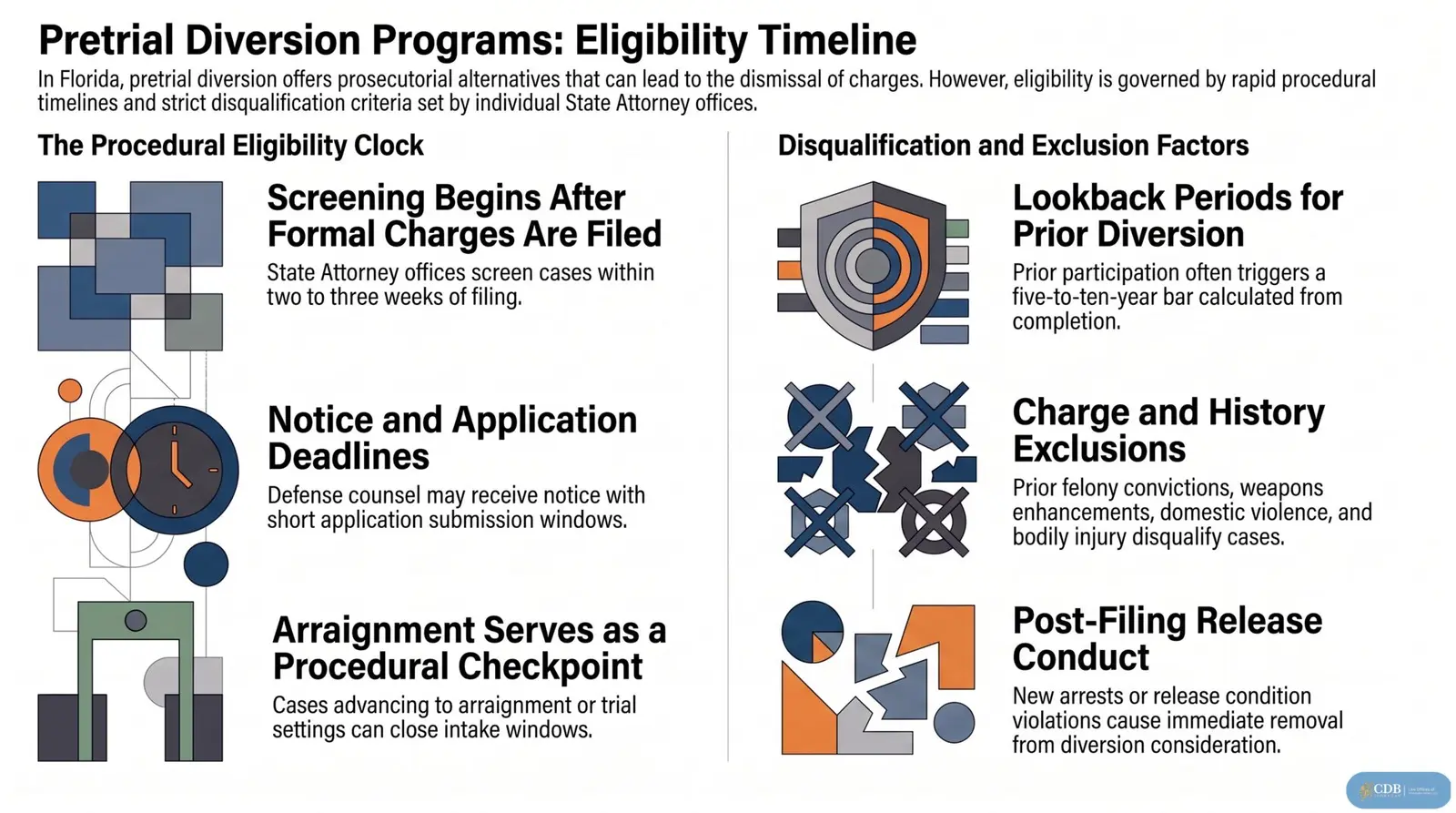
When you are charged with a crime, your world can feel like it’s shrinking. The legal process moves forward with or without you, and crucial opportunities can disappear before you even understand what they are. One of the most important of these is pretrial diversion, a path that can lead to the dismissal of your charges without the stain of a conviction. But this path is not open indefinitely. In Florida, the eligibility timeline is often swift and unforgiving, sometimes measured in weeks, and, once notice is given, in days. Understanding this clock is the first step toward reclaiming control of your future.

Pretrial diversion programs are prosecutorial alternatives to traditional adjudication. They allow eligible defendants to complete conditions, community service, restitution, treatment, educational courses, or other program requirements, in exchange for dismissal of charges. Florida Statutes authorize certain pretrial intervention and diversion options, but they do not guarantee admission in every eligible case. That authorization leaves State Attorneys with substantial discretion over who qualifies, when applications are accepted, and what the timeline looks like in practice.
When the Eligibility Window Opens
For many diversion programs, the practical clock begins at filing, not at arrest. Once formal charges appear in the court system, the State Attorney’s Office may review the case for program eligibility. In many circuits, diversion screening occurs within the first two to three weeks after charges are filed. Some jurisdictions conduct initial eligibility assessments before arraignment; others require defense counsel to submit a formal application within a set number of days.
The timeline varies by judicial circuit, but the pattern is consistent: diversion decisions happen early. Waiting until a case “develops” or until discovery is complete can mean waiting too long. By the time a defendant appears for arraignment, the window may already be narrowed or closed under local program rules. Prosecutors move quickly through screening criteria, and once a case is coded as ineligible or routed to the trial docket, reversing that decision can become difficult.
Consider a hypothetical: A defendant is charged with petit theft on March 1. The State Attorney’s diversion unit screens the case on March 10 and flags it as eligible based on charge type and criminal history. Defense counsel receives notice on March 15 with a deadline to submit the application by March 22. Arraignment is set for March 29. If the defendant delays the application until after arraignment, the program may no longer accept it. The seven-day window between notice and deadline may be the entire opportunity.
Statutory and Policy Exclusions That Shorten or Close the Timeline
Even when a case enters the system within the general diversion timeframe, statutory criteria and policy-based exclusions can eliminate eligibility quickly. Florida law does not provide one universal eligibility standard for every diversion program; each State Attorney’s Office uses its own criteria within the bounds of governing law. Common exclusions or limiting factors include:
- Prior felony convictions
- Prior diversion participation within a specified lookback period, often five or ten years
- Charges involving serious bodily injury to a victim
- Firearms or weapons enhancements
- Domestic violence allegations, even when charged as misdemeanors
- DUI offenses, particularly repeat DUI
- Sexual offenses or offenses requiring sex offender registration
These exclusions are not always apparent from the charge title alone. A battery charge may appear eligible on its face, but if the probable cause affidavit documents substantial injury, weapon use, or other aggravating facts, the case may be disqualified under local policy. The timeline for diversion eligibility, in such cases, may never meaningfully open.
Because diversion screening relies heavily on the defendant’s criminal history and the specifics of the current charge, delays in confirming a complete record can compress the timeline further. A defendant with out-of-state priors, older records, or sealed or expunged matters that require legal review may find that eligibility cannot be confirmed until weeks after filing, leaving little time to prepare and submit the application before the program closes intake.
The Role of Arraignment in Closing the Door
Arraignment serves as a procedural checkpoint. Under Florida Rule of Criminal Procedure 3.160, the defendant is called upon to plead, and the case proceeds to pretrial or trial settings. Arraignment does not automatically end diversion eligibility in every Florida circuit, and many defendants enter not guilty pleas while negotiations continue. Still, some diversion programs require application before arraignment or before the case advances too far into the adversarial track.
Some jurisdictions allow continuances of arraignment to preserve diversion eligibility. Defense counsel may request additional time to gather documentation, complete intake interviews, or finalize the application. Judges vary in their willingness to grant such continuances, and prosecutors may object if they believe the request is dilatory. The result is a narrow margin: in some cases, diversion applications must be submitted, reviewed, or approved before the defendant’s first court appearance.
In circuits that permit post-arraignment diversion referrals, the timeline does not disappear entirely; it can contract. Programs may impose earlier deadlines for applications filed after arraignment, or require additional approvals from supervisory prosecutors. Each procedural step adds delay, and delay erodes opportunity. For more context on what occurs during arraignment and how plea entry affects case trajectory, see Arraignment in Florida: What Happens and When.
How Prior Participation Resets the Clock
Defendants who successfully completed pretrial diversion in the past face lookback periods that vary by program. A common standard is a five-year bar: if the defendant completed diversion within the preceding five years, the current case is ineligible. Some programs extend that bar to ten years or impose a lifetime prohibition on repeat participation.
The lookback is usually calculated from the date of completion, not the date of arrest or charge in the earlier case. A defendant who finished diversion in July 2019 and is arrested in February 2024 may still fall within a five-year window and be excluded. The timeline for eligibility, in this scenario, does not open until the lookback period expires, and by then, the current case may already have proceeded toward resolution.
Application Deadlines and Required Documentation
Pretrial diversion is not automatic. It requires a formal application, often including:
- A written statement or personal narrative
- Proof of employment, enrollment, or community ties
- Letters of recommendation
- Substance abuse or mental health evaluations, if relevant
- Payment of an application or program fee, where required
Assembling this documentation takes time. Defendants who learn of diversion eligibility only days before the application deadline face a compressed preparation window. Missing a required document can result in an incomplete application, which programs may reject rather than hold open for supplementation.
Some circuits require that defendants complete an intake interview with a diversion coordinator before the application is considered. Scheduling that interview, especially in high-volume jurisdictions, can add a week or more to the process. The application deadline may not extend to accommodate scheduling delays, and once the deadline passes, the opportunity can be lost.
Programs may also require that restitution be quantified and agreed upon before diversion is finalized. If the victim’s losses are still being calculated, or if the defendant disputes the amount, the case may remain ineligible until restitution is resolved. That dispute can outlast the diversion timeline entirely, forcing the case into plea negotiations or trial preparation. For insight into how plea negotiations operate once diversion is no longer available, see Plea Negotiations: Offers and Deadlines.
Post-Filing Developments That Can Disqualify a Defendant
Eligibility is not static. Events that occur after charges are filed can disqualify a defendant from diversion, even if the application was submitted on time. New arrests, violations of pretrial release conditions, positive drug screens, or failures to appear can all trigger immediate removal from diversion consideration.
Some programs require that the defendant remain arrest-free not only during the application period but throughout the pendency of the diversion agreement. A subsequent arrest, even for an unrelated minor offense, can result in termination and reinstatement of the original charges. The timeline for diversion, in such cases, extends beyond intake and acceptance; it governs conduct for months.
Defendants on pretrial release with special conditions, GPS monitoring, no-contact orders, travel restrictions, must comply fully during the diversion application and review period. A single violation, even technical, can close the door. Prosecutors often view compliance during the application phase as a predictor of compliance with diversion conditions. Any lapse may be treated as disqualifying.

Access to diversion is often not just a question of the facts of the case. It can also be a question of timing, documentation, and the narrow procedural windows that open and close soon after charges are filed. Those windows do not wait for clarity or for a defendant to feel ready. They operate on the court’s calendar, not the defendant’s.
Closing Remarks
When you’re facing a criminal charge, the path forward can seem uncertain and intensely lonely. The deadlines for programs like pretrial diversion are strict, and a missed opportunity can change the course of your life. You do not have to navigate this complex system alone. While our name, CDB Injury Law, speaks to our long history of helping the physically injured, our founding mission is to restore hope for anyone feeling powerless, including those facing the Florida justice system. We believe in protecting your future. Let us talk about your options and ensure no door closes before you have the chance to walk through it.
Frequently Asked Questions
How soon after arrest can a defendant apply for pretrial diversion?
Application timelines generally begin after formal charges are filed or after the prosecutor makes a diversion referral, not at arrest. Many programs screen cases within two to three weeks of filing and set application deadlines shortly thereafter. Defendants should begin gathering documentation and consulting with counsel as soon as charges appear in the court system, ideally before arraignment is scheduled.
Can a defendant apply for diversion after entering a not guilty plea at arraignment?
Eligibility after arraignment depends on the judicial circuit and the specific program. Some programs require application before arraignment or before a plea is entered; others allow post-arraignment applications but impose stricter deadlines or additional approval requirements. Continuances of arraignment are sometimes granted to preserve eligibility, though judges and prosecutors vary in their willingness to delay proceedings for diversion purposes.
What happens if a defendant misses the diversion application deadline?
Missing the deadline can result in ineligibility for that case. Pretrial diversion is generally a prosecutorial discretion program, and once the case proceeds beyond the intake window, it may be coded for traditional prosecution. Late applications are rarely accepted unless local policy allows an exception. The case then proceeds through arraignment, discovery, and either plea negotiations or trial.
Does prior successful completion of diversion prevent future eligibility?
Yes, in many circuits. Programs impose lookback periods that may range from five to ten years, often calculated from the date of prior diversion completion. Some programs prohibit repeat participation, regardless of time elapsed. A defendant with a prior diversion on record should verify the applicable lookback period immediately upon new charges, as eligibility may be foreclosed before the application process even begins.
Can charges be amended to restore diversion eligibility if the original charge was disqualifying?
Charge amendments are within prosecutorial discretion and are not automatic. If the original charge carries a statutory or policy exclusion, such as a domestic violence designation or a firearm enhancement, prosecutors may agree to amend the charge as part of diversion negotiations, but only if the evidence supports a lesser charge and the victim’s position is considered under applicable law and policy. Charge amendments for the sole purpose of securing diversion eligibility are uncommon and require negotiation early in the case timeline.
Are there diversion options available after arraignment if the pretrial window has closed?
Some jurisdictions offer deferred prosecution agreements, treatment court options, or post-plea programs that function similarly to pretrial diversion but occur later in the case timeline. These programs are less common, may require a plea or admission to be held in abeyance, and carry different conditions and consequences. Eligibility and availability vary widely by circuit and charge type, and they should not be assumed as fallback options if pretrial diversion is missed.
References