


TL;DR: When you or someone you love is arrested in Florida, the bond hearing is the first and most critical step. This isn’t a trial about guilt; it’s a hearing to decide if you can come home while your case proceeds. The outcome depends on the arguments made and the evidence presented about your ties to the community, your history, and any potential risk. A prepared attorney can make the difference between waiting for your trial at home or in a jail cell.
An arrest throws your world into chaos. Suddenly, you are facing a judge, and your freedom is on the line. The decisions made in the next few hours can affect your job, your family, and your ability to prepare a strong defense. The question before the court is whether you must remain in custody or if you can be released, perhaps with conditions, while your case is pending. Understanding what happens in that courtroom is the first step toward regaining control.
Bond hearings in Florida operate under a specific legal framework, and judges are given meaningful discretion within it. Knowing what factors they must consider, which arguments tend to carry weight, and what missteps can cost you your freedom is essential to seeking release.
The Bond Hearing Framework Under Florida Law
 In Florida, the law presumes that most people charged with a crime are entitled to pretrial release on reasonable conditions. That presumption isn’t absolute. Under the Florida Constitution and Florida Rule of Criminal Procedure 3.131, a person charged with a capital offense or an offense punishable by life imprisonment may be held without bond when the proof of guilt is evident or the presumption of guilt is great. Florida Statutes § 907.041 also allows the State to seek pretrial detention in certain other cases. For most charges, however, the court addresses release at first appearance, which must occur within 24 hours of arrest if you are still in custody.
The hearing itself moves quickly. Rather than calling witnesses, the attorneys for both sides typically summarize the key facts for the judge, a process called a “proffer.” The judge reviews the arrest affidavit and your criminal history and listens to argument from the prosecutor and your defense attorney. The State argues why detention or strict conditions are necessary. Your attorney’s job is to present a clear picture of who you are and a reliable plan for your release.
Statutory Factors That Shape the Decision
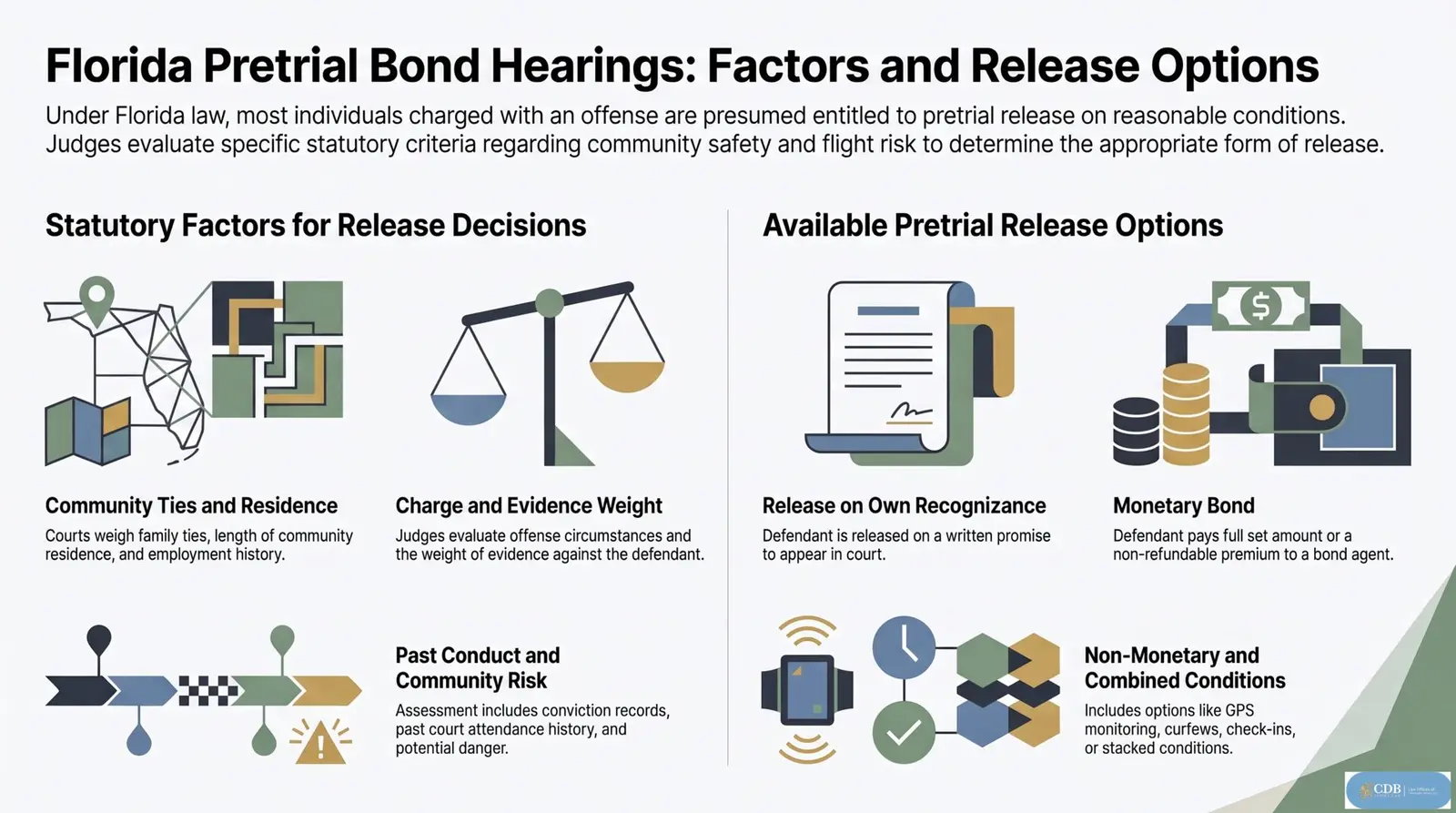
When a judge decides whether to release you, the analysis is not guesswork. Florida Rule of Criminal Procedure 3.131 and section 903.046, Florida Statutes, set out the factors the court weighs, including:
- The nature and circumstances of the offense charged
- The weight of the evidence against the defendant
- The defendant’s family ties, length of residence in the community, and employment history
- The defendant’s past and present conduct, including any record of convictions, previous flight to avoid prosecution, or failure to appear at court proceedings
- The nature and probability of danger that the defendant’s release poses to the community
- The source of funds used to post bond
- Whether the defendant is already on release pending resolution of another criminal proceeding or is on probation, parole, or other release pending completion of a sentence
Each of these factors tells a piece of your story and can tip the scales. A stable job, a local address, and family depending on you can build a strong foundation for release. On the other hand, a history of missing court dates or allegations involving violence makes the judge’s decision harder. The court is assessing risk, and the central question is this: can conditions, such as GPS monitoring, a curfew, or regular check-ins, manage that risk well enough to allow you to return home?
The Role of Criminal History and Prior Failures to Appear
Prior convictions matter, but their weight often depends on how long ago they occurred and whether they show a pattern of ignoring court orders. A single misdemeanor from years ago generally carries less weight than a recent felony. What tends to hurt most is a history of failing to appear (FTA) in court. Judges often read FTAs as evidence that you may not come back. Even one missed court date creates a hurdle your attorney must address with concrete assurances, such as a responsible person willing to supervise you or an agreement to electronic monitoring.
Community Ties and the Credibility of a Release Plan
 Your connections to the community, your job, your family, your home, are more than personal details; they are your anchor. If you have lived at the same address for years, hold a steady job, and have family who depend on you, you generally present a lower risk of flight than someone without those ties. It is not enough to simply say so. Your defense attorney should be ready to support those facts with documents such as lease agreements, pay stubs, or letters from employers and family. Judges respond to proof, not promises.
What the State Argues and How to Counter It
Prosecutors often follow a familiar script at bond hearings. They rely on the arrest affidavit, highlighting the most serious aspects of the charge and any aggravating details such as the alleged use of a weapon or injury to a victim. Their goal is to persuade the judge that you are a danger to the community or a flight risk. If you are already on probation or out on bond in another case, they will argue that release would be a mistake.
An effective defense does not ignore the charge; it reframes the purpose of the hearing. This is not the proceeding where guilt or innocence is decided. The arrest affidavit is one side of the story, written before any evidence has been tested. Your attorney can introduce context, identification problems, questions of intent, or other factual disputes that will be developed later. The objective is to show the judge that pretrial detention is unnecessary and that reasonable conditions can address any legitimate concern. For anyone facing the criminal justice system in Florida, the bond hearing is often the first meaningful battleground.
The Types of Release and What Each Requires
Florida courts have several options for pretrial release, each with different requirements:
- Release on own recognizance (ROR): You are released on your written promise to appear in court. This is more common in less serious cases where the person has strong community ties and no history of missing court.
- Non-monetary conditions: These may include GPS monitoring, a curfew, regular check-ins with pretrial services, or no-contact orders. There is no money to pay upfront, but violating a condition can lead to your arrest.
- Monetary bond: The judge sets a dollar amount. You can post the full amount with the court (returned at the conclusion of the case if you appear as required) or pay a non-refundable premium, commonly around 10%, to a bail bond agent.
- Combination: A monetary bond paired with non-monetary conditions, such as GPS monitoring and pretrial supervision.
Judges frequently stack conditions when they have concerns but do not believe detention is warranted. The more conditions you have, the more there is to manage. A single misstep, a missed check-in or contact with a protected person, can be enough for the court to revoke release and return you to jail.
The Financial Reality of Monetary Bond
When a judge sets a monetary bond, the financial strain can be immediate and overwhelming. Many families cannot pay the full amount. That often means turning to a bail bond agent, who charges a non-refundable premium, commonly around 10% in Florida. On a $50,000 bond, that can mean $5,000 you will not get back, even if the charges are later dropped. For a family already reeling from an arrest and lost income, that can be an impossible burden. In practical terms, a bond no one can afford functions less like a condition of release and more like an order of detention.
Bond Revocation and Modification Hearings
Pretrial release is not guaranteed to last. A violation of your release conditions, a new arrest, a failed drug test, or contact with a co-defendant, can prompt the State to move to revoke or increase your bond. At the hearing that follows, the State’s burden is lower than the “beyond a reasonable doubt” standard that applies at trial. If the judge finds a violation occurred, the court can increase the bond, add stricter conditions, or revoke release entirely.
You also have the ability to ask the court to modify your bond by lowering the amount or removing a condition. That request is strongest when circumstances have changed, perhaps you have completed a treatment program, secured stable employment, or your family situation has shifted. A successful motion usually requires showing the judge that positive change and demonstrating full compliance with your existing conditions. This can overlap with other opportunities in a case; for example, someone accepted into pretrial diversion may also ask to have bond conditions eased.
Closing Remarks
The bond hearing is where preparation shows. In a very short window, a judge makes a decision based on limited information. The difference between going home and staying in custody often comes down to whether your story is told well, whether your community ties are documented, your release plan is credible, and the judge sees a person with roots and responsibilities rather than a file number.
At CDB Injury Law, our work has always been about restoring hope to people who feel powerless. If you or someone you love is sitting in a jail cell waiting for a bond hearing, you are living one of the hardest days of your life. You do not have to face this alone. Let us talk about what comes next and how to fight for your release. Contact us for a confidential consultation about your case.
Frequently Asked Questions
Can bond be denied entirely in Florida?
Yes. In capital cases and offenses punishable by life imprisonment, a person may be held without bond when the proof of guilt is evident or the presumption of guilt is great. Florida law also permits pretrial detention in certain other circumstances when the court finds that no conditions of release will reasonably protect the community or ensure your appearance in court. These outcomes are the exception rather than the rule, but they do happen.
What happens if bond is set but cannot be afforded?
If you cannot afford the bond amount, you generally remain in custody until the bond is posted, the case resolves, or your attorney persuades the court to lower it. Judges are supposed to consider a defendant’s financial resources, but high bonds still leave many people in jail simply because they lack the money. An attorney can file a motion to reduce the bond or convert it to non-monetary conditions, though the outcome depends on the facts of your case.
How quickly does a bond hearing occur after arrest?
Florida law requires that a person in custody be brought before a judge for first appearance within 24 hours of arrest. Release is usually addressed at that hearing. In some situations the matter is continued so your attorney can gather documents and prepare a fuller argument. If you were arrested on a warrant that already lists a bond amount, you may be able to post it and be released without waiting for a judge.
Can bond be increased after it has been set?
Yes. If new information surfaces, additional charges, a new arrest, or a violation of release conditions, the State can ask the judge to raise the bond. After a hearing, the court may increase the amount, impose more restrictive conditions, or revoke release. The process works in both directions: your attorney can also move to reduce bond if your circumstances improve.
Does hiring private counsel affect the bond decision?
The law applies the same way regardless of who represents you, and no lawyer can promise a particular result. What can differ is preparation. An attorney with time to gather pay stubs, proof of residence, and letters from family can present a documented release plan instead of a general description. Public defenders are capable and dedicated advocates, but heavy caseloads can limit the time available before a first appearance. When your freedom is on the line, that preparation matters.
References
- Fla. Stat. § 903.046. (Purpose of and criteria for bail determination).
- Fla. Stat. § 907.041. (Pretrial detention and release).
- Fla. R. Crim. P. 3.131. (Pretrial Release).