

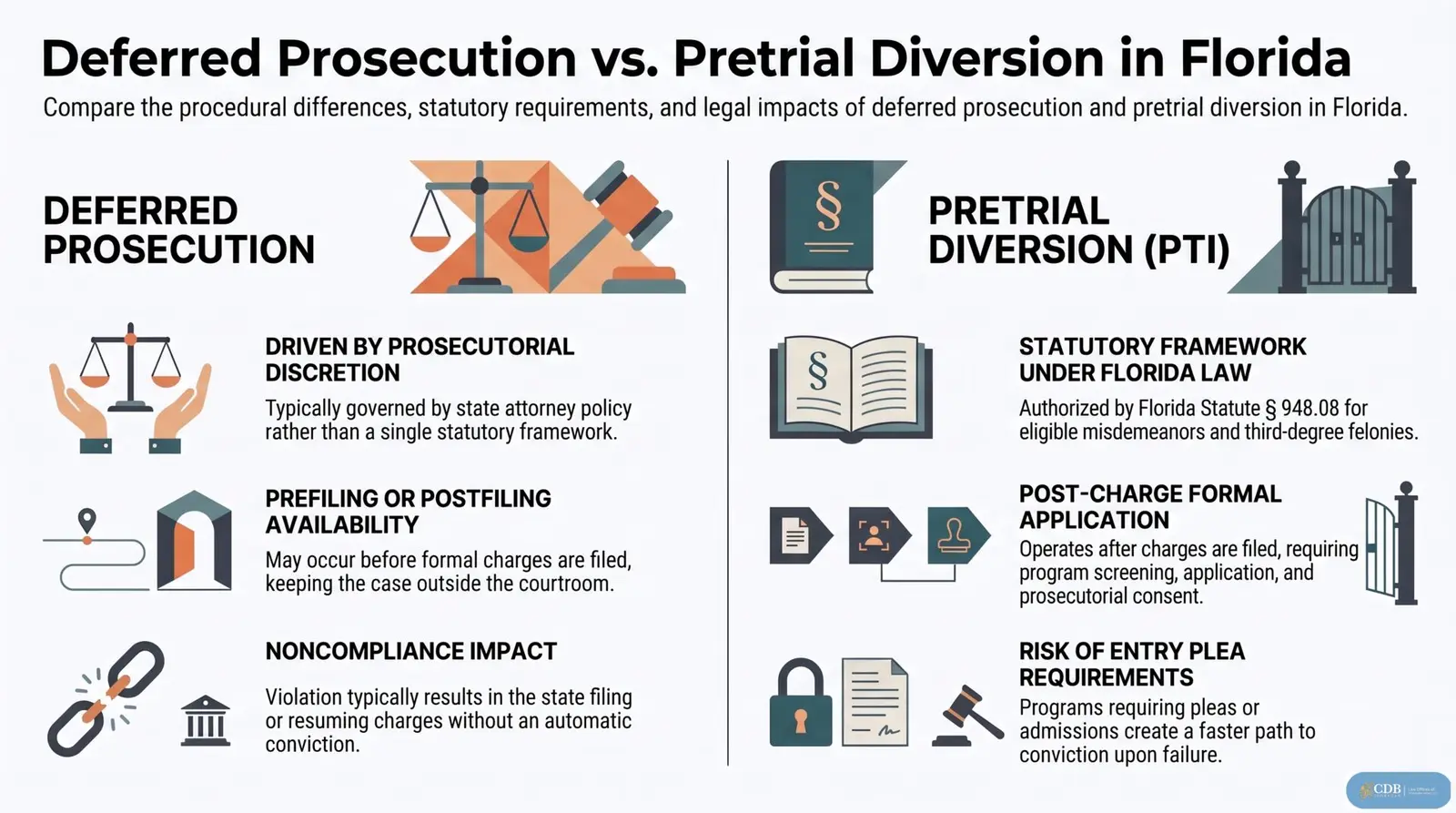
Deferred prosecution and pretrial diversion/pretrial intervention can both offer paths to avoid a formal conviction in Florida, but the labels and requirements vary by county and program. A deferred prosecution agreement may be offered before or after formal charges, while statutory pretrial intervention usually applies after a case is filed and requires approval, screening, and compliance with program terms. Some diversion programs require a plea or written admissions; others do not. The exact agreement determines eligibility, risk, and the strategic window for negotiation.
When you are facing criminal charges, the world can feel like it’s closing in. The uncertainty of what comes next, the court dates, the potential penalties, the impact on your family and career, is overwhelming. In this critical moment between an arrest and a final judgment, two powerful options may emerge that offer a path away from a conviction: deferred prosecution and pretrial diversion. Both can promise a second chance and the possibility of a dismissal, but they are not identical, and Florida counties do not always use these labels the same way. Understanding the precise terms matters, because the choice you make, or the opportunity you miss, can define what happens next.

Deferred prosecution agreements are usually built around prosecutorial discretion. A prosecutor, reviewing the evidence and the defendant’s history, may agree to hold prosecution in abeyance while the defendant completes certain conditions, community service, restitution, counseling, drug treatment, classes, or other requirements. In some cases, this happens before an information is filed, meaning the case may never formally enter the court system. In other cases, a deferred prosecution agreement may be negotiated after filing, with the state agreeing to dismiss or decline further prosecution if the defendant completes the agreement. The defendant signs a contract with the state attorney’s office, acknowledging the terms and the consequences of noncompliance. If the defendant fulfills every condition within the agreed period, the state may decline to file charges, dismiss the pending charge, or enter a nolle prosequi, depending on the posture of the case. The arrest record remains, but there is no conviction and no adjudication of guilt from the agreement itself.
This arrangement may live largely outside the courtroom, but not always. If no formal charge has been filed, the defendant may not stand before a judge to enter a plea. If the case has already been filed, court dates may be continued while the agreement runs. The leverage lies in the prosecutor’s discretion, the defendant’s willingness to comply, and the written terms of the agreement. Deferred prosecution is not codified in a single Florida statute governing all criminal cases; it is typically a matter of prosecutorial policy, shaped by state attorney office guidelines and individual case evaluation. Some offices use it liberally for first-time nonviolent offenders. Others reserve it for narrow categories, shoplifting under a certain dollar amount, minor drug possession, bad checks with restitution, or similar low-level offenses. Availability depends on jurisdiction, charge severity, victim input, and the defendant’s criminal history.
What Pretrial Diversion Requires
Pretrial diversion, often called pretrial intervention or PTI, operates within the formal criminal system. Florida Statute § 948.08 authorizes pretrial intervention programs for eligible defendants. The defendant is charged. An information is filed. The case appears on the docket. Before trial, the defendant applies to the program, often through the state attorney’s office, a program administrator, or the court process used in that circuit. Acceptance commonly depends on prosecutorial consent, program screening, and, where required by law or local procedure, victim and court approval. Conditions may include drug testing, community service, restitution, classes, counseling, regular reporting, or treatment.
Florida law does not make a guilty or no-contest plea a universal requirement for every PTI placement. Some local diversion, drug court, or negotiated programs require a plea, a stipulation to facts, written admissions, or waivers before entry. Other programs allow participation without a plea while prosecution is suspended. This distinction is critical. If a plea or factual admission is part of the entry paperwork, a defendant who fails the program may face a faster path to conviction or sentencing. If no plea was entered, failure usually means the prosecution resumes and the state must still prove the case.
Successful completion generally triggers dismissal or a nolle prosequi. The charge is dropped, and no conviction appears on the record. But the benefit depends on completing every condition and on the exact paperwork signed at entry. Pretrial diversion functions as a conditional opportunity: the defendant gets a chance to demonstrate compliance before the court and the state decide whether the case should be closed without a conviction.
Eligibility is more structured than many deferred prosecution policies. Florida law generally focuses statutory PTI on defendants with limited criminal history who are charged with eligible misdemeanors or third-degree felonies, and it excludes felonies involving violence and other disqualifying offenses. Some jurisdictions impose additional restrictions based on prior record, pending charges, restitution issues, victim position, or the nature of the offense. Acceptance is not automatic. A defendant applies, the state reviews, and the program administrator evaluates whether the case fits the program’s purpose, diversion of appropriate defendants away from incarceration and formal conviction.
Timing and Strategic Windows
The most consequential difference often lies in timing. A deferred prosecution offer may come early, sometimes before the first court date, sometimes before the defendant has retained counsel, and sometimes after an information has been filed if the local state attorney’s office permits it. If the prosecutor declines to defer prosecution or the defendant misses an early deadline, formal prosecution may move forward. There is no general statutory right to deferred prosecution; it is discretionary. Once the case advances, a prefiling deferred prosecution opportunity may disappear, although a negotiated postfiling agreement may still be possible in some jurisdictions.
Pretrial diversion opens after charges are filed but before trial or final plea negotiations conclude. The timeline varies by jurisdiction, but many programs require application within a set window, often within 30 to 90 days of arraignment. Some allow application later if criminal defense counsel negotiates an extension, but delay can work against the defendant. Prosecutors may withdraw consent if discovery reveals aggravating facts, if the victim objects, or if the defendant picks up new charges. The strategic moment is narrow. Waiting too long can mean rejection; applying without understanding the terms can mean locking into conditions the defendant cannot meet.
Defense counsel often encounters the diversion question at the first substantial meeting with the client. The prosecutor may have already mentioned it. The defendant may have received paperwork. The decision tree forks immediately:
- Is a deferred prosecution agreement still available, and if so, is it prefiling or postfiling?
- Does the defendant qualify for PTI under Florida law, local rules, and program screening criteria?
- Are the conditions realistic given the defendant’s work schedule, finances, transportation, health, and support system?
- What happens if the defendant is terminated from the program, does prosecution resume, or has the defendant signed a plea, stipulation, or waiver that can be used against them?
These are not hypothetical concerns. A defendant who accepts diversion without understanding the drug-testing frequency may fail within weeks. A defendant who agrees to pay restitution in installments may discover that a single missed payment triggers termination. The consequences of noncompliance differ based on the agreement. In a deferred prosecution agreement with no plea on file, violation typically means the state files or resumes charges and the case proceeds. In a pretrial diversion program that required a plea or written admissions, violation may allow the court or prosecutor to use that paperwork in a way that sharply limits the defendant’s options. The signed documents matter.
Records, Sealing, and Long-Term Impact
Neither deferred prosecution nor successful pretrial diversion produces a conviction, but both leave traces. The arrest record remains unless it is sealed or expunged. Florida law allows sealing or expunction of certain criminal history records under Chapter 943 if the defendant meets statutory eligibility requirements, including requirements related to prior adjudications, prior sealing or expunction, and the final disposition of the case. But sealing or expunction is not automatic. It requires a separate process, usually including a certificate of eligibility and a court petition. Until relief is granted, the arrest may appear on background checks. Employers, landlords, and licensing boards may see the charge, even if it was dismissed.
For defendants in licensed professions, nursing, real estate, contracting, law enforcement, the distinction between a conviction and a diversion dismissal can determine whether a career continues. Licensing boards often ask not only about convictions but also about arrests, charges, and diversions. A charge dismissed after successful PTI may still require disclosure and explanation. The arrest record itself can be a barrier, even when the legal outcome is favorable.
Defendants facing federal employment, security clearances, or immigration proceedings must weigh another layer. Federal agencies and immigration authorities do not treat state diversion dismissals identically to never-arrested or never-charged cases. The arrest and the underlying conduct may remain part of the record, and the defendant may be required to provide the full factual basis, even if the state case was resolved without conviction. Florida sealing or expunction does not bind every federal agency, and information sealed in state court may still be visible in some federal databases.
Negotiation and Prosecutorial Discretion
Neither program is an entitlement. Both exist because a prosecutor or program authority decided to extend the option. That discretion is shaped by office policy, victim input, statutory limits, and case-specific factors. A defendant with a prior arrest, even one that did not result in conviction, may be ineligible for deferred prosecution in some counties. A defendant charged with an offense involving violence may be excluded from statutory PTI or rejected under local policy, regardless of mitigation. A victim who demands prosecution may persuade the state to reject diversion even when the defendant otherwise appears to qualify.
Defense counsel can sometimes negotiate terms or advocate for admission when initial rejection occurs. A prosecutor who sees mitigation, mental health treatment records, employment stability, family support, may reconsider. A defendant who enters treatment before the diversion decision may demonstrate commitment that shifts the state’s calculus. But these negotiations happen early, often before discovery is complete, and require a tactical judgment: push too hard, and the prosecutor may harden the state’s position; wait too long, and the window closes.

The difference between deferred prosecution and pretrial diversion is procedural, but the consequences are profound. One may avoid the courtroom entirely; the other usually proceeds through a filed case under program supervision. One may involve no plea at all; another may require a plea, admissions, or waivers. The choice, or the lack of one, if timing forecloses an option, shapes the defendant’s risk, the permanence of the record, and the path to sealing or expunction. When the state offers a second chance, the written terms matter as much as the offer itself.
Closing Remarks
Navigating these legal crossroads can be incredibly stressful. A deferred prosecution offer may have a short deadline, or the rules for a diversion program can seem complex and unforgiving. Making the right choice under pressure is difficult, but you do not have to do it alone. At CDB Injury Law, we help clients in Florida understand their options, negotiate favorable terms, and protect their future. If you are facing a criminal charge and need to know the best path forward, we are here to restore your sense of control and fight for the cleanest possible outcome. Contact us to talk about your case and how we can help.
Frequently Asked Questions
Can a defendant apply for pretrial diversion after charges are filed if deferred prosecution was never offered?
Yes. Pretrial diversion or pretrial intervention generally operates after formal charging, so a defendant who was not offered deferred prosecution, or who declined it, may still apply if the charge, criminal history, and local program rules allow it. The application process typically begins shortly after arraignment, and acceptance depends on prosecutorial consent, program screening, and any required victim or court approval. Missing the application window or failing to meet eligibility criteria can close this option.
What happens if a defendant violates the terms of a deferred prosecution agreement?
Violation of deferred prosecution terms typically allows the state to file formal charges, resume prosecution, or withdraw the promised dismissal, depending on whether the case had already been filed. If no plea was entered and no adjudication occurred, the defendant generally retains the right to contest the charges at trial, and the state must still prove the case beyond a reasonable doubt. However, statements, admissions, or waivers made during the deferred prosecution process may have consequences, depending on the agreement’s terms and applicable law.
Does successful completion of pretrial diversion prevent the arrest from appearing on a background check?
No. Successful completion usually results in dismissal of the charge, but the arrest record remains visible on many background checks unless it is sealed or expunged under Florida law. Sealing or expunction requires a separate process and compliance with statutory eligibility requirements under Chapter 943. Until relief is granted, the arrest and charge may appear in criminal history searches conducted by employers, landlords, and licensing agencies.
Are violent felonies ever eligible for pretrial diversion in Florida?
Florida Statute § 948.08 excludes felonies involving violence from standard pretrial intervention, including offenses such as murder, sexual battery, robbery, aggravated assault, aggravated battery, and other violent crimes. Some jurisdictions impose additional exclusions through local policy. Even for charges not statutorily barred, prosecutors retain discretion to reject diversion applications based on the severity of the offense, the defendant’s prior record, or victim input. Eligibility is case-specific and jurisdictional, and exclusion is common for offenses involving violence or significant harm.
Can a defendant withdraw from pretrial diversion after entering the program?
Withdrawal may be possible, but the consequences depend on the documents signed at entry and the program’s rules. If entry required a guilty or no-contest plea, stipulation, or waiver, withdrawing or being terminated may allow the court or prosecutor to use that paperwork against the defendant. If no plea was entered, the case typically returns to the normal prosecution track. The safer course is to evaluate the feasibility of every program condition before entering, because exiting after entry can forfeit the benefit of diversion entirely.
References
- Florida Statutes § 948.08 (Pretrial intervention programs).
- Florida Statutes § 943.0585 (Court-ordered expunction of criminal history records).
- Florida Statutes § 943.059 (Court-ordered sealing of criminal history records).