

TL;DR: Soft tissue injuries and herniated discs are both common consequences of motor vehicle collisions and other trauma, but they differ dramatically in diagnosis, treatment duration, and claim valuation. Herniated discs involve structural damage to the spine that is often visible on MRI, while soft tissue injuries affect muscles, tendons, and ligaments without necessarily showing up on imaging. Understanding the distinction matters because insurance carriers routinely undervalue soft tissue claims while treating herniated disc cases with greater reserve authority.
The MRI report changes everything. Until that moment, the claim sits in the adjuster’s soft tissue file, a sprain, a strain, something that should resolve in six weeks. Then radiology confirms a herniated disc at L4-L5, and the entire trajectory shifts. What looked like a minor rear-end collision may now carry surgical potential, permanent restrictions, and a substantially higher settlement range. The injury was always there. The difference is that one shows up on film, and the other does not. That distinction determines how aggressively the claim gets defended, how much authority the adjuster holds, and whether the case resolves before suit or requires litigation to force fair compensation.

Soft tissue injuries and herniated discs live on opposite ends of the credibility spectrum in Florida personal injury claims. Both can cause disabling pain. Both can prevent someone from working, sleeping, or caring for their family. But insurance carriers treat them as fundamentally different risks, and that treatment drives every decision from initial offer to trial preparation.
What Defines a Soft Tissue Injury
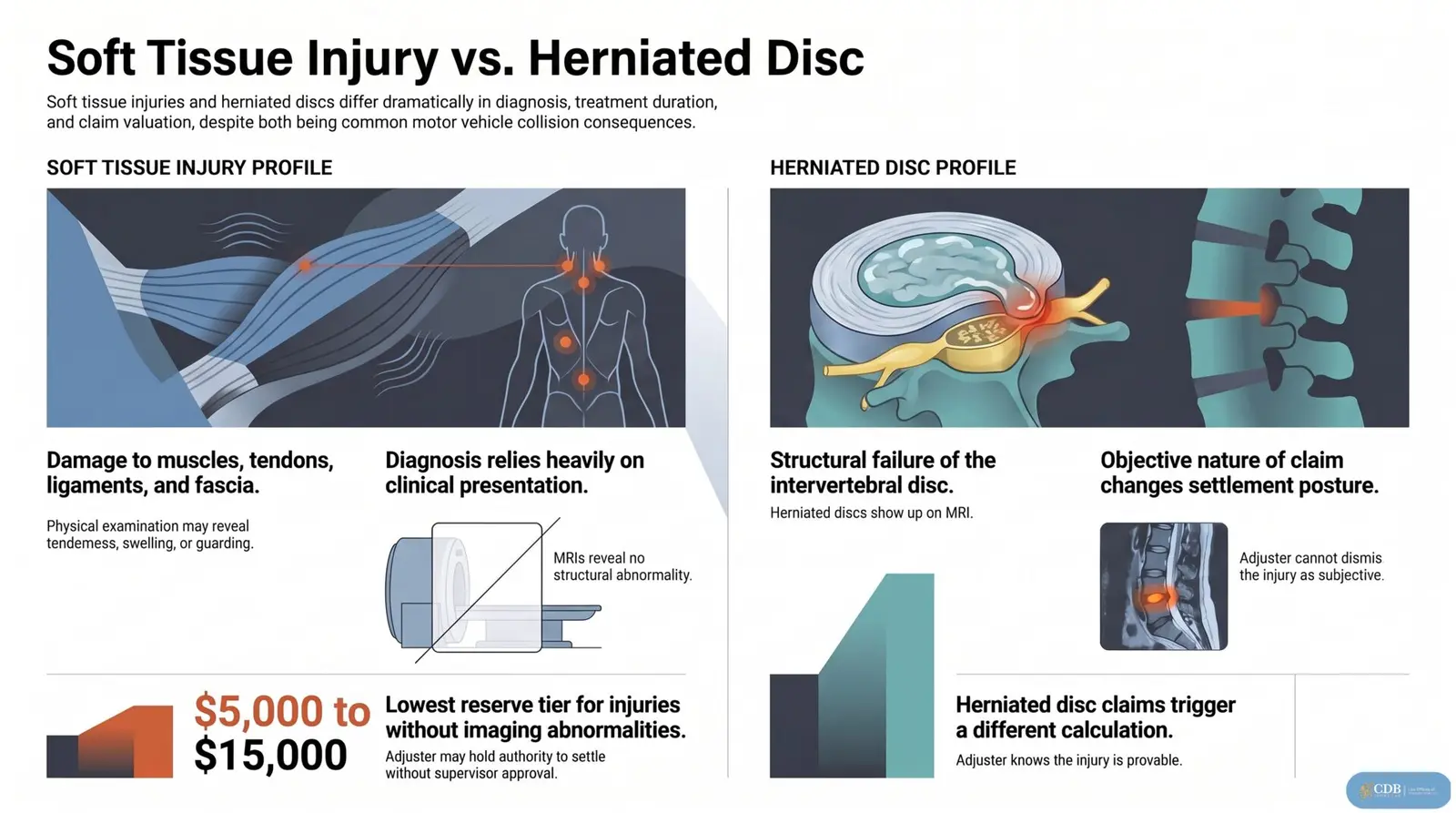
Soft tissue injuries involve damage to muscles, tendons, ligaments, and fascia, the connective structures that support joints and facilitate movement. These injuries occur when blunt force or rapid deceleration stretches, tears, or inflames tissue without breaking bones or damaging discs. Whiplash is the most recognized example: the head snaps forward and back, straining the cervical ligaments and muscles that stabilize the neck.
Diagnosis relies heavily on clinical presentation. The injured person reports pain, stiffness, reduced range of motion, or muscle spasms. Physical examination may reveal tenderness, swelling, or guarding. But X-rays show nothing. MRIs reveal no structural abnormality. CT scans come back unremarkable. The injury exists in the patient’s symptoms and the physician’s clinical judgment, not in objective imaging.
Treatment typically involves conservative care: rest, ice, anti-inflammatory medication, physical therapy, and chiropractic adjustment. Most soft tissue injuries improve within weeks to months. Some resolve completely. Others leave lingering discomfort that flares with weather changes, prolonged sitting, or physical exertion. The absence of permanent objective findings makes it difficult to prove residual impairment, and that difficulty translates directly into settlement resistance.
Insurance adjusters approach soft tissue claims with skepticism baked into their training. The claims manual assigns lower reserve ranges. The adjuster knows the plaintiff cannot point to a film and say, “There, that’s the damage.” Credibility becomes the battlefield. Did treatment start immediately or weeks later? Did the claimant miss work? Are there pre-existing complaints in prior medical records? The adjuster scrutinizes every gap, every inconsistency, every reason to argue the injury is minor, resolved, or unrelated to the collision.
What Defines a Herniated Disc
A herniated disc involves structural failure of the intervertebral disc, the cushion of cartilage that sits between vertebrae. Each disc has a tough outer layer called the annulus fibrosus and a gel-like center called the nucleus pulposus. Trauma, sudden impact, twisting force, compression load, can cause the nucleus to push through a tear in the annulus. That protrusion is the herniation. When the extruded material presses against a nerve root, it causes radiculopathy: shooting pain, numbness, tingling, or weakness radiating into an arm or leg.
Herniated discs show up on MRI. The radiologist describes the location, size, and degree of nerve impingement. L4-L5 and L5-S1 herniations in the lumbar spine are common in rear-end collisions. C5-C6 and C6-C7 herniations appear in the cervical spine after high-speed impacts. The imaging provides objective evidence that something inside the body is broken in a way that was not broken before.
Treatment starts conservatively: physical therapy, epidural steroid injections, pain management, but some herniations do not resolve with conservative care. When conservative care fails and neurological deficits persist, surgery may become necessary. Microdiscectomy, laminectomy, or fusion procedures carry their own risks, recovery timelines, and permanent limitations. Even successful surgery can leave the patient with permanent restrictions: no lifting over 20 pounds, no repetitive bending, no prolonged sitting. Those restrictions affect employability, earning capacity, and long-term quality of life.
The objective nature of a herniated disc claim changes the settlement posture. The adjuster cannot dismiss the injury as subjective. The carrier’s medical consultant cannot credibly argue the claimant is malingering when the MRI confirms a 5mm posterolateral protrusion compressing the left L5 nerve root. Tampa car accident claims involving herniated discs may carry materially higher reserves, depending on the severity of symptoms, whether surgery occurred, whether permanency is established, available insurance coverage, and disputed causation issues. Adjusters may have limited authority to settle these claims pre-suit, which can force litigation even when liability is clear.
How Insurance Carriers Value Each Injury Type Differently
Insurance carriers assign claims reserves based on objective findings, treatment intensity, and permanency. Soft tissue injuries without imaging abnormalities fall into the lowest reserve tier. The adjuster may hold authority to settle for $5,000 to $15,000 without supervisor approval. That range assumes a few months of chiropractic care, no lost wages, and full recovery. If the claimant demands more, the file goes to a supervisor, then to a senior adjuster, then to litigation. The carrier’s playbook is delay and attrition: make the process costly and slow, bet that the claimant will accept a lowball offer rather than wait two years for trial.
Herniated disc claims trigger a different calculation. The reserve may jump substantially depending on surgical intervention, permanent impairment, future care needs, and policy limits. The adjuster knows the injury is provable. The carrier knows a jury will see the MRI images, hear the surgeon’s testimony, and award significant damages if the case goes to trial. That risk changes negotiation dynamics. The carrier may still lowball the initial offer, but the gap between offer and demand often narrows faster. The adjuster has less room to argue the injury is fabricated or exaggerated.
Florida’s modified comparative negligence rule adds another layer. Under Florida Statutes § 768.81, a plaintiff who bears more than 50 percent fault generally recovers nothing in a negligence action. Even when liability is clear, adjusters attempt to shift a percentage of fault onto the claimant, late braking, failure to maintain lane, distraction. The tactic works more effectively in soft tissue cases because the injury’s severity is easier to question. When a herniated disc requires surgery, the fault allocation fight becomes less about whether the injury is real and more about whether the collision caused it or merely aggravated a pre-existing degenerative condition.
Florida motor vehicle cases also carry a separate no-fault threshold. Under Florida Statutes § 627.737, an injured person generally may not recover pain-and-suffering damages from an at-fault driver unless the injury meets a statutory threshold, such as significant and permanent loss of an important bodily function, permanent injury within a reasonable degree of medical probability, significant and permanent scarring or disfigurement, or death. That threshold matters most in soft tissue claims, where permanency can be harder to prove without objective findings.
Common Tactics Adjusters Use to Devalue Soft Tissue Claims
- Arguing the injury should have resolved within a standard recovery period, dismissing ongoing complaints as unrelated.
- Pointing to gaps in treatment as evidence the claimant was not actually in pain.
- Highlighting pre-existing conditions documented in prior medical records, even when the collision clearly aggravated those conditions.
- Offering nuisance-value settlements before the claimant reaches maximum medical improvement, banking on financial pressure to force acceptance.
- Disputing medical causation by claiming the mechanism of injury was too minor to cause the reported symptoms.
Herniated disc cases face similar tactics, but the objective imaging blunts their effectiveness. The adjuster cannot argue the injury does not exist. The fight shifts to causation. Was the disc herniated before the collision, or did the collision cause it? That question requires competing medical expert opinions, which increases litigation cost for both sides and creates settlement pressure the carrier cannot ignore.
Why Diagnostic Imaging Timing Matters for Settlement Value
The MRI does not create the herniation. It reveals it. But the timing of that revelation changes the claim’s trajectory. If the treating physician orders an MRI within the first few weeks after the collision and it shows a fresh herniation, causation is straightforward. If the MRI happens six months later after conservative care fails, the carrier will argue the disc was already degenerating and the collision merely accelerated an inevitable process.
Soft tissue claims that linger without objective findings face a credibility problem. Three months of chiropractic care with no improvement raises questions. Six months of ongoing complaints without imaging suggests either chronic pain syndrome, a diagnosis carriers dispute aggressively, or exaggeration. The absence of an MRI does not mean the injury is not real. It means the injury is harder to prove, and anything hard to prove is hard to settle.
Some claimants avoid MRIs because of cost or because their primary care physician does not believe imaging is medically necessary yet. That delay can materially reduce settlement value. Once significant time passes between collision and diagnosis, the carrier argues the herniation is degenerative, the soft tissue injury resolved months ago, and any ongoing symptoms are unrelated. The diagnostic gap becomes the defense’s strongest argument.
When Conservative Treatment Ends and Permanency Begins
Maximum medical improvement is the point at which further treatment will not significantly change the patient’s condition. For soft tissue injuries, MMI usually arrives within three to six months. The physician discharges the patient with instructions to continue home exercises and manage flare-ups with over-the-counter medication. If there are no permanent restrictions and no residual objective findings, economic damages may be limited to past medical bills and lost wages. In Florida motor vehicle cases, noneconomic damages, pain, suffering, loss of enjoyment of life, may also face the statutory threshold in § 627.737. Without qualifying permanency or another threshold injury, recovery for those damages can be sharply limited or unavailable.
Herniated discs often do not reach MMI for a year or longer, especially if surgery is involved. Post-surgical recovery takes months. Physical therapy continues. Pain management may be ongoing. When the treating surgeon assigns permanent restrictions, no lifting over 25 pounds, no repetitive bending, no prolonged standing, the claim expands to include future lost earning capacity. A 40-year-old construction worker with a permanent 25-pound lifting restriction has lost a significant portion of future income. An economic expert calculates that loss, and it becomes a line item in the demand.
Settling before permanency is established risks leaving money on the table. Settling too late, after the claimant has exhausted savings, lost a job, or fallen behind on medical bills, creates pressure to accept less than the claim is worth. The timing decision is strategic, and it requires understanding both the medical trajectory and the carrier’s settlement authority. Comparative negligence determinations also play into timing, since a claimant’s perceived contribution to the collision affects the carrier’s willingness to pay policy limits or force litigation.

Soft tissue injuries and herniated discs represent two points on a spectrum of collision-related trauma. One is harder to prove but no less painful. The other is objectively verifiable but often requires surgery and leaves permanent limitations. Insurance carriers know the difference and adjust their strategies accordingly. The claimant who understands that difference, and who builds a claim with documentation, consistency, and strategic timing, navigates the process with leverage instead of hope.
Closing Remarks
If an MRI has confirmed a herniated disc months after the collision, if conservative care has failed and surgery is now recommended, or if ongoing soft tissue pain has been dismissed by an adjuster offering a settlement that does not cover medical bills, the claim is being undervalued at the moment it matters most. CDB Injury Law handles Florida personal injury claims involving both soft tissue injuries and herniated discs, led by Chris Debari, admitted to the Florida Bar in 1999, holding carriers accountable when they lowball traumatic injuries. Contact us today for a consultation. You do not have to face this alone.
Frequently Asked Questions
Can a soft tissue injury be just as disabling as a herniated disc?
Yes. Chronic soft tissue injuries can cause ongoing pain, restricted range of motion, and functional limitations that interfere with work and daily life. The difference lies not in severity but in objective proof. A herniated disc shows up on MRI; soft tissue damage typically does not. Insurance carriers use that distinction to argue soft tissue injuries are minor or resolved, even when the claimant’s experience contradicts that narrative. Credibility, consistent treatment records, and documentation of functional limitations become critical in soft tissue claims.
Does Florida law require an MRI to recover damages for a back or neck injury?
No. Florida law does not require objective imaging to pursue a personal injury claim. A claimant can recover damages based on clinical findings, symptom reports, and physician testimony even without an MRI. However, the absence of imaging makes the claim significantly harder to prove and easier for the carrier to dispute. In Florida motor vehicle cases, a claimant seeking pain-and-suffering damages must also address the statutory threshold for noneconomic damages. Adjusters and defense attorneys will argue that without objective evidence, the injury is either minor, pre-existing, or fabricated. An MRI that confirms a structural abnormality eliminates much of that argument and changes settlement dynamics.
If an MRI shows a herniated disc, does that prove the collision caused it?
Not automatically. The MRI shows the herniation exists, but it does not timestamp when the herniation occurred. Defense attorneys and insurance medical consultants routinely argue that disc herniations are degenerative, age-related changes that were present before the collision. Proving causation requires correlation between the collision’s mechanism of injury, the immediate onset of radicular symptoms, and the absence of prior complaints. The shorter the gap between collision and MRI, the stronger the causation argument. Delayed imaging or gaps in treatment give the defense room to argue the disc was already herniated or that the collision merely aggravated a pre-existing condition.
Why do soft tissue injury claims take so long to settle?
Soft tissue claims drag because carriers bet on attrition. Without objective findings, the claim depends on subjective complaints, and adjusters know those complaints are harder to prove at trial. The longer the claim takes, the more financial pressure the claimant feels. Medical bills accumulate. Lost wages mount. The claimant needs money now, and the carrier knows it. Lowball offers appear at strategic moments, right after a bill goes to collections, right before a statute of limitations deadline. The carrier’s strategy is to make waiting more painful than accepting a fraction of what the claim is worth. That dynamic shifts only when the claimant has counsel willing to litigate and the resources to withstand delay.
Can someone have both a soft tissue injury and a herniated disc from the same collision?
Absolutely. A single collision can cause both. The impact herniates a disc in the lumbar spine and strains the cervical ligaments. The disc shows up on MRI. The neck strain does not. Both injuries cause pain and limitation, but the carrier will focus settlement dollars on the herniated disc and minimize the soft tissue component. The claimant experiences both, but the claim’s value is driven by what the MRI reveals. That is why comprehensive diagnostic workup matters. If symptoms persist in an area not covered by existing imaging, additional imaging may uncover a second structural injury that changes the settlement calculation.