

TL;DR: An incident report created after a slip and fall documents what happened, who was involved, and the initial observations of the property owner or manager. The report often becomes a critical piece of evidence in evaluating liability, credibility, and notice of a dangerous condition. What goes into that report, and what gets left out, can shape the outcome of a premises liability claim.
A fall happens in seconds. The confusion and pain arrive immediately. But the paperwork begins the moment someone with a clipboard or phone camera steps in to document the scene. That incident report, typed or scribbled on a pre-printed form, becomes the first official account of what happened. It is rarely neutral. The questions asked, the details recorded, and the statements captured are filtered through the lens of whoever holds the pen, and that person usually works for the property owner. By the time medical treatment starts, the narrative is already taking shape. Understanding what that report means, what it omits, and how it will be used is essential for anyone who has fallen and been injured on someone else’s property.

Slip and falls often occur in retail stores, restaurants, apartment complexes, parking lots, and office buildings. A shopper steps on spilled liquid in a grocery aisle. A tenant trips on a cracked walkway. A guest slips on a wet lobby floor in a condominium. In most of these settings, employees or managers are trained to respond, not primarily to help the injured person, but to protect the business. The incident report is a tool designed for risk management, not care. It exists to document the event in a way that minimizes exposure and creates a defensible record. That purpose shapes every question and every entry.
What Gets Recorded in an Incident Report
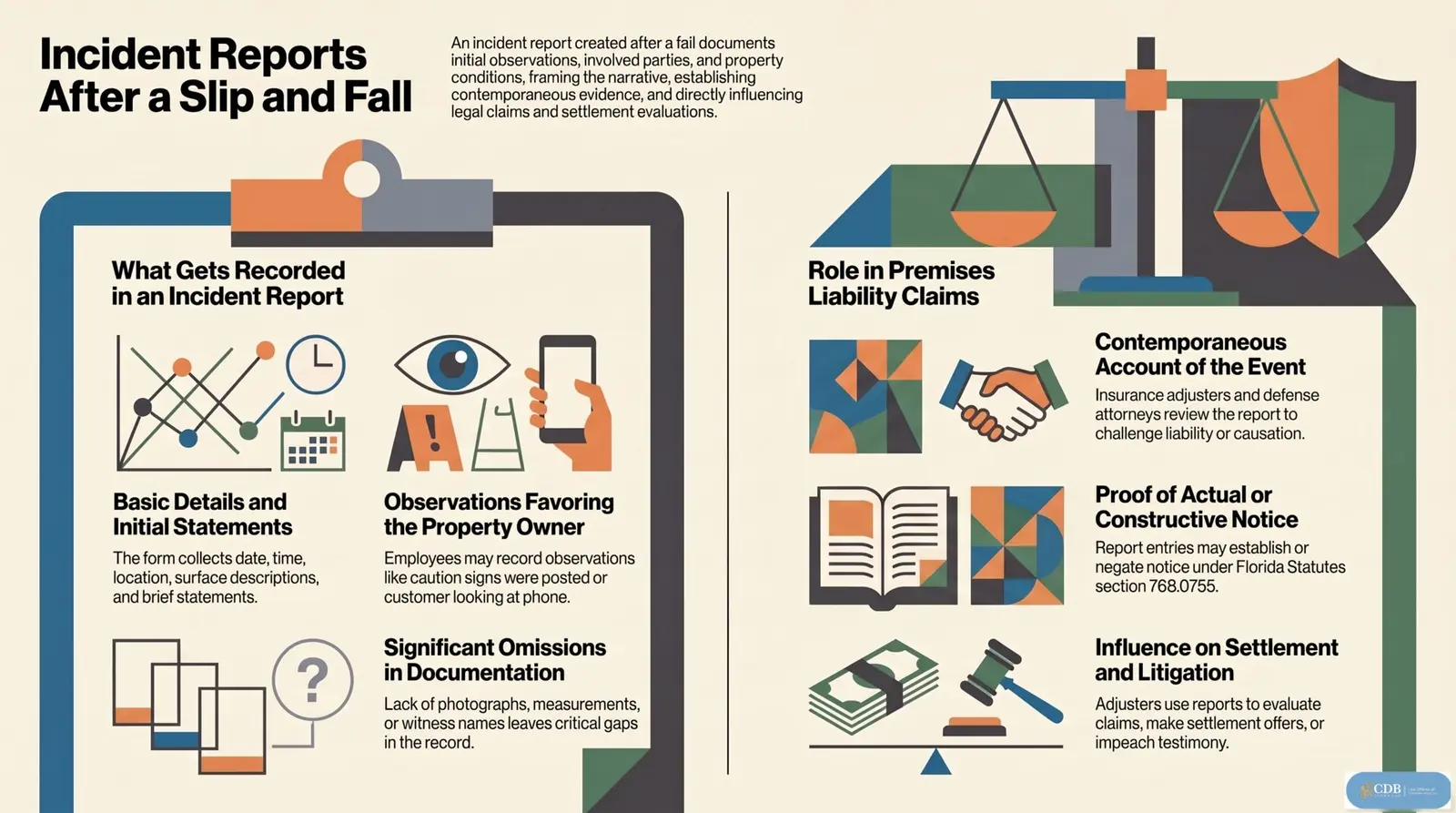
The structure of an incident report varies by business, but most follow a predictable format. The form collects basic information: date, time, location within the property, weather conditions if outdoors, and a description of the surface where the fall occurred. It records the injured person’s name, contact information, and a brief statement about what happened. Often, it asks whether the person refused medical attention or accepted an ambulance. Witness names may be included, though they are frequently omitted if no one stepped forward or if bystanders left before being identified.
More telling than what is recorded is how it is recorded. Descriptions are often sparse. The injured person’s account may be summarized in a single sentence, sometimes accurately, sometimes not. Employees writing the report may include observations that favor the property owner: “No visible liquid on floor,” “Caution signs were posted,” “Customer was running,” “Customer was looking at phone.” These characterizations, even when inaccurate or speculative, become part of the permanent record. The injured person, still disoriented and in pain, may not realize how the report frames the event until much later.
Why the Report Matters in a Premises Liability Claim
Florida law generally requires property owners to maintain their premises in a reasonably safe condition and to warn invitees of dangerous conditions that are not obvious and that the owner knows or should know about. In slip-and-fall claims involving a transitory foreign substance in a business establishment, Florida Statutes section 768.0755 specifically requires proof that the business had actual or constructive knowledge of the dangerous condition and should have acted to remedy it. The incident report is one of the first documents reviewed when a claim is made. It serves as the property owner’s contemporaneous account, a narrative created close in time to the event, before legal proceedings began.
Insurance adjusters and defense attorneys scrutinize the report for statements that can be used to challenge liability or causation. If the report contains the injured person’s own words, especially if they said something like “I wasn’t paying attention” or “I should have been more careful.” Those statements may be quoted to suggest comparative fault. If the report notes that no hazard was visible, that claim will be repeated in correspondence and, if the case proceeds, in court filings. The report does not prove the truth of its contents, but it does frame the dispute.
Conversely, the absence of certain details can be just as significant. If no photograph was taken, no measurements recorded, or no witnesses named, the lack of documentation may suggest that the property owner was not diligent in investigating the incident. If the report contradicts later testimony, such as an employee claiming in deposition that a spill had been present for an hour when the incident report stated no hazard was observed, the inconsistency becomes a tool for cross-examination and credibility assessment.
Constructive Notice and the Role of Documentation
One of the central issues in many slip and fall cases is whether the property owner had actual or constructive notice of the dangerous condition. Actual notice means the owner or employees knew about the hazard. Constructive notice means the hazard existed for a long enough period that the owner should have discovered it through reasonable inspection, or that the condition occurred with enough regularity that it was foreseeable. Incident reports sometimes contain admissions that establish notice. A manager might note that the spill was reported earlier, or that the area had been flagged for repair but not yet fixed. Those entries can be decisive.
More often, the report is silent on notice, or actively asserts the opposite. “No prior complaints,” “Area inspected at start of shift,” “No hazards observed during walkthrough.” These statements are crafted to negate constructive notice. They may be accurate. They may also be aspirational, written to create a paper trail that insulates the owner from liability. Independent evidence, such as prior incident reports, repair logs, or employee shift notes, may tell a different story. The incident report is one piece of a larger evidentiary puzzle, but it is the piece the property owner controls from the start.
Common Elements That Shape Liability Analysis
- Date and time stamps that establish how long a hazard may have been present
- Descriptions of the surface condition, wet, dry, uneven, cracked, debris present
- Statements attributed to the injured person, especially any admission of fault or inattention
- Employee observations, including notations of warning signs, barriers, or prior inspections
- Photographs or lack thereof, which either preserve the scene or leave critical gaps
- Witness information, or the absence of any effort to identify witnesses
- Medical refusal or acceptance, which may later be cited to minimize injury severity
What Happens When the Report Is Incomplete or Inaccurate
Not all incident reports are intentionally slanted. Many are simply incomplete. The employee who fills out the form may be rushed, untrained, or distracted. Details may be omitted because no one thought to ask. The injured person may have been too shaken to provide a clear account. In these cases, the report becomes less useful as evidence, but it does not disappear. Even a sparse or vague report can be cited to argue that the injured person’s later, more detailed recollection is inconsistent or embellished.
Inaccuracies pose a different problem. An employee who did not witness the fall may record speculation as fact. A manager may add commentary that mischaracterizes the injured person’s condition or behavior. Once the report is filed, correcting those errors is difficult. The injured person typically does not receive a copy on the spot, and may not learn what was written until weeks or months later, after legal counsel requests it. By that time, the false or incomplete narrative has already been shared with the insurance carrier and may be embedded in the claim file.
Challenging the accuracy of an incident report requires corroboration. Witness testimony, photographs taken by the injured person or bystanders, medical records that document the mechanism of injury, all of these can be used to demonstrate that the report does not reflect what actually happened. The report is not gospel. But it is evidence, and like all evidence, it carries weight unless something else tips the scale.
How the Report Influences Settlement and Litigation
Most slip and fall claims never reach trial. They are resolved through negotiation between counsel and the property owner’s insurance carrier. The incident report is one of the first documents the adjuster reviews when evaluating the claim. If the report supports liability, hazard documented, no comparative fault suggested, timely medical attention, the carrier may make a reasonable settlement offer early in the process. If the report undermines liability or suggests shared fault, the adjuster may deny the claim outright or offer a minimal settlement, expecting that the injured person will accept rather than litigate.
When a case does proceed to litigation, the incident report becomes a key document. It may be produced in discovery, attached to motions, referenced in depositions, and potentially offered at trial, subject to the rules of evidence and any objections. Defense counsel will use it to impeach any testimony that deviates from the written account. Plaintiff’s counsel will use it to highlight inconsistencies, omissions, or admissions that favor the injured party. The report’s significance is amplified by its timing. It was created when memories were fresh, before legal strategy entered the picture. Courts and juries may view it as a snapshot of the event, even when that snapshot is incomplete or distorted.

Understanding what an incident report means requires looking beyond the surface. It is not simply a factual record; it is a document created by a party with interests adverse to the injured person. It reflects what the property owner chose to document, how they chose to document it, and what they chose to omit. It shapes the narrative before the injured person has a chance to tell their own story. In premises liability claims, that narrative can determine whether accountability is acknowledged or denied. Recognizing the report’s purpose, its limitations, and its impact is essential for anyone navigating the aftermath of a fall.
Closing Remarks
If an incident report has been filed after a fall, if the documented account contradicts the actual events, or if the property owner’s insurance carrier has denied a claim based on that report, the early stages of the case are already in motion. CDB Injury Law represents individuals injured on unsafe property and works to ensure that the full story, not just the property owner’s version, is heard. You do not have to face this alone. Contact us to discuss your situation and the path toward recovery.
Frequently Asked Questions
Can an incident report be used against the injured person in court?
Yes. Statements made by the injured person and recorded in an incident report can be cited by the defense to challenge credibility, suggest comparative fault, or undermine the claim. Anything said immediately after the fall, especially admissions or apologies, may appear in the report and be used later. The report, or portions of it, may be offered as evidence depending on the circumstances and the applicable evidentiary rules. Careful attention to what is said and how it is documented matters from the very beginning.
What should someone do if they are asked to complete an incident report after a fall?
Providing basic factual information, name, contact details, location of the fall, a simple description of what happened, is reasonable. Avoid speculating about cause, accepting blame, or agreeing to characterizations written by the employee. It is appropriate to request a copy of the completed report before leaving the property. If pain or confusion makes it difficult to participate, it is also appropriate to defer detailed statements until after medical evaluation. The goal is to ensure an accurate record without inadvertently undermining a future claim.
Can the injured person obtain a copy of the incident report?
Requesting a copy at the time of the incident is the most straightforward approach, though not all businesses comply voluntarily. If a claim is filed, the report may be requested through counsel, a preservation or records request, or formal discovery if litigation becomes necessary. Because access is not always immediate, prompt action is advisable so the report can be compared against photographs, witness accounts, medical records, and other evidence while memories are still fresh.
Does an incident report prove that the property owner is liable?
No. The incident report is evidence, not proof by itself. Liability in a premises liability case depends on whether the property owner owed a duty, breached that duty by failing to maintain safe conditions or warn of hazards, and caused injury as a result. In Florida business-establishment slip-and-fall cases involving a transitory foreign substance, the injured person must also prove actual or constructive knowledge under section 768.0755. The report may contain admissions or documentation that support liability, but it may also contain denials, justifications, or gaps that the defense will use to contest the claim. Other evidence, witness testimony, photographs, maintenance records, expert analysis, will shape the outcome.
What if the incident report contains false information?
False or inaccurate entries in an incident report do not end the case, but they do create challenges. The injured person can refute the inaccuracies through testimony, witness statements, photographs, and other documentation. Medical records showing the nature and severity of the injury may contradict claims in the report that the fall was minor or that no injury occurred. Discrepancies between the report and other evidence can be used to question the credibility of the property owner’s account. Addressing inaccuracies early and thoroughly is critical to preserving the strength of the claim.