
Property owners in Florida have a legal duty to maintain their premises in a reasonably safe condition. When dangerous conditions exist, broken stairs, uneven flooring, inadequate lighting, or known hazards left unaddressed, and someone is injured as a result, the owner may be held liable. Understanding what must be fixed, and when that duty arises, is essential to recognizing whether an injury was preventable.
A slip on a wet floor. A fall down stairs with no handrail. A trip over cracked pavement in a parking lot. These moments happen fast, but the consequences can last for months, or longer. Medical bills arrive. Work is missed. Daily routines become difficult. And in the aftermath, a question takes shape: was this preventable? Was there something the property owner should have fixed?

Florida law recognizes that people who own or control property, whether a business, landlord, or private homeowner, carry a responsibility to those who enter. That responsibility is not absolute, but it is real. When a dangerous condition exists, and the owner knows or should know about it, the failure to repair or warn can become the basis for a negligence claim. The law does not expect perfection. It expects reasonable care. And when that care is absent, and someone is hurt, accountability follows.
What Florida Law Requires of Property Owners
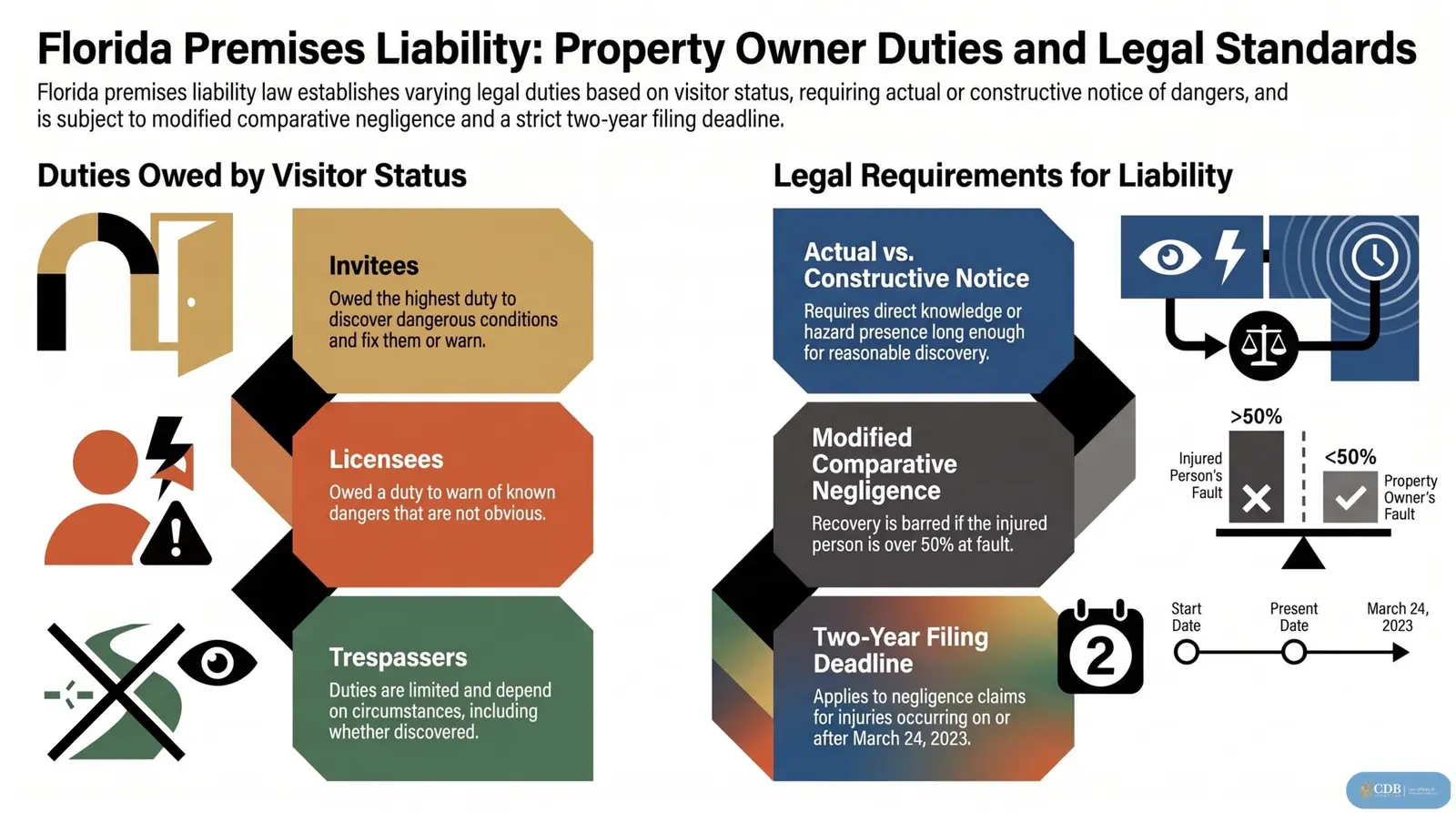
Under Florida premises liability law, the duty owed by a property owner depends on the status of the person injured. Invitees, those who enter for a purpose that benefits the owner, such as customers in a store, are owed the highest duty. The owner must use reasonable care to discover dangerous conditions and either fix them or provide adequate warning. Licensees, who enter with permission but for their own purposes, are owed a duty to warn of known dangers that are not obvious. Duties owed to trespassers are much more limited and depend on the circumstances, including whether the trespasser was discovered and whether a known, non-obvious danger existed; special rules may also apply when children are involved.
The distinction matters because it defines the scope of what must be fixed, and when. For invitees, the obligation is proactive. The owner cannot wait until a problem is reported. Regular inspections, maintenance schedules, and a system for identifying hazards become part of the legal expectation. For licensees, the duty is narrower but still significant: if the owner knows a danger exists, and the visitor does not, a warning or repair is required.
Florida’s modified comparative negligence framework also plays a role. Even when a property owner failed to address a dangerous condition, the injured person’s own conduct is weighed. If the hazard was open and obvious, or if the person was distracted or acting carelessly, recovery may be reduced by that person’s percentage of fault. In most Florida negligence cases, a person found more than 50% at fault is barred from recovering damages. But comparative fault does not erase the owner’s responsibility; it determines how fault affects the final outcome.
Common Dangerous Conditions That Must Be Addressed
Not every imperfection on a property rises to the level of a dangerous condition. A small crack in a sidewalk, visible in daylight, may not create liability. But certain hazards appear repeatedly in premises liability cases, and for good reason: they are both common and capable of causing serious harm.
- Wet or slippery floors without warning signs, especially in entryways, restrooms, or areas where spills are likely
- Uneven flooring, including transitions between surfaces, loose tiles, or torn carpeting that creates a tripping hazard
- Broken or missing handrails on stairs, ramps, or elevated walkways
- Inadequate lighting in stairwells, parking lots, or hallways, making hazards difficult to see
- Potholes, cracked pavement, or uneven surfaces in parking areas and walkways
- Unmarked changes in elevation, such as a single step in an unexpected location
- Defective or poorly maintained equipment, including automatic doors, escalators, or shopping carts
- Known hazards left unrepaired, such as loose floorboards, exposed wiring, or broken fixtures
The key factor is not whether the condition is inherently dangerous, but whether the owner knew or should have known about it and had a reasonable opportunity to fix it. A spill that occurs moments before someone slips may not create liability. The same spill, left unaddressed for hours in a high-traffic area, is more likely to support a claim. When an injury results from a property owner’s failure to maintain safe conditions, understanding the full scope of personal injury claims becomes essential to protecting one’s rights.
The Role of Notice
Proving that a property owner should have fixed a dangerous condition often hinges on notice, either actual or constructive. Actual notice means the owner or an employee was directly informed of the hazard. A customer reports a spill. A tenant notifies the landlord of a broken step. A maintenance worker observes a defect but does not repair it. In these situations, the owner’s knowledge is clear.
Constructive notice is more nuanced. It arises when the condition existed for a long enough period that a reasonable inspection would have discovered it. In Florida business-establishment cases involving a transitory foreign substance, the injured person must prove the business had actual or constructive knowledge of the dangerous condition and should have acted to fix it. The question becomes: how long was the hazard present, and what steps did the owner take to monitor the property? A freshly mopped floor with no warning sign may not establish constructive notice if the fall happens within minutes. But a cracked step that has been visible for weeks, or a pothole that deepens over months, tells a different story.
Documentation plays a critical role here. Inspection logs, maintenance records, and incident reports can either support or undermine a claim. When records are absent, that absence may become an important fact in evaluating whether reasonable inspection and maintenance systems were actually in place.
What Happens When a Dangerous Condition Is Left Unaddressed
Injuries from dangerous conditions are rarely minor. A fall can result in fractures, head trauma, spinal injuries, or soft tissue damage that takes months to heal. Medical treatment begins immediately, emergency room visits, imaging, follow-up appointments. Bills accumulate. Time away from work creates financial pressure. Pain and mobility limitations disrupt sleep, family life, and independence.
The injured person may not immediately realize that the property owner’s failure to fix a known hazard is the reason the injury occurred. Initial focus is on recovery. But as medical expenses mount and the injury’s impact becomes clear, the question of accountability gains urgency. In Florida, the statute of limitations for most negligence claims was recently shortened. For injuries occurring on or after March 24, 2023, the deadline to file a lawsuit is two years. For injuries that happened before that date, the prior four-year deadline generally still applies. Waiting too long can foreclose the right to seek compensation entirely.
Navigating a premises liability claim involves complex legal rules and procedural requirements. Early consultation ensures that critical deadlines are not missed and that evidence, photographs, witness statements, maintenance records, is preserved while still available.
Recognizing When a Hazard Should Have Been Fixed
Not every injury on someone else’s property creates a valid claim. The law does not impose strict liability. A person who ignores a clearly marked wet floor sign, or who runs through a dimly lit area despite a safe alternative path, may bear responsibility for the resulting injury. But when a hazard is hidden, poorly lit, or left unaddressed despite repeated complaints, the balance shifts.
Consider a hypothetical: A grocery store receives a complaint about a broken floor tile near the produce section. The tile is uneven, creating a small lip that is difficult to see under overhead lighting. The store logs the complaint but does not repair the tile or place a warning cone. Two weeks later, a customer trips over the same tile and fractures a wrist. The store’s actual knowledge, combined with the time elapsed and the absence of corrective action, forms the foundation of a premises liability claim.
The question is not whether the injury was foreseeable in a general sense, trips and falls happen, but whether this specific hazard, given its characteristics and the owner’s knowledge, created an unreasonable risk that should have been eliminated.
The Intersection of Maintenance and Liability
Property maintenance is not a one-time event. It is an ongoing obligation. Seasonal changes affect outdoor surfaces. Foot traffic wears down flooring. Weather degrades handrails and lighting. The duty to fix dangerousconditions is continuous, and it requires systems; inspection schedules, responsive repairs, clear reporting channels, that enable the owner to identify and address hazards before someone is hurt.
When those systems fail, or when the owner cuts corners to save costs, the risk shifts to those who enter the property. And when harm results, thelaw provides a mechanism to restore what was lost: medical expenses, lost income, pain and suffering, and in cases of permanent injury, future medical costs and diminished earning capacity.
The moment after a fall, the cause may seem abstract. But the injury is real. The bills are real. The time away from work and family is real. And the question of whether the property owner’s failure to fix a dangerous condition contributed to that injury is not just legal, it is personal. Knowing what property owners are required to repair, and when that duty arises, is the first step toward understanding whether an injury was preventable and whether accountability is owed.
Closing Remarks
If a fall occurred on property where broken stairs were left unrepaired, inadequate lighting obscured a hazard, or a known defect was ignored despite complaints, the question is not just what happened, but whether it should have been prevented. CDB Injury Law represents individuals injured by dangerous conditions that property owners failed to fix. Contact us to discuss your situation and the path toward recovery.
Frequently Asked Questions
What is the difference between actual and constructive notice in a premises liability case?
Actual notice means the property owner or an employee was directly informed of the dangerous condition, through a complaint, a report, or personal observation. Constructive notice arises when the hazard existed long enough that a reasonable inspection would have discovered it. Both forms of notice can establish that the owner should have fixed the condition before someone was injured.
Does a property owner have to fix every minor imperfection?
No. Florida law requires reasonable care, not perfection. Minor imperfections that are open and obvious, or that do not create an unreasonable risk of harm, typically do not give rise to liability. The focus is on hazards that are hidden, inadequately lit, or otherwise likely to cause injury to someone exercising reasonable care.
Can a property owner avoid liability by posting a warning sign?
A warning sign may reduce or eliminate liability if it adequately alerts visitors to the danger and gives them a reasonable opportunity to avoid it. But a sign does not always substitute for repair. If the hazard is severe, or if the warning is insufficient, placed in poor lighting, worded vaguely, or positioned where it is easily missed, the owner may still be held responsible for failing to fix the underlying condition.
How long does a property owner have to fix a dangerous condition once they know about it?
There is no fixed timeline. The law requires the owner to act within a reasonable time given the severity of the hazard and the practical ability to repair it. A spill may need to be cleaned immediately, or at minimum cordoned off and marked. A broken handrail may require scheduling a contractor, but the owner must act promptly and, in the interim, may need to restrict access or post warnings. Delay that is unreasonable under the circumstances can support a negligence claim.
What if the dangerous condition was caused by another visitor, not the property owner?
The property owner may still be liable if they had notice of the condition and failed to address it within a reasonable time. For example, if a customer spills a drink in a store aisle and the store is notified but does not clean it up for an hour, the owner’s failure to act, not the original spill, becomes the basis for liability. The question is whether the owner had the opportunity to discover and fix the hazard before the injury occurred.
Does comparative negligence apply if the injured person was distracted or not paying attention?
Yes. Florida applies a modified comparative negligence standard. If the injured person’s own conduct contributed to the fall, such as texting while walking or ignoring a visible warning, damages may be reduced by their percentage of fault. In most negligence cases, if the injured person is found more than 50% at fault, recovery is barred. However, comparative negligence does not eliminate the property owner’s duty. Recovery may still be possible if the owner failed to fix a dangerous condition they knew or should have known about and the injured person is not barred under Florida’s fault rules.
References
- Florida Statutes § 95.11(4) (a).
- Florida Statutes § 768.0755
- Florida Statutes § 768.81