


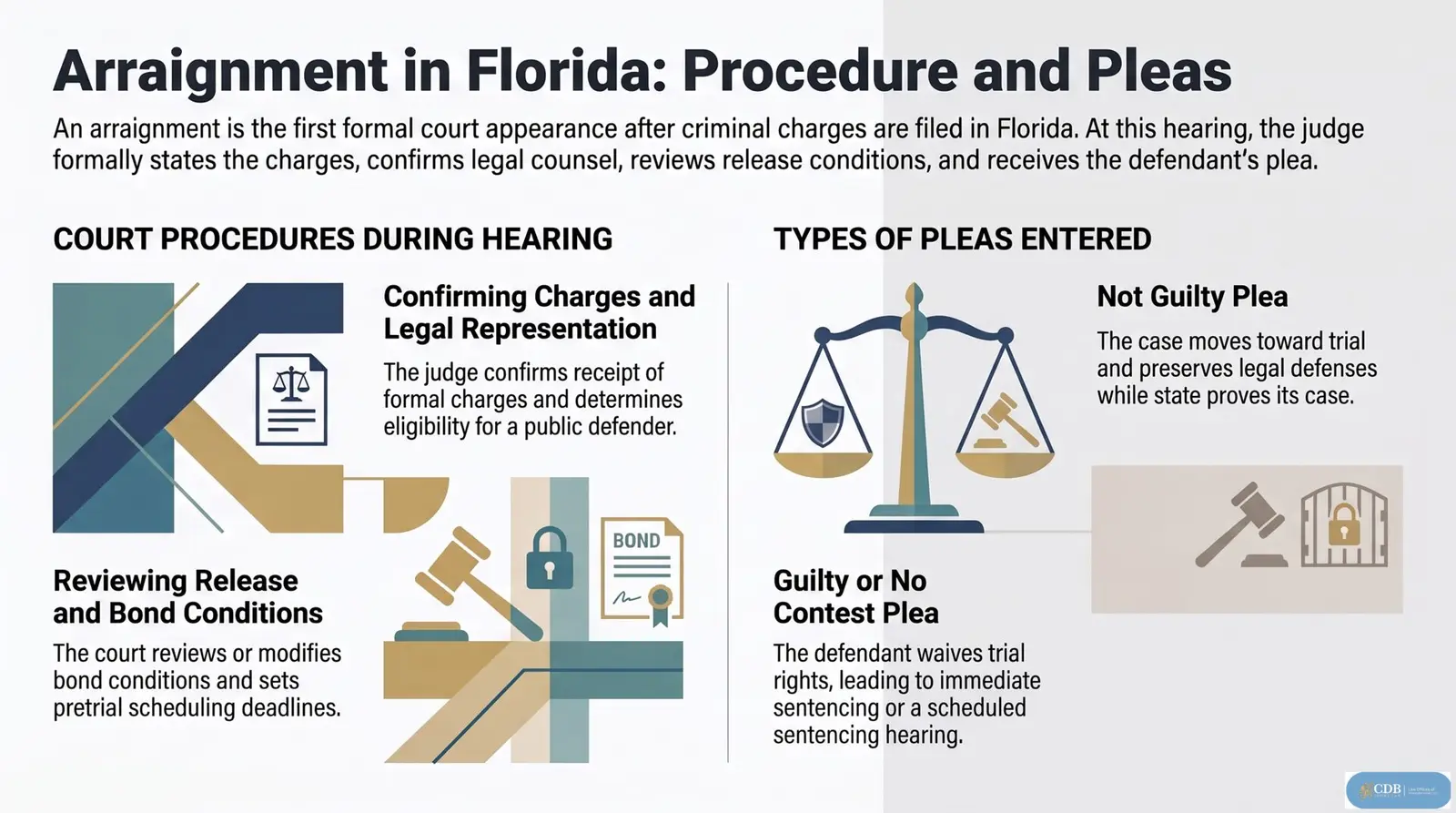
An arraignment is your first formal court appearance after criminal charges are filed in Florida. At this hearing, you are officially told the charges against you, and you will enter a plea. The judge also addresses release conditions, confirms whether you have a lawyer, and sets the schedule for the next steps in your case.
An arraignment notice can feel like a summons to a world you never wanted to enter. Formal charges are no longer a possibility; they are a reality, stated in stark, legal language. The uncertainty of what happens in that courtroom, what you should say, what will be decided, and what it all means for your future, can be overwhelming. This is a moment when control feels lost, and the path forward is anything but clear.

An arraignment is not a trial where guilt or innocence is decided. It is a critical first step in the court process, but one where the decisions made have lasting consequences. Understanding what happens during this hearing, the importance of your plea, and how it affects everything that follows is the first step toward reclaiming a sense of control.
What the Arraignment Is and When It Occurs
An arraignment is the formal hearing where a judge informs you of the criminal charges filed against you and asks you to enter a plea. Under Florida Rule of Criminal Procedure 3.160, the arraignment is conducted in open court unless it is properly waived. A defendant is not always required to personally appear if a written plea of not guilty and waiver are properly filed and the court does not require appearance, but this depends on the charge, the court, and local practice. You should never assume you are excused from court unless your attorney or the court has confirmed it.
The timing depends on how your case started. If you were arrested and had a first appearance hearing, the arraignment usually happens after the State files the formal charging document. If charges were filed after an investigation without an initial arrest, the arraignment is often your very first time in court. The exact date can vary by county, charge level, and court schedule, and it may be continued or waived when the rules allow.
The court clerk is supposed to send a notice with the arraignment date, but this notice can arrive late or get lost in the mail. Missing your arraignment is serious; it can lead to a bench warrant for your arrest and the loss of any bond you have posted.
What Happens During the Arraignment Hearing
The arraignment hearing follows a set procedure. The judge calls your case, the prosecutor states the charges against you, and then you are asked to enter a plea: guilty, not guilty, or no contest.
If you plead not guilty, your case moves forward toward trial. This plea does not mean you are disputing every fact; it simply means you are exercising your right to have the State prove its case beyond a reasonable doubt. If you plead guilty or no contest, the judge may sentence you immediately or schedule a separate sentencing hearing. A no contest plea, sometimes called nolo contendere, has the same result as a guilty plea in the criminal case, but it may offer an important protection because it generally cannot be used against you as an admission of guilt in a separate civil lawsuit. That protection can be fact-specific, so it should be discussed with a lawyer before any plea is entered.
During the arraignment, the judge will also handle several other important matters:
- Confirming you have received a copy of the formal charges.
- Appointing a public defender if you cannot afford an attorney and are eligible.
- Reviewing and possibly changing the bond conditions that were set at your first appearance.
- Setting deadlines for future steps, like exchanging evidence and filing pretrial motions.
If you do not have a lawyer and cannot afford one, the court will determine if you are financially eligible for a public defender. Florida law guarantees legal representation to those who face potential jail time and cannot afford to hire an attorney. If you have retained a private criminal defense lawyer, they will file a notice of appearance and can handle many aspects of the hearing for you, including seeking to waive your personal appearance when the rules and the judge allow it.
The Significance of the Plea Entered
The plea you enter at arraignment directs the path of your case. A not guilty plea preserves all your legal defenses and opens the door for your attorney to file motions to suppress evidence, dismiss charges, or challenge statements. The burden remains on the State to prove its case. This plea is not set in stone; it can be changed later if plea negotiations result in a favorable resolution.
Conversely, a plea of guilty or no contest at arraignment means you are waiving your right to a trial and most other challenges. Before accepting such a plea, the judge must conduct a formal series of questions to ensure your plea is being made voluntarily, knowingly, and intelligently. You will have to confirm that you understand the charges, the maximum penalties, and the constitutional rights you are giving up, such as the right to a jury trial and the right to remain silent.
Many people plead not guilty at arraignment even if they plan to resolve the case later. This provides crucial time for their defense team to conduct an investigation, review the State’s evidence, and negotiate from a position of strength. Your initial plea is a strategic step, not necessarily your final word.
Bond Review and Pretrial Release Conditions
For those in custody, the arraignment can be an important opportunity to ask the judge to reconsider bond. Your defense attorney can argue for a lower bond amount, a switch to supervised release instead of a monetary bond, or changes to restrictive conditions like house arrest or no-contact orders. The judge will weigh factors under Florida Rule of Criminal Procedure 3.131, including your ties to the community, your criminal history, the nature of the charges, and any potential danger to the public.
If you are already out on bond, the judge will confirm the existing conditions. If you were not arrested but instead received a notice to appear in court, the judge may set release conditions for the first time at your arraignment if the court believes they are necessary.
Navigating the bond hearing process requires a clear understanding of what judges look for and what arguments can be made to protect your freedom while the case is pending.
Scheduling Pretrial Motions and Discovery
After a not guilty plea, the court sets a timeline for the pretrial phase. This includes discovery, the formal process of exchanging evidence governed by Florida Rule of Criminal Procedure 3.220. Once discovery is invoked, the rule governs what the State must disclose, what the defense may request, and what reciprocal obligations may apply.
Pretrial motions are powerful tools used to challenge the State’s case. They can include motions to suppress illegally obtained evidence, motions to dismiss charges due to procedural errors or lack of evidence, or motions to prevent the other side from introducing unfairly prejudicial information at trial. Missing court-ordered deadlines can mean losing the chance to file these critical challenges.
The judge will also schedule future court dates, such as a case management conference, where both sides report their progress. If the case is not resolved through motions or plea negotiations, a trial date will be set, often months away, to allow time for thorough preparation.

An arraignment is often over in minutes, but its impact lasts for the entire life of the case. The plea entered, the bond conditions set, and the legal deadlines established at this brief hearing are foundational. These are not mere formalities; they are strategic decisions that require foresight and guidance. Having a steadfast advocate by your side ensures your rights are protected from this very first step.
Closing Remarks
Facing criminal charges can make you feel powerless, your future hanging on a process you do not understand. You do not have to face this alone. At CDB Injury Law, our mission has always been to stand up for people when their lives are thrown into chaos, whether by a sudden injury or a frightening criminal allegation. We are here to restore your clarity, control, and peace of mind. Let us talk about what comes next. Contact us for a confidential consultation to protect your rights and your future.
Frequently Asked Questions
Can an attorney appear at arraignment on behalf of the defendant?
Yes, in some circumstances. Florida Rules of Criminal Procedure 3.160 and 3.180 allow arraignment to be waived or personal appearance to be excused when counsel properly files a written plea of not guilty and the court does not require the defendant to appear. This is common in many misdemeanor cases, but felony cases and local court practices vary. Some judges require the defendant’s presence even when counsel is ready to proceed, so you should confirm your obligations before the hearing date.
What happens if the defendant pleads not guilty at arraignment but later wants to change the plea?
A not guilty plea entered at arraignment is not binding. The defendant can change the plea to guilty or no contest at any time before trial, usually as part of a negotiated plea agreement. The change of plea occurs at a separate hearing where the judge asks a series of questions to ensure the new plea is voluntary and informed. Changing a plea after arraignment is common and does not reflect negatively on the defendant. It is a normal part of the pretrial process as discovery is reviewed and negotiations proceed.
Does the arraignment affect eligibility for pretrial diversion or deferred prosecution?
The arraignment itself does not determine eligibility for diversion programs, but the timing matters. Pretrial diversion and deferred prosecution programs in Florida typically require application before a plea of guilty or no contest is entered. Entering a not guilty plea at arraignment preserves the opportunity to apply for diversion while the case is pending. Once a guilty or no contest plea is entered and accepted, diversion is generally no longer available. Defense counsel can negotiate for diversion during the pretrial period that follows arraignment.
What happens if the defendant does not understand the charges read at arraignment?
If you do not understand the charges, the legal language, or the potential penalties, you have the right to ask for clarification before entering any plea. The court can address the nature of the charges, and your attorney can explain the legal meaning, possible penalties, and defense strategy in more detail. If you do not speak English, the court must provide an interpreter. If more time is needed, the arraignment may be postponed so you can meet with your lawyer and review the charging document. You should never enter a plea without fully understanding what is being alleged and what your plea means.
Can bond be increased at arraignment even if it was already set at first appearance?
Yes. Bond set at a first appearance is often based on the limited information in an arrest report. By the arraignment, the prosecutor has filed formal charges, which may contain more details or additional counts. The prosecutor can ask to increase your bond, and the court may grant it if new information justifies a higher amount or more restrictive conditions. You have the right to argue against any proposed changes, and your attorney can present evidence and arguments to keep your bond fair and reasonable.
References
- Florida Rule of Criminal Procedure 3.160
- Florida Rule of Criminal Procedure 3.131
- Florida Rule of Criminal Procedure 3.220
- Florida Rule of Criminal Procedure 3.180