
Sealing hides a criminal record from most public view, while expungement effectively destroys it. In Florida, you typically get only one chance to clear your record, and eligibility depends on how your case was resolved, your prior history, and specific waiting periods. The right choice is critical, as it is often permanent.
Long after a criminal case is over, the arrest record can linger, casting a shadow that blocks opportunities for jobs, housing, and peace of mind. Every background check becomes a source of anxiety, making you feel judged for a past that no longer reflects who you are. Florida law provides two powerful tools to clear a record: sealing and expungement, but the path is filled with strict rules and potential pitfalls. Understanding the difference is the first step toward reclaiming your future.

Record relief in Florida is not automatic. It is a formal legal process with rigid requirements. Sealing and expungement serve different purposes, have different eligibility rules, and lead to different outcomes. Both require a court order and proof that you meet all statutory conditions. The choice between them depends entirely on the details of your case and what you need this relief to achieve.
What Sealing a Record Does and Does Not Hide
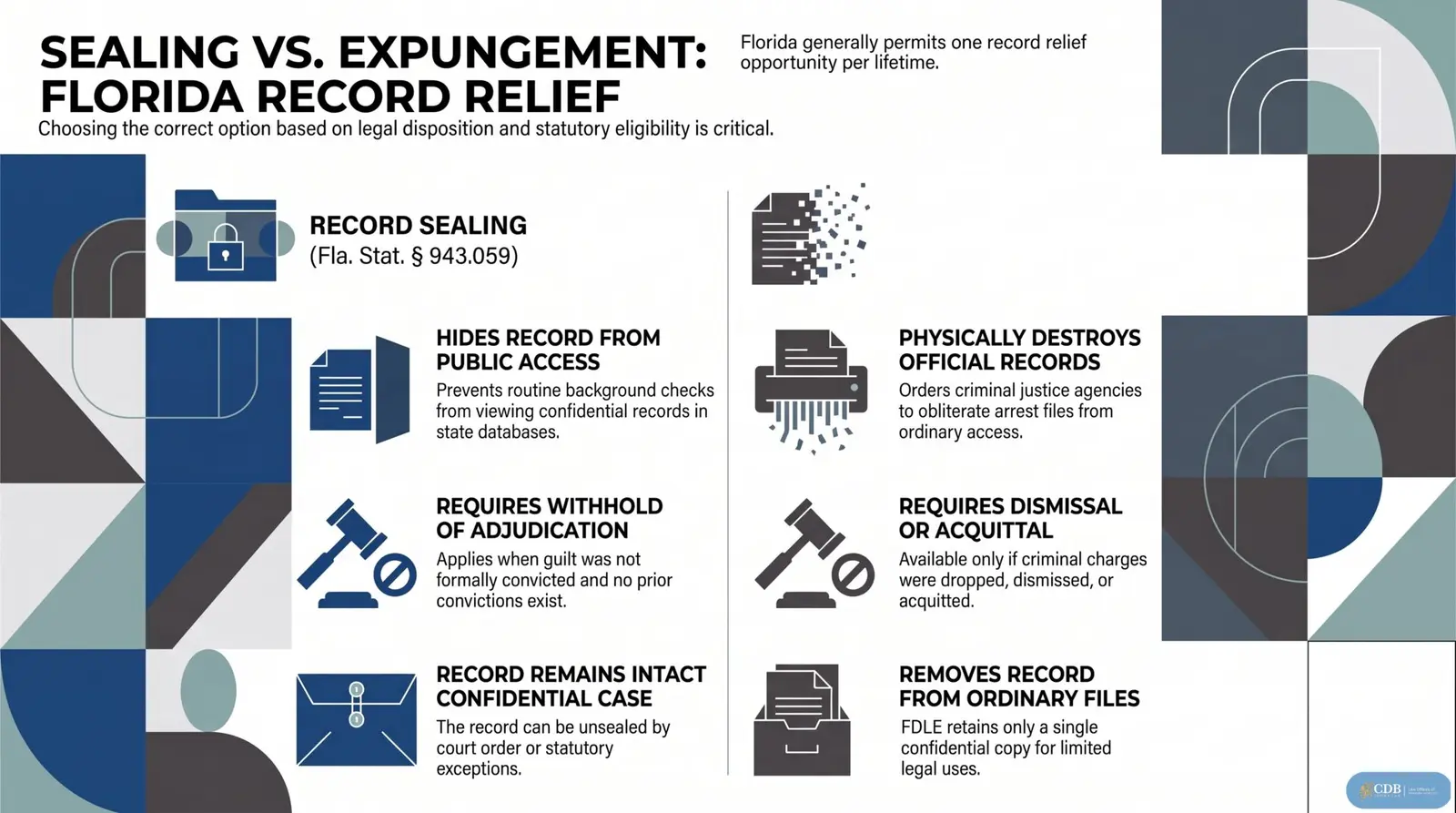
Sealing makes a criminal record confidential under Florida Statute § 943.059. While the record still exists, it is removed from public access. This means most private employers, landlords, and other routine background checkers will not see it through the Florida Department of Law Enforcement’s public criminal history database.
However, “sealed” does not mean invisible. Certain government and state-licensed entities can still access these records when authorized by law. Law enforcement agencies, the Florida Bar, the Department of Children and Families, and agencies that screen for jobs with children or vulnerable adults may be able to see sealed records in specific statutory situations. A sealed record may also become accessible again if you are later charged with a new crime.
Despite these exceptions, Florida law allows individuals with sealed records to lawfully deny the arrest in most situations. The statute lets you state that you were not arrested on many applications for employment, licenses, or other civil privileges, but it also lists situations where disclosure is still required. Sealing offers meaningful relief, but it is not a complete erasure of the event.
What Expungement Removes From Official Systems
Expungement offers a more complete solution. Under Florida Statute § 943.0585, a court order to expunge a record generally requires criminal justice agencies to physically destroy or obliterate the arrest record and related docume nts. The record is not just hidden from the public; it is removed from ordinary agency files. FDLE retains a confidential copy for very limited statutory uses, such as a future criminal investigation or other purposes allowed by law.
Like sealing, expungement allows you to lawfully deny the arrest ever occurred in most settings, except in specific statutory situations, such as applying for certain sensitive jobs or dealing with a criminal justice agency. Private data companies might still have old information they collected before the expungement, so additional follow-up may be needed if outdated information appears in a private background check. You may have rights under the Fair Credit Reporting Act if a background reporting company reports inaccurate or legally outdated information that harms an opportunity.
The key difference is permanence. A sealed record can be unsealed by a court order. An expunged record is removed from ordinary public and agency access, with only narrow statutory exceptions. For those who qualify, it is the closest thing to a truly clean slate.
Florida Allows One Record Relief Per Lifetime
Florida law generally provides only one opportunity to clear a record in a lifetime. While a narrow exception exists that may allow a sealed record to be expunged after ten years, this option has strict requirements and is not a guaranteed path. This makes your initial choice not just strategic, but permanent in most situations.
Eligibility Turns on Disposition and Disqualifying Offenses
Not every case is eligible for sealing or expungement. Florida law sets clear criteria that must be met before a court will even consider a petition.
Expungement is generally available only if:
- The charge was dismissed, dropped (no-actioned), or you were acquitted at trial.
- No conviction was entered.
- You have never been convicted of any criminal offense.
- You have never successfully sealed or expunged a record before.
- The case does not involve a statutory disqualifying offense under Florida’s sealing and expungement laws.
Sealing is available if:
- The court withheld adjudication of guilt (meaning you were not formally convicted).
- You were not convicted of the offense.
- You have never been convicted of a criminal offense or previously sealed or expunged a record.
- The case does not involve a statutory disqualifying offense under Florida’s sealing and expungement laws.
Florida law lists numerous offenses that can prevent sealing or expungement, even when adjudication was withheld. These disqualifying offenses are now addressed in § 943.0584 and include many charges involving violence, sexual misconduct, child abuse, and other serious conduct. These restrictions are set by law and are not something a judge can simply overlook, which is why verifying eligibility at the very start is so important. For guidance on how a withhold of adjudication functions, see our post on Withhold of Adjudication vs. Conviction: FL.
Certificate of Eligibility, Prosecutorial Input, and Judicial Discretion
Even if you meet the basic criteria, relief is not guaranteed. The process starts with applying to the Florida Department of Law Enforcement (FDLE) for a Certificate of Eligibility. The FDLE reviews your criminal history to confirm you qualify under the statute. This certificate does not grant the relief itself. It simply gives you permission to ask the court for it.
With the certificate in hand, a formal petition is filed with the court where the case was handled. The State Attorney’s Office is notified and can object to your petition. If the state objects, or if the judge has questions, a hearing will be held.
The final decision is up to the judge. Even with an FDLE certificate and no objection from the prosecutor, a judge can deny the petition if they believe it is not in the interest of justice. The court might consider the nature of the original offense, your behavior since the arrest, and the impact on any victims.
This is where careful preparation is vital. Your petition must not only prove you are technically eligible but also persuade the court that you deserve this second chance. Understanding how to position your case from the very beginning can preserve these future options, a key aspect we cover in our guide to Criminal Defense.
Timing and the Prohibition on Concurrent Relief
You cannot seek to seal or expunge a record while you have other criminal charges pending. The ca se you want to address must be completely resolved, whether through dismissal, a withhold of adjudication, or an acquittal. If your case included probation, court costs, or other sentence requirements, those obligations generally must be completed before the court will grant relief.
Choosing Between Sealing and Expungement When Both Are Possible
It is rare for someone to qualify for both options for the same charge. Expungement is generally for cases that were dismissed, dropped, or resulted in an acquittal, while sealing is generally for cases that ended with a withhold of adjudication. However, if your charge was dismissed and you have a clean record, expungement is usually the stronger choice. It removes the record from ordinary agency files instead of just hiding it from public view and reduces the risk of it resurfacing later.
If adjudication was withheld, sealing is likely your only option. It still provides powerful relief, allowing you to move forward without the constant worry of a public record. It restores dignity and opens doors, but it is a compromise, not a complete reset.
Because you only get one chance, the choice is irreversible in most cases. Filing to seal a record without understanding the long-term consequences could prevent you from ever obtaining a better form of relief. Getting clear le gal advice before you file is not just a good idea, it’s essential.

Clearing your record is not a simple administrative task; it is a complex legal process with strict rules and lifelong consequences. The difference between sealing and expungement can seem small, but in practice, it is everything. One leaves a trace, while the other removes it from ordinary access. Florida law offers you one shot to get it right.
Closing Remarks
If an old arrest record is holding you back, you do not have to navigate this complicated process alone. The feeling of being stuck is one we understand deeply. At CDB Injury Law, our mission has always been to h elp people regain control when they feel powerless, whether it is after an injury or a legal entanglement from the past. We provide dedicated guidance on sealing and expungement to help you clear your record and move forward with confidence. Let us talk about the best path for your situation.
Frequently Asked Questions
Can a sealed record be unsealed later?
Yes. A sealed record still exists and can be unsealed by a court order in certain situations. Florida law also allows access to sealed records in specific statutory circumstances, including certain later criminal proceedings. Expungement, in contrast, removes the record from ordinary agency files and is generally irreversible, subject to narrow statutory exceptions.
Does expungement remove the arrest from private background check databases?
An expungement order legally requires criminal justice agencies to destroy or obliterate most of their records, while FDLE retains a confidential copy for limited statutory purposes. However, private data companies that collected the information before the order might still have it in their systems. If a background reporting company continues to report inaccurate or legally outdated information, you may have legal recourse under the Fair Credit Reporting Act.
Can someone seal or expunge multiple arrests from the same incident?
Yes. If multiple charges arose from a single criminal incident, Florida law allows them to be treated as one “criminal history record” for the purpose of sealing or expungement. This allows you to clear the entire event at once. This exception does not apply to unrelated arrests that happened at different times.
What happens if FDLE denies the Certificate of Eligibility?
If the FDLE determines you do not meet the statutory requirements, it will deny the certificate and explain why. From there, you may be able to correct the issue, provide missing documentation, or challenge FDLE’s determination through available administrative or legal channels. The court generally cannot grant sealing or expungement without the required certificate, so this step must be handled carefully.
Does a withhold of adjudication count as a conviction for purposes of eligibility?
No. For the purposes of sealing a record under § 943.059, Florida law does not consider a withhold of adjudication to be a conviction. This is what makes many people eligible for sealing. However, a case that resulted in a withhold is generally not eligible for expungement unless specific and rare conditions are met. This distinction is critical in determining which relief you can seek.
Can record relief be sought while on probation?
Generally, no. Florida law requires you to complete all terms of your sentence, including probation, before you can apply to have your record sealed or expunged. If you successfully file a motion for early termination of your probation, you may become eligible sooner. Until your sentence is fully complete, the case is not considered resolved.
References
- Fla. Stat. § 943.059 (Sealing of criminal history records). (Last Verified: September 2023).
- Fla. Stat. § 943.0585 (Expunction of criminal history records). (Last Verified: September 2023).
- Fla. Stat. § 943.0584 (Criminal history records ineligible for court-ordered expunction or court-ordered sealing). (Last Verified: September 2023).