
In Florida, sealing a criminal record hides it from most public searches but law enforcement and certain agencies can still access it, while expungement physically destroys the record in most cases. Eligibility for either depends on charge disposition, prior record, statutory exclusions, and whether a certificate of eligibility has been obtained from FDLE. Many who assume their case qualifies discover disqualifying factors only after filing.
A criminal record does not fade with time. It sits in databases, waiting to surface during background checks, loan applications, licensing reviews, and employment screenings. For those who resolved a charge years ago, through dismissal, withhold of adjudication, or completion of diversion, the assumption is often that the matter is closed. Then the denial letter arrives, or the interview ends abruptly, and the reality becomes clear: the record still speaks, louder than any explanationever will. Florida law offers two forms of relief, sealing and expungement, but the paths are narrow, the eligibility rules unforgiving, and the consequences of choosing the wrong remedy can foreclose future options entirely.

Understanding the difference between these two forms of record relief, and knowing which charges qualify under Florida law, is not academic. It determines whether someone can reclaim opportunities or remain tethered to a moment they have long since moved past.
What Sealing a Record Actually Does
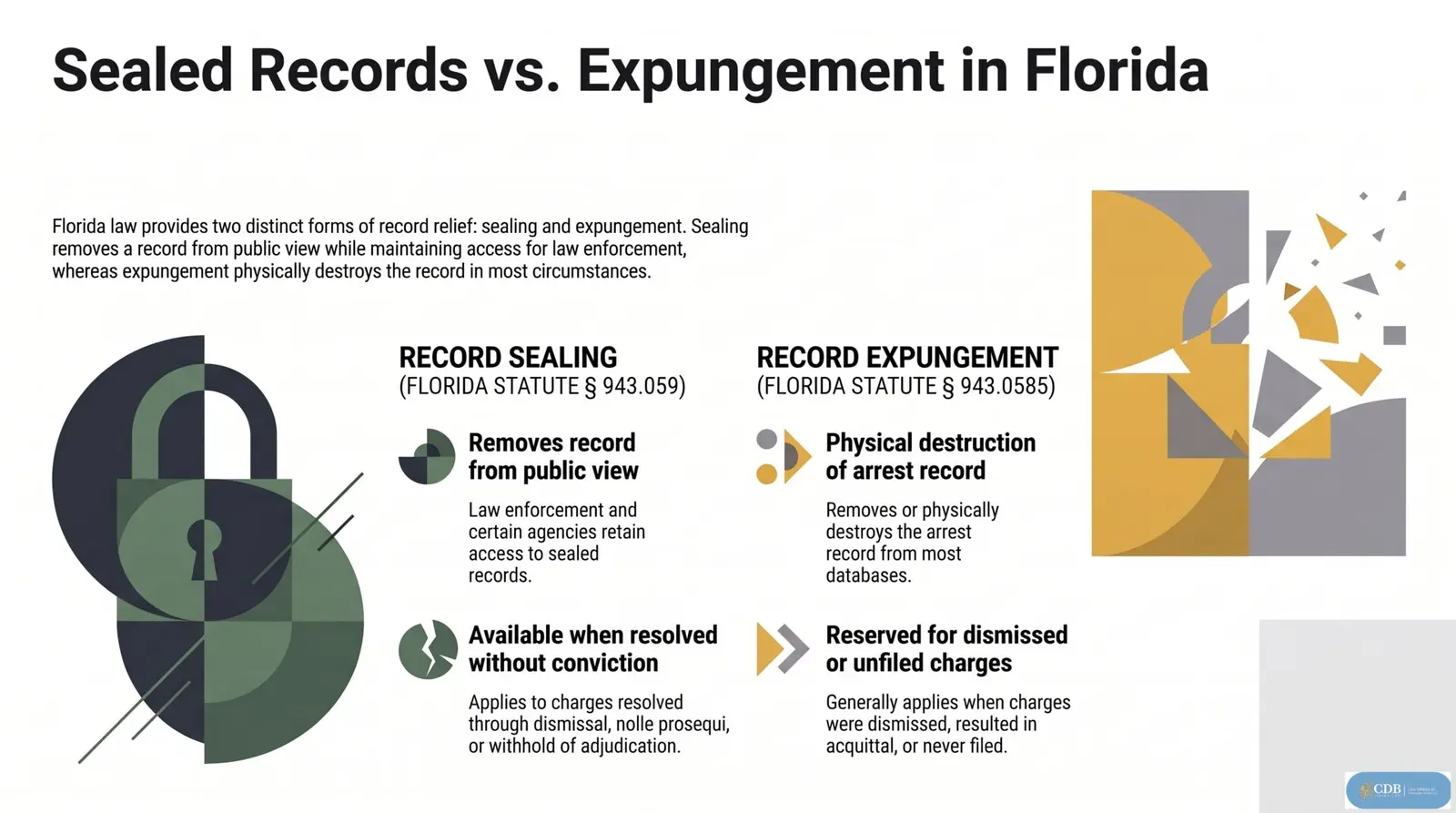
Sealing a criminal record under Florida Statute § 943.059 removes it from public view. The arrest, charges, and disposition no longer appear in most background checks conducted by private employers, landlords, or educational institutions. But sealed does not mean erased. Law enforcement agencies, prosecutors, courts, and certain licensing boards retain access. When applying for jobs in law enforcement, healthcare, education, or positions requiring state licensure, a sealed record may still be disclosed and considered.
Sealing is available when a charge was resolved without a conviction, typically through a dismissal, nolle prosequi, or withhold of adjudication. A withhold means the court did not formally enter a conviction, even though the defendant may have entered a plea and completed probation. This distinction matters. Someone who received a withhold of adjudication after completing pretrial diversion or a negotiated plea may be eligible to seal the record, provided no other disqualifying factors exist.
But access to sealing is not automatic. It requires a certificate of eligibility from the Florida Department of Law Enforcement (FDLE), a process that scrutinizes the applicant’s entire criminal history. A single prior sealing, expungement, or disqualifying offense can result in denial.
What Expungement Actually Does
Expungement under Florida Statute § 943.0585 goes further. It results in the physical destruction or removal of the arrest record from most databases. Once expunged, the individual can lawfully deny the arrest in most contexts, including on employment applications. But like sealing, expungement does not erase the record from every corner of the system. Criminal justice agencies retain a confidential copy, accessible in limited circumstances such as future prosecution or certain licensure applications.
Expungement is generally reserved for charges that were dismissed, resulted in acquittal, or were never filed after arrest. It is not ordinarily available if the defendant entered a plea, received a withhold of adjudication, or was found guilty, even if adjudication was withheld, unless a separate statutory pathway applies, such as a qualifying record that has first been sealed for the required period. This creates a sharp divide: those who fought their case and won, or whose charges were dropped, may pursue expungement. Those who resolved the matter through negotiation, even successfully, are usually limited to sealing.
The stakes are real. Someone arrested on a felony charge that was later reduced to a misdemeanor and resolved with a withhold cannot usually expunge the arrest. The reduction helps at sentencing and probation, but the record relief available is often sealing only. The difference becomes critical when the question on a professional license application asks, “Have you ever been arrested?” rather than “Have you ever been convicted?”
Statutory Exclusions That Can Bar Relief
Florida law lists specific offenses that can bar sealing or expungement when the person was found guilty of, or pled guilty or nolo contendere to, the listed offense, even if adjudication was withheld. These exclusions appear in Florida Statutes § 943.059(2)(a) for sealing and § 943.0585(2)(a) for expungement. The lists overlap significantly but are not identical, and both are detailed and unforgiving.
The following list includes common examples of offenses that may disqualify an individual, but it is not exhaustive. The exact statutory charge, plea history, and final disposition are what determine eligibility.
- Aggravated assault or aggravated battery
- Arson
- Burglary of a dwelling and certain serious property offenses
- Child abuse, neglect, or pornography offenses
- Drug trafficking or certain controlled-substance manufacturing offenses
- DUI or boating under the influence offenses
- Kidnapping or false imprisonment
- Lewd or lascivious offenses
- Manslaughter, homicide, or vehicular homicide
- Robbery or carjacking
- Sexual battery or sexual misconduct offenses
- Stalking or aggravated stalking
- Terrorism-related offenses
- Offenses that serve as predicates for sexual predator or sexual offender registration
A later reduction or dismissal does not automatically answer the eligibility question. FDLE and the court may need to review the arrest record, charging document, plea, disposition, and statutory basis for each count. Someone originally arrested for a serious felony but later charged with and pleading to a non-disqualifying misdemeanor may face a different analysis than someone who pled to the disqualifying offense and received a withhold. The eligibility determination turns on the actual record, not just the short label that appears on a public docket.
This is where many self-filed petitions fail. The applicant sees a dismissal or a reduced charge, assumes eligibility, submits the certificate application, and receives a denial months later because another part of the record tells a different story.
The Certificate of Eligibility Process and Why It Fails
Before a court can grant sealing or expungement, FDLE must issue a certificate of eligibility. This is not a formality. FDLE conducts a comprehensive review of the applicant’s Florida and national criminal history. The application requires fingerprints, a processing fee, and certified copies of case dispositions. Processing can take three to five months, sometimes longer.
FDLE denies certificates for several reasons: prior sealing or expungement (Florida allows only one in a lifetime for most applicants), disqualifying offenses on the record, incomplete disposition information, or pending charges. A prior arrest that was never formally resolved, perhaps because the person moved out of state or the case sat inactive, can trigger a denial. A failure to appear that resulted in a bond revocation or capias, even if later recalled, may need to be addressed before FDLE will approve the application.
Denials are not always accompanied by detailed explanations. The applicant is left to reconstruct their own history, often across multiple counties and decades, to determine what disqualified them. Reapplication requires starting over, new fingerprints, new fees, new waiting period.
Why Sealed Records Still Cause Problems
Even after sealing, certain doors remain closed or partially open. Federal agencies, including immigration authorities and the FBI, retain access to sealed records. Applications for federal employment, security clearances, or immigration relief often require disclosure of arrests even if sealed under state law. Some professional licensing boards, particularly in healthcare, law, and financial services, have statutory authority to access sealed records and may deny licensure based on the underlying conduct, regardless of whether a conviction was entered.
The expectation that sealing resolves all consequences is a common miscalculation. It removes the record from the public sphere, but it does not eliminate it from the systems that matter most in certain career paths.

Expungement offers a stronger shield, but even expunged records are not entirely invisible. They remain accessible to criminal justice agencies in the event of a subsequent arrest or prosecution and may be considered in future plea negotiations or sentencing if the person is charged again. The legal fiction that the arrest “never happened” has limits defined by statute and caselaw.
Closing Remarks
If a charge was dismissed but the arrest still appears on background checks, if a withhold of adjudication years ago now blocks a professional license, or if an FDLE certificate application was denied without clear explanation, the path forward can feel uncertain. A criminal record often feels like a permanent injury to your reputation and opportunities. At CDB Injury Law, our criminal defense practice is dedicated to helping people restore their lives when they feel powerless. We guide individuals throughout Florida in navigating the complex sealing and expungement process, from eligibility review to the final court hearing. You do not have to face this alone. Contact us to discuss your record and what relief may be available.
Frequently Asked Questions
Can a felony charge that was reduced to a misdemeanor be expunged?
Expungement eligibility depends on the charging history and final disposition, not simply the severity of the original arrest. If the reduced misdemeanor was dismissed or resulted in acquittal, expungement may be possible. If it was resolved with a plea and withhold of adjudication, sealing is usually the available remedy, and only if the offense is not on the statutory exclusion list. The reduction itself does not create expungement eligibility if the case was resolved through a plea.
How long does someone have to wait before applying for sealing or expungement?
There is no mandatory waiting period after final disposition for most cases. An application for a certificate of eligibility can be filed as soon as all conditions of the case are satisfied, fines paid, probation completed, restitution fulfilled. However, if charges are still pending in any case, FDLE will deny the application. Some applicants wait years before discovering they were eligible immediately after their case closed.
Does sealing a record remove it from FBI databases?
No. Sealing under Florida law removes the record from state public access systems, but federal databases maintained by the FBI and other agencies retain the information. When applying for federal jobs, immigration benefits, or positions requiring federal background checks, sealed records may still be disclosed. Expungement offers slightly more protection but does not guarantee removal from all federal systems.
Can someone seal more than one arrest in Florida?
Florida law generally permits only one sealing or expungement in a person’s lifetime, with limited exceptions. If a prior record was sealed or expunged, a subsequent application for a different arrest will typically be denied by FDLE. There are narrow exceptions for certain juvenile records or cases sealed administratively, but for most adults, the one-time rule is absolute. Choosing which record to seal or expunge, when multiple arrests exist, requires careful evaluation of which record causes the most harm.
What happens if FDLE denies a certificate of eligibility?
A denial from FDLE is not a court order. The next step is usually to identify the reason for denial and determine whether the issue can be corrected. If the denial was based on incorrect information, such as a disposition that was never updated in the system, submitting corrected records and reapplying may succeed. If the denial was based on a disqualifying offense or prior sealing, the legal options are limited. Some applicants pursue a pardon from the governor as an alternative pathway, though pardons are rare and discretionary.
References
- Florida Statute § 943.059 (Court-ordered sealing of criminal history records).
- Florida Statute § 943.0585 (Court-ordered expunction of criminal history records).