
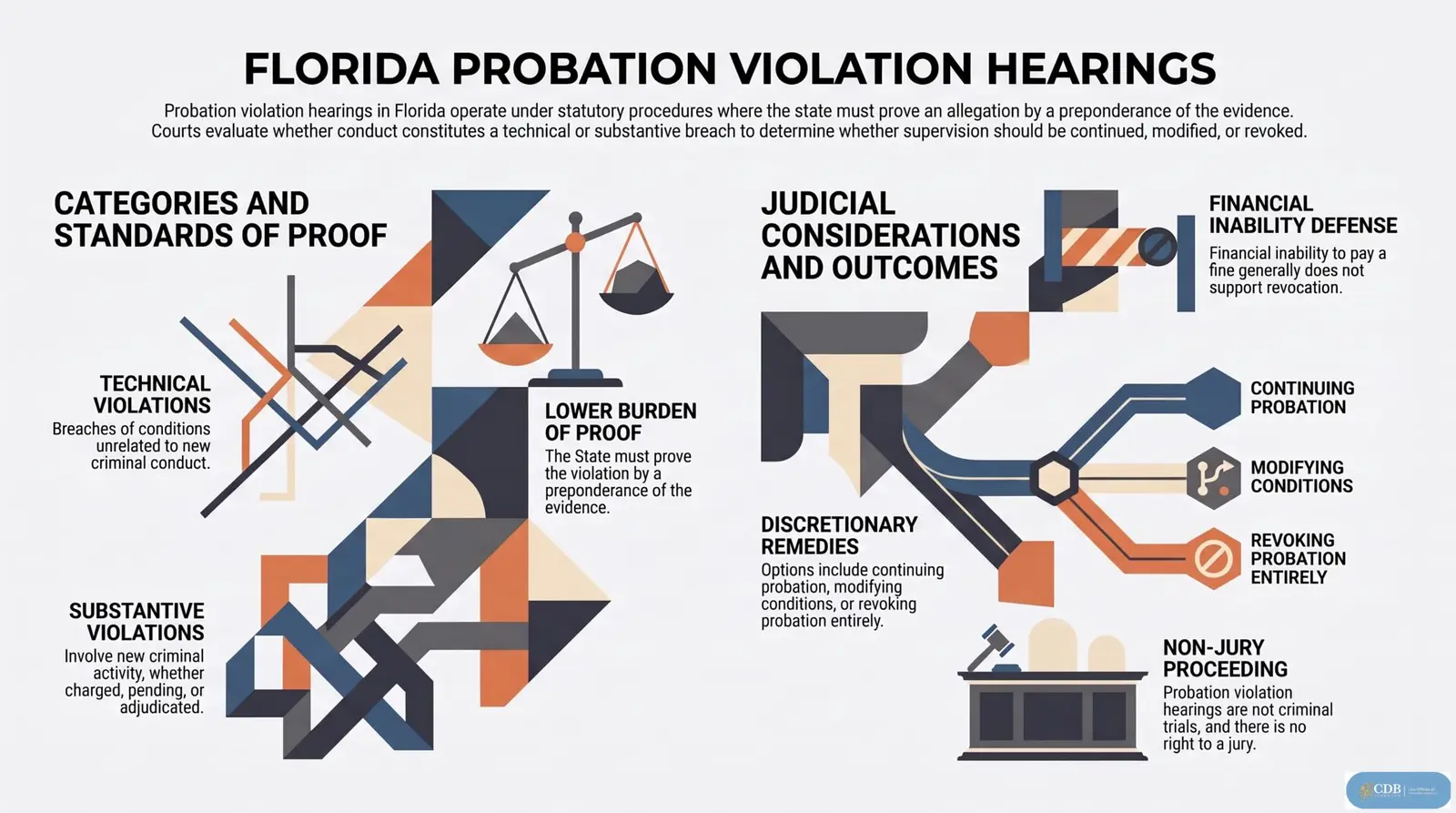
TL;DR: A probation violation hearing determines whether the court revokes probation, modifies conditions, or continues supervision. Florida Statutes § 948.06 governs the process, and the burden of proof is lower than at trial. Courts consider the severity of the violation, prior compliance history, and whether incarceration or continued supervision serves justice.
The day you were sentenced to probation, you likely felt a wave of relief. It was a second chance: a path to move forward without being incarcerated. But now, that fragile sense of security is gone. An alleged violation, a missed meeting, a failed drug test, or a new arrest, has put everything you have worked for at risk. The full weight of your original sentence hangs over you, and the fear of your freedom being revoked is overwhelming.
You are not just facing a hearing; you are fighting to stay out of jail. It is important to understand that a probation violation hearing is not a new criminal trial. The rules are different, the burden of proof is much lower for the prosecution, and the court already sees you as someone convicted of a crime. This is not a battle you should face alone. Knowing what arguments can preserve your probation can mean the difference between going home and being taken into custody.
What Triggers a Violation of Probation Hearing
Probation violations fall into two categories: technical violations and substantive violations. Technical violations involve breaches of conditions unrelated to new criminal conduct, missing a scheduled meeting with a probation officer, failing to complete court-ordered community service, testing positive for a controlled substance, leaving the jurisdiction without permission, or failing to pay fines and costs on schedule. Substantive violations involve new criminal activity, whether charged, pending, or adjudicated. An arrest alone does not automatically prove a violation, but the conduct underlying that arrest can support a probation violation allegation under Florida law even without a conviction.
Florida Statutes § 948.06 sets out the procedure. A probation officer submits an affidavit detailing the alleged violation. The court issues a warrant or summons. You are entitled to a hearing, but many of the protections available at trial, strict rules of evidence, the beyond-a-reasonable-doubt standard, jury participation, do not apply. Hearsay is often admissible, though under Florida law a revocation cannot rest on hearsay alone. The judge decides credibility. You must present a defense knowing the court already imposed one sentence and retains the authority to impose another.
The Burden of Proof and Evidentiary Standard
The State must prove the violation by a preponderance of the evidence, a “more likely than not” standard far easier to meet than the beyond-a-reasonable-doubt threshold required for criminal convictions. This reduced burden reflects the nature of probation: a conditional liberty granted after conviction, not an entitlement. Courts treat probation as an act of leniency that may be withdrawn if you demonstrate an inability or unwillingness to comply.
Hearsay testimony, lab reports, and officer affidavits can carry significant weight. A probation officer’s statement that you admitted drug use during a meeting may be considered even if you now deny the statement. Police reports summarizing witness accounts may be introduced, although Florida courts require at least some non-hearsay evidence before revoking supervision. Cross-examination rights exist but are more limited than at trial. This procedural tilt places a premium on you and your attorney presenting compelling mitigation, not merely poking holes in the State’s case.
What Courts Consider Before Revoking Probation
Judges weigh several factors when deciding whether to revoke probation, modify conditions, or continue supervision. The nature and severity of the violation matter. A single missed appointment may prompt a warning; a new violent felony arrest often results in revocation. Your overall compliance history plays a role. If you have reported consistently, paid restitution on time, and completed treatment programs, you may receive more leniency than someone with a pattern of non-compliance.
Courts also consider whether the violation was willful and substantial. Financial inability to pay a fine generally does not support revocation if you made good-faith efforts to comply. Missing a meeting due to a documented medical emergency carries less weight than repeated no-shows without explanation. The distinction between cannot and will not matters. Evidence of intent, cooperation, and remedial steps taken after the violation can shape the outcome.
- Severity of the underlying offense that led to probation
- Number and type of prior violations during the probation term
- Whether the violation involved new criminal conduct or a technical breach
- Your efforts to remedy the violation before the hearing
- Availability of alternative sanctions, including extended supervision or treatment
- Public safety considerations and risk of further violations
Florida courts possess wide discretion to fashion remedies. Options include continuing probation with a formal warning, modifying probation conditions to add curfews or electronic monitoring, requiring additional community service or treatment, imposing a short jail sanction followed by reinstatement, or revoking probation entirely and sentencing you on the underlying offense. The range of outcomes reflects the court’s attempt to balance punishment, deterrence, and rehabilitation.
What Arguments Preserve Probation
An effective defense at a violation hearing requires more than denying the allegation. Courts expect accountability and a forward-looking plan. Demonstrating that the violation was unintentional, promptly remedied, or caused by circumstances beyond your control can be the difference between a revocation and a modification. Enrollment in a treatment program before the hearing, documentation of employment or family responsibilities, and letters from employers or counselors support a request for continued supervision.
When the violation stems from financial hardship, presenting evidence of income, expenses, and good-faith payment efforts can counter allegations of willfulness. If a failed drug test triggered the violation, proof of subsequent clean tests, participation in counseling, and honest acknowledgment of the relapse can shift the court’s focus from punishment to recovery. The goal is to show that revocation would undo real progress rather than protect the public.
Legal challenges to the sufficiency of the evidence remain available. If the affidavit lacks specificity, if the State’s proof falls short even under the preponderance standard, or if the alleged conduct does not actually breach a condition the court imposed, the defense can move to dismiss the affidavit or for a judgment of acquittal on the violation. Constitutional defenses may also apply in limited circumstances, though probationers have reduced Fourth Amendment protections and Florida courts have generally held that the exclusionary rule does not bar illegally obtained evidence at a violation hearing. A criminal defense attorney in Tampa familiar with probation law and the local judiciary can identify these narrow but critical arguments.
Sentencing alternatives matter. Proposing a structured plan, residential treatment in lieu of incarceration, community control instead of revocation, extended probation with modified conditions, gives the court an off-ramp. A judge who sees revocation as the only option will often take it. A judge presented with a credible alternative that addresses the underlying behavior and protects public safety may choose it instead. The defense must frame the alternative as a solution, not an excuse.
The Role of Prior Record and Sentencing Guidelines
Probation violations occur in the shadow of the original case. When a Florida court places a defendant on probation, it may withhold adjudication, withhold imposition of a sentence, or impose a sentence and suspend part of its execution. Upon revocation, the court may sentence you on the underlying offense up to the statutory maximum, subject to any sentence already pronounced. Florida’s Criminal Punishment Code, found in Chapter 921, governs felony sentencing. The scoresheet from the original case remains relevant, and revocation proceedings allow courts to consider the totality of your conduct, including the nature of the violation and any new charges.
Prior compliance and your criminal history influence judicial discretion. A probationer with a clean record before the current offense and a history of compliance during supervision may receive mitigation. Conversely, a pattern of violations or new arrests signals unwillingness to conform, making revocation more likely. Courts view probation as an opportunity. When that opportunity appears wasted, leniency evaporates.
Understanding how the original sentence was structured helps frame the defense. If adjudication was withheld, the court retains broad sentencing authority upon revocation and may impose any sentence it could have imposed originally. If the sentence was a split sentence with jail time followed by probation, revocation may mean serving the remainder of the original term. In cases where you completed a pretrial diversion program and later violated probation on a subsequent charge, the court evaluates compliance across multiple cases. Each layer of the record matters.
The outcome of your hearing often hinges on preparation, credibility, and your ability to present a compelling alternative to incarceration. Courts are not obligated to give second chances, but a judge has the discretion to do so when the facts provide a reason. When you take responsibility, show accountability, and offer a concrete plan for future compliance, you give the court a reason to preserve your freedom. Minimizing responsibility or offering no remedial steps makes revocation the path of least resistance.
Closing Remarks
If you are facing an alleged probation violation, the ground can feel like it is falling out from under you. The fear and uncertainty are real, but you do not have to face this alone. At CDB Injury Law, attorney Chris Debari and our team bring a career of standing beside people at the moments that matter most. We defend individuals across Florida facing probation revocation, presenting strong mitigation, challenging the State’s evidence, and fighting for alternatives to incarceration. Let us talk about what comes next and how we can protect your freedom.
Frequently Asked Questions
Can probation be revoked for a single missed appointment?
A single missed appointment can support a violation allegation, but revocation is not automatic. Courts consider the reason for the absence, your overall compliance history, and whether the miss was willful and substantial. A documented emergency or prompt communication with the probation officer may result in a warning rather than revocation. Repeated failures to report, however, signal non-compliance and increase the likelihood of serious sanctions.
Does an arrest alone, without a conviction, justify revoking probation?
An arrest by itself is not enough. Florida law permits revocation based on the conduct underlying a new offense, even if the charges are still pending or are later dismissed, but the State must prove that conduct by a preponderance of the evidence at the violation hearing. The standard is not beyond a reasonable doubt, so an acquittal in the new case does not necessarily prevent a violation finding. You will need to counter the State’s evidence to avoid revocation.
Can the court impose a sentence longer than the original suspended sentence upon revocation?
Upon revocation, the court may impose any sentence that was available at the time of the original sentencing, up to the statutory maximum for the offense, with credit for time already served in custody. If the court imposed a specific suspended sentence, for example, five years in prison, suspended in favor of probation, revocation typically allows imposition of that term. The court cannot exceed the statutory maximum for the underlying offense.
What happens if the probationer cannot afford to pay fines or restitution on time?
Inability to pay, standing alone, does not justify revocation if you made good-faith efforts to comply. Florida law requires courts to consider your financial circumstances and whether the non-payment was willful. Presenting evidence of income, expenses, partial payments, or attempts to secure employment can demonstrate good faith. Courts may modify payment schedules or extend probation rather than revoke for financial hardship.
Can the probationer request a jury trial at a violation hearing?
No. Probation violation hearings are not criminal trials, and there is no right to a jury. The hearing is conducted before a judge, who determines whether the violation occurred and what sanction to impose. You have the right to be heard, to present evidence, and to cross-examine witnesses, but the proceeding remains non-jury and subject to a lower burden of proof than a criminal trial.
If probation is revoked, does the time already served on probation count toward the sentence?
Generally, no. Time spent on probation is not credited as time served in custody. Upon revocation, the court sentences you on the underlying offense, and you receive credit only for actual incarceration, such as jail time served before sentencing or while awaiting the violation hearing. Months or years of successful supervision may be powerful mitigation, but they do not reduce the prison term by operation of law.
References
- Florida Statutes § 948.06 (Violation of probation or community control; revocation; modification; continuance; failure to pay restitution or cost of supervision).
- Florida Statutes Chapter 921 (Sentence; Criminal Punishment Code).