
Facing criminal charges can make you feel powerless, especially when the evidence against you seems fundamentally unfair. You may be reliving the moment of your arrest—a traffic stop that felt wrong, a search that went too far, or an interrogation where your rights were ignored. When the foundation of the state’s case is built on evidence that never should have been collected, it can feel like the system is designed to work against you.
But the U.S. and Florida Constitutions provide a powerful shield: the motion to suppress evidence. This is not a legal loophole; it is a fundamental protection that holds law enforcement accountable and ensures a fair process. When police violate your rights to gather evidence, a successful motion to suppress can have that evidence thrown out, often weakening the prosecution’s case or leading to a dismissal of the charges altogether. Understanding when this vital tool works is the first step toward reclaiming control.
The Foundation: Fourth Amendment Violations and the Exclusionary Rule
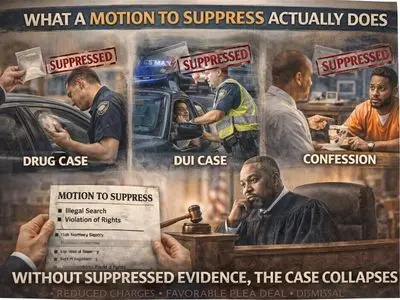 The exclusionary rule is the legal principle that stops the government from using illegally obtained evidence against you. Florida courts take this rule seriously, especially when law enforcement oversteps the boundaries set by the Fourth Amendment. The most common grounds for suppression involve searches and seizures conducted without probable cause, without a warrant when one was required, or beyond the scope of a valid warrant.
Consider a common scenario: officers stop a vehicle based solely on a vague, anonymous tip. Feeling pressured by the uniformed officers, the driver agrees to a search. Inside a locked glove compartment, officers find contraband. Here, the initial stop lacked the “reasonable suspicion” required by law. This means every piece of evidence flowing from that illegal stop—including the contraband—is considered “fruit of the poisonous tree” and is subject to suppression. The consent to search becomes invalid because the entire encounter violated the Fourth Amendment from the start.
Florida Statutes § 933.02 and § 933.04 govern search warrants, requiring probable cause supported by an affidavit that particularly describes the place to be searched or the items to be seized. When a warrant fails to describe with particularity the place to be searched or the items to be seized, or when the affidavit supporting it contains intentional or reckless false information or material omissions necessary to probable cause, evidence found under that warrant may be suppressed. Courts carefully review the “four corners” of the warrant and its supporting affidavit. A warrant built on deception or critical omissions will not stand up to judicial review.
Warrantless searches face an even higher hurdle. While Florida law recognizes narrow exceptions—like emergencies, searches related to a lawful arrest, and items in plain view—the state carries the heavy burden of proving an exception applies. A strong criminal defense strategy often focuses on showing that the state cannot meet this burden.
Statements, Confessions, and Miranda Custody
This protection isn’t just for physical evidence. Statements taken in violation of your Fifth Amendment right against self-incrimination or Sixth Amendment right to counsel are also subject to suppression. The landmark case of Miranda v. Arizona established that you must be read your rights before any custodial interrogation, and Florida courts enforce this rule with precision.
What is “Custody”? Custody does not always mean you are in handcuffs. The key question is whether a reasonable person in your situation would have felt free to leave.
 “Interrogation” includes not just direct questions but any words or actions by police that they should know are likely to make you incriminate yourself. If officers continue to question you after you have clearly stated you wish to remain silent or have asked for a lawyer, any statements you make afterward can be suppressed.
Imagine being questioned at a police station for hours. Detectives tell you that you are free to go, but they stand in front of the door and repeatedly tell you that cooperating is your only option. Worn down, you eventually make incriminating statements. Despite the officers’ words, the overall situation may be considered custody. If you were never read your Miranda rights, those statements are inadmissible in court.
Even if you received proper Miranda warnings, a confession can be suppressed if it was not voluntary. Statements induced by coercion, threats, or false promises of leniency are not considered voluntary. Florida courts look at all the circumstances, including your age, education, mental state, and the tactics used during the interrogation. A statement given under duress holds no legal weight.
Procedural Requirements: Timing, Burden, and Hearing Mechanics
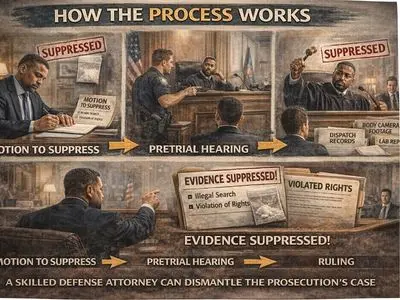
The substantive grounds for suppression mean nothing without proper procedure. In Florida, these motions are governed by the Rules of Criminal Procedure, specifically Rule 3.190(g) for illegally seized evidence and Rule 3.190(h) for confessions or admissions. The rules require that a motion to suppress be filed before trial, typically within a timeframe set by the court. Failing to file on time can mean waiving your right to challenge the evidence, a mistake that can be devastating to a defense.
The motion must state with specificity the legal and factual grounds for suppression. A generic motion is not enough. For example, a motion challenging an unlawful search must identify which constitutional right was violated, describe the circumstances of the search, and explain why no warrant exception applies. Precision is critical.
At the suppression hearing, the burden depends on the issue. When the police acted without a warrant, the state generally must justify the search or seizure by proving that a recognized exception applies. When a search was conducted under a warrant, the defense usually must identify the defect that makes the warrant invalid. Officers may testify, and evidence like body-worn camera footage, dispatch logs, and warrant applications may be examined. The judge listens to all the evidence and decides who is more credible.
The judge’s decision can be appealed, but the standards of review are important. An appellate court will generally defer to the trial judge’s factual findings (like whether an officer seemed truthful), but it will independently review the legal conclusions (like whether those facts amount to a constitutional violation). This is why a properly filed and argued motion is so crucial—it preserves these vital issues for every stage of the case.
When Suppression Changes Everything: Case Outcomes and Strategic Leverage
A successful motion to suppress is more than a procedural victory; it can fundamentally alter the course of your case. When key evidence is thrown out, prosecutors may be forced to dismiss the charges entirely. More often, suppression gives your defense team powerful leverage in plea negotiations, turning what the state saw as a strong case into a much weaker one.
- Illegal Traffic Stop: Can lead to the suppression of all evidence found during the stop, including drugs, weapons, or incriminating statements.
- Unlawful Entry into a Home: Suppresses all evidence seized inside and any statements made during the encounter.
- Miranda Violation: Can suppress the unwarned statement; if the statement was also coerced or involuntary, derivative evidence may be challenged as well.
- Coerced Confession: Is suppressed, along with any other evidence the police found as a direct result of the tainted confession.
Developing a strategy for suppression begins early. Thoroughly reviewing discovery materials—body-cam video, officer reports, dispatch recordings—often reveals inconsistencies that can be challenged. The officers’ training and adherence to department policy come under scrutiny. The entire narrative the state plans to present at trial depends on its evidence surviving these critical pretrial challenges.
Even suppressing some of the evidence can reshape a case. If evidence was seized from multiple locations—a car, a home, and a storage unit—getting the evidence from one location suppressed might eliminate a charge or significantly reduce the severity of the allegations. Each piece of evidence must stand on its own legal footing.
Common Pitfalls and Limitations
Not every constitutional violation leads to suppression. The “good-faith exception,” for instance, may allow evidence to be used if it was obtained with a warrant that seemed valid at the time, even if it was later found to be flawed. Florida courts apply this exception cautiously to ensure it does not undermine the purpose of the exclusionary rule.
Two other doctrines—independent source and inevitable discovery—can also limit suppression. If the state can prove with actual evidence, not speculation, that the evidence came from a lawful independent source or would have been discovered through normal lawful investigation, a judge may allow it. These doctrines still require a concrete showing from the prosecution; they cannot rest on hindsight alone.
Standing is another key issue. To challenge a search, you must have had a “reasonable expectation of privacy” in the place searched. For instance, a passenger might not have standing to challenge a search of the driver’s locked glove box. This is a threshold determination a court makes before even considering the merits of the suppression claim.
Successfully suppressing evidence requires more than just a feeling that something was wrong. It demands a thorough factual investigation, precise legal arguments, and disciplined adherence to procedure. Your constitutional rights exist on paper until a skilled attorney files a motion to make them a reality in the courtroom. When law enforcement crosses the line, suppression is not just possible—it is necessary for justice.
Closing Remarks
If you are facing charges built on evidence that feels unjust—from a questionable traffic stop, an invasive search, or a coercive interrogation—you are not without options. The constitutional protections are strong, but they must be asserted with skill and precision. You do not have to navigate this complicated process alone. The team at CDB Injury Law is here to listen to your story, protect your rights, and restore your peace of mind. Let us talk about how we can build a strong defense for you.
Frequently Asked Questions
What happens if a motion to suppress is granted?
When a court grants a motion to suppress, the excluded evidence cannot be introduced at trial or used to support the prosecution’s case. Depending on the centrality of the suppressed evidence, the state may dismiss charges, reduce charges, or proceed to trial with a weakened case. Suppression does not automatically end a prosecution, but it often creates the conditions for a more favorable resolution.
Can a defendant file a motion to suppress after entering a plea?
Generally, entering a plea waives the right to challenge evidence through a motion to suppress. Florida law permits a defendant to enter a plea while expressly reserving the right to appeal a prior ‘dispositive’ order, such as the denial of a motion to suppress under Fla. R. App. P. 9.140(b)(2)(A)(i). While the trial court must accept the plea, the prosecution’s consent is not legally required to preserve a truly dispositive issue for appellate review. Once a standard plea is entered and accepted without this reservation, suppression challenges are typically foreclosed.
Does the exclusionary rule apply to all criminal cases in Florida?
Yes. The exclusionary rule applies in all criminal prosecutions in Florida courts, whether the charges are misdemeanors or felonies. It also applies in juvenile delinquency proceedings. The rule does not extend to certain civil proceedings or administrative hearings, but in the criminal context, it is a fundamental protection enforced without regard to the severity of the charge.
What is the difference between suppressing evidence and excluding it at trial?
Suppression occurs through a pretrial motion, resulting in a court order that prevents the state from introducing the evidence at any stage of the prosecution. Exclusion at trial refers to an objection raised during trial when the state attempts to introduce evidence. Suppression is proactive and binding; exclusion is reactive and depends on timely objection. Pretrial suppression is strongly preferred because it removes the evidence from consideration entirely and shapes plea negotiations before trial begins.
Can suppressed evidence be used for any purpose?
Suppressed evidence generally cannot be used in the prosecution’s case-in-chief. Depending on why the evidence was suppressed, however, the law may allow limited use for impeachment if the defendant testifies and makes statements contradicted by the suppressed material. This exception is narrow, and involuntary or coerced statements remain subject to stronger protections. The primary effect of suppression—removal from the state’s proof—remains intact.
How long does a suppression hearing take?
The length of a suppression hearing depends on the complexity of the issues, the number of witnesses, and the volume of evidence. Simple hearings involving a single officer and clear facts may conclude in under an hour. Complex hearings involving multiple officers, body-worn camera footage, expert testimony, and detailed legal arguments may span several hours or multiple days. Courts schedule hearings based on the anticipated scope, and continuances may extend the timeline if additional discovery or investigation is needed.
References