

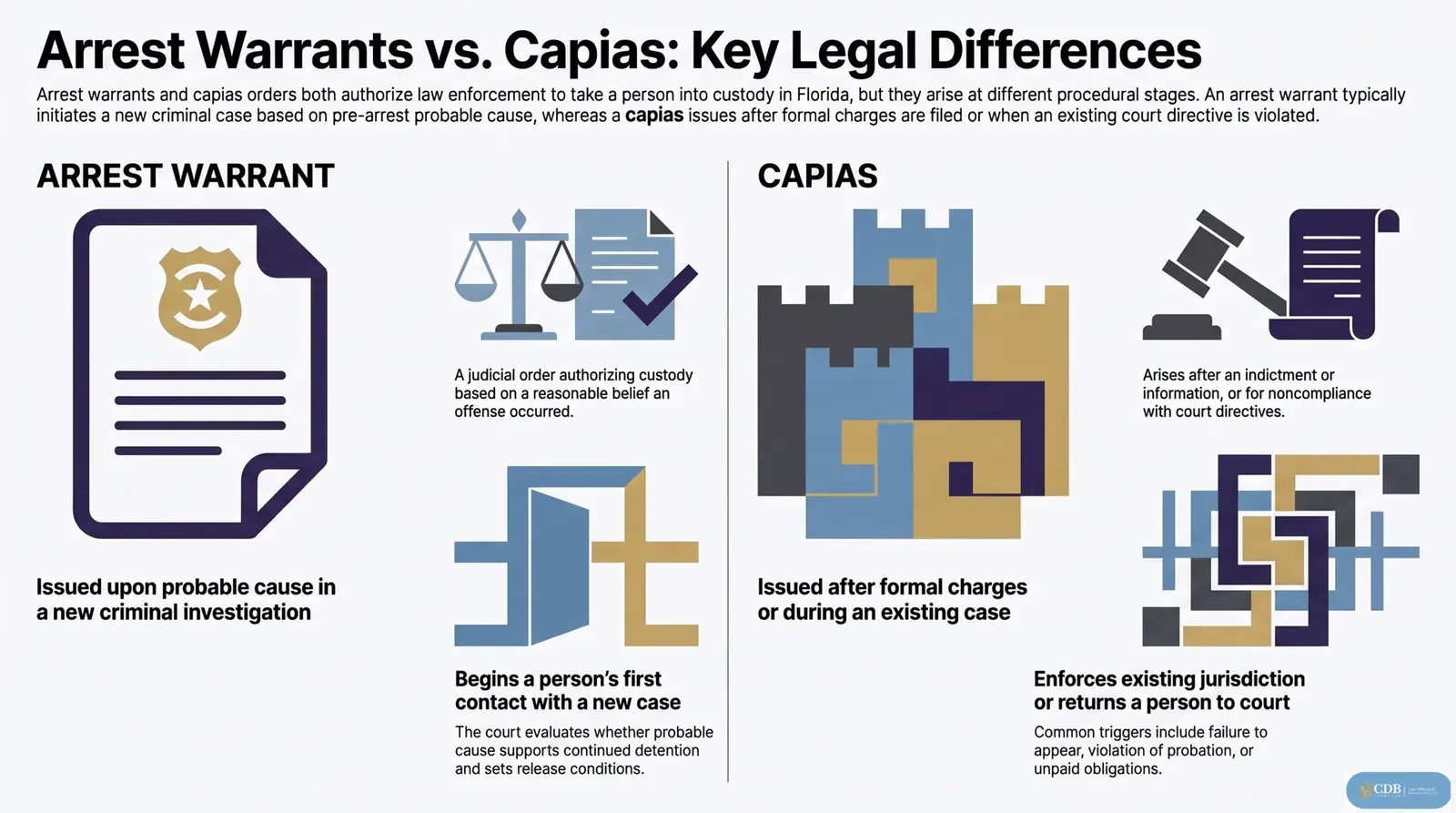
Arrest warrants and capias orders both authorize law enforcement to take someone into custody, but they can arise at different points in a Florida criminal case. Arrest warrants typically issue after a judge finds probable cause in a new criminal investigation. A capias may issue after formal charges are filed when the defendant is not already before the court, or later when someone fails to appear or comply with court directives. Understanding which document triggered an arrest shapes the defense strategy and reveals what the State must prove at the next hearing.
A phone call arrives with news of an arrest. The caller says there was a warrant. Or maybe it was a capias. The terms sound interchangeable, but they are not. One may reflect an allegation under investigation; the other may signal that formal charges have already been filed or that an existing case has broken down because of a missed hearing, probation issue, or other court directive. The difference determines what happens next: what the court will ask, what the State must show, and what levers remain available to challenge detention or secure release. Confusion about the document that authorized the arrest leaves defendants and their families navigating a system they cannot map.

What an Arrest Warrant Is and When It Issues
An arrest warrant is a judicial order authorizing law enforcement to take a person into custody based on probable cause that the person committed a crime. Under Florida Statute § 901.02, a judge may issue an arrest warrant when a complaint or affidavit establishes a reasonable belief that an offense was committed and that the person named committed it. In practice, these warrants often issue after a law enforcement officer or prosecutor files a probable cause affidavit with the court. The affidavit presents facts and evidence suggesting that a specific individual committed a specific offense. A judge reviews the affidavit and, if satisfied that probable cause exists, signs the warrant.
Arrest warrants appear most commonly at the beginning of a criminal case. They follow investigations into alleged conduct such as battery, theft, fraud, drug offenses, where the suspect was not arrested at the scene. The warrant brings the accused before the court for the first time. Once executed, the individual is booked, processed, and scheduled for a first appearance, where a judge determines whether probable cause supports continued detention and sets conditions of release when release is legally available.
The content and timing of an arrest warrant carry procedural weight. Errors in the affidavit, staleness of the allegations, or lack of specificity in identifying the accused can form the basis for later challenges. The warrant itself does not prove guilt, but it reflects a judicial determination that enough evidence exists to justify depriving someone of liberty pending adjudication. That initial showing becomes relevant when criminal defense counsel evaluates whether to challenge probable cause at subsequent hearings.
What a Capias Is and How It Differs
A capias is also a court order or writ authorizing arrest, but in Florida it is not simply another name for every arrest warrant. A capias commonly appears in two settings. First, under Florida Rule of Criminal Procedure 3.131, a capias may issue after an indictment or information is filed when the defendant is not already in custody or otherwise before the court on that charge. Second, a capias may issue during an existing case when someone fails to comply with a court directive. Common triggers include failure to appear for a scheduled court date, violation of probation conditions, or noncompliance with a court-ordered obligation such as payment of fines or completion of community service.
Unlike an arrest warrant based on a pre-arrest probable cause affidavit, a capias often depends on the procedural status of the case. If formal charges have already been filed, the capias brings the defendant before the court to answer those charges. If the defendant misses court, the capias enforces the court’s existing jurisdiction. If probation is at issue, the supervising officer typically files an affidavit of violation, and the court issues process to bring the probationer before the court for a violation proceeding.
The procedural posture is therefore different. An arrest warrant usually begins a person’s first contact with a new case; a capias may either bring a person into a formally filed case or return that person to court in a case already underway. The legal questions at the resulting hearing shift accordingly. With an arrest warrant, the court evaluates whether sufficient evidence supports the arrest and what conditions of release are appropriate. With a capias issued after formal charges, the court may address release, arraignment, and scheduling. With a capias for failure to appear, the court may address why the defendant missed the hearing, whether there was willful noncompliance, and whether bond should be revoked or modified. With a capias or warrant for probation violation, the hearing focuses on whether the alleged violation occurred and what sanctions are warranted. Understanding which document issued reveals what the State must prove and what defenses may apply.
How to Determine Which Document Was Issued
Determining whether an arrest resulted from an arrest warrant or a capias requires examining the booking documents and case file. Both the arrest affidavit and the warrant or capias itself should be available through the clerk of court or the detention facility. The face of the document typically identifies it by name. An arrest warrant will usually reference the probable cause affidavit and cite the criminal statute allegedly violated. A capias may reference an information, indictment, underlying case number, prior court proceeding, and the reason for issuance, such as a newly filed charge, “failure to appear,” or “violation of probation.”
Key indicators include:
- Whether there is an existing case number or whether this is the first court involvement for the alleged conduct
- Whether the document cites a new criminal statute, a filed information or indictment, or a prior sentence, bond order, or probation term
- Whether the arrest occurred during an investigation, after formal charges were filed, or after a missed court appearance or probation check-in
- Whether the booking paperwork lists the charge as a new offense or as a violation of a prior court order
Online court dockets sometimes label the document type, but errors and inconsistencies occur. The most reliable method is obtaining the actual court order from the case file. Defense counsel can pull the full record to confirm the document’s origin and the procedural path that led to issuance.
Practical Consequences of the Distinction
The difference between an arrest warrant and a capias affects bond eligibility, the burden at the next hearing, and the strategic options available to the defense. A person arrested on criminal process is generally entitled to a first appearance within 24 hours under Florida Rule of Criminal Procedure 3.130. At that hearing, the court addresses probable cause when required and considers conditions of pretrial release unless release is restricted by the nature of the charge, a lawful detention request, or the defendant’s risk of flight, danger to the community, or failure to comply with court orders.
When a capias issues after formal charges are filed, the court may focus on bringing the defendant into the case and setting release conditions. When a capias issues for failure to appear, bond may be revoked entirely or set at a higher amount to ensure future compliance. The court’s focus shifts from probable cause for the original arrest to whether the defendant can be trusted to appear. When a capias or warrant issues for violation of probation, bond is discretionary. Florida Statute § 948.06 governs probation violation proceedings and permits the court to hold the alleged violator without bond pending the violation hearing. The burden of proof at that hearing is lower, preponderance of the evidence rather than beyond a reasonable doubt. The sanctions can include revocation and imposition of the original suspended sentence.
The distinction also shapes the defense narrative. Any new criminal charge carries the presumption of innocence and the State’s obligation to prove guilt. But a failure-to-appear or probation capias adds another layer: the court is concerned not only with the underlying accusation, but also with compliance, reliability, and whether a prior court order was violated. Knowing which document triggered the arrest allows counsel to tailor the argument, gather the relevant evidence, and prepare for the specific hearing that will follow.

Both arrest warrants and capias orders carry the same immediate consequence: loss of liberty. But they can emerge from different legal contexts, require different showings, and lead to different procedural paths. The document that authorized the arrest is not a technicality. It is the map to what comes next.
Closing Remarks
If an arrest followed a missed court date, a probation officer’s affidavit, a newly filed information, or an investigation that predated any prior case involvement, the type of warrant or capias issued determines the next hearing, the burden of proof, and the arguments that matter. At CDB Injury Law, we believe that everyone deserves a staunch defense. Our criminal defense team represents individuals charged with offenses in Florida, from first appearance through resolution. You do not have to face this alone. Contact us to review the documents, assess the procedural posture, and build a defense grounded in what the court must actually decide.
Frequently Asked Questions
Can a capias be issued without prior notice?
Yes. A capias can be issued without advance warning that it is about to be signed. When someone fails to appear for a scheduled hearing or allegedly violates probation, the court can issue the capias immediately. A capias may also issue after formal charges are filed if the defendant is not already before the court on that charge. Lack of actual notice may be relevant at the subsequent hearing, especially in a failure-to-appear situation, but it does not automatically invalidate the capias.
Does an arrest warrant expire?
Most arrest warrants in Florida do not have an expiration date. Once signed by a judge, the warrant remains active until it is executed, recalled by the court, or the underlying charge is resolved or dismissed. Some jurisdictions periodically review and purge old warrants, but there is no automatic expiration. A warrant issued years ago can still result in arrest if the individual is encountered by law enforcement or flagged during a routine background check.
What happens at the first court appearance after a capias arrest?
The hearing depends on the reason for the capias. If the capias issued after formal charges were filed, the court will address the pending charge, release conditions, and the next case setting. If the capias issued for failure to appear, the court will address why the defendant missed the prior hearing, determine whether the absence was willful, and decide whether to reinstate the original bond, modify it, or revoke it entirely. If the capias issued for a probation violation, the court will schedule a violation of probation hearing and decide whether to set bond or hold the defendant without bond pending that hearing. The capias brings the defendant before the court so the pending case or alleged violation can proceed.
Can you challenge the validity of a capias?
Challenges to a capias are possible but narrow. If the capias was issued in error, such as after the defendant already appeared, after probation was discharged, or under the wrong case number, counsel can present evidence to the court and request that the capias be quashed. If the underlying court order was invalid or the defendant was never properly served with notice of the original proceeding, those issues can be raised. However, a capias based on a valid court order and factual noncompliance is typically enforceable, and the remedy often lies in the subsequent hearing, not in invalidating the capias itself.
What should someone do if they learn a warrant or capias has been issued?
They should speak with criminal defense counsel as soon as possible. Voluntarily surrendering with counsel prepared to appear is often the best course, but the timing and approach should be planned carefully. Turning oneself in can allow the defendant to control the timing, prepare for the hearing, and avoid the unpredictability of a field arrest. Counsel can coordinate the surrender, appear at the first hearing, and immediately advocate for reasonable bond. Ignoring a warrant or capias prolongs uncertainty, limits defense options, and increases the likelihood of harsher bond conditions or additional charges for evading arrest.
References
- Florida Statute § 901.02
- Florida Rule of Criminal Procedure 3.131
- Florida Rule of Criminal Procedure 3.130
- Florida Statute § 948.06