
TL;DR: Florida’s $10,000 personal injury protection (PIP) coverage can be exhausted quickly after a serious injury. When this happens, medical bills don’t stop arriving, and providers, health insurers, and other parties will expect payment. Understanding what to do when your treatment costs exceed your coverage is essential for protecting both your health and your financial stability.
The accident happened in a moment, but the aftermath unfolds over weeks and months. There’s the emergency room, the diagnostic scans, the follow-up appointments, and physical therapy. Each step is necessary for your recovery, and each one generates a bill. While your PIP insurance is designed to cover 80 percent of reasonable medical expenses, the $10,000 limit is often no match for the costs of a serious injury. When that coverage runs out, the bills keep coming. Your doctors won’t stop treatment, and soon, you may start receiving notices from your health insurer or government programs like Medicare. The financial pressure builds at the exact moment your physical recovery needs your full attention.
Florida’s no-fault system was created to provide immediate medical coverage and reduce lawsuits over smaller claims. However, it was never designed to handle catastrophic injuries. A $10,000 policy limit might seem adequate until a single ER visit with a CT scan and an ambulance ride consumes half of it. What follows is not just a gap in care, but a confusing web of new bills, insurance claims, and legal notices. How these are handled will have a significant impact on the final outcome of your bodily injury claim and your personal financial recovery.
When PIP Coverage Runs Out Mid-Treatment

Under Florida Statutes § 627.736, PIP provides benefits for 80 percent of reasonable medical expenses, up to $10,000, as long as you seek initial treatment within 14 days of the accident. The statute, however, doesn’t address the difficultsituation that arises when necessary medical care, like a $15,000 surgery or months of rehabilitation far exceeds that limit. For many injured people, coverage exhaustion happens without warning while they are still actively trying to heal.
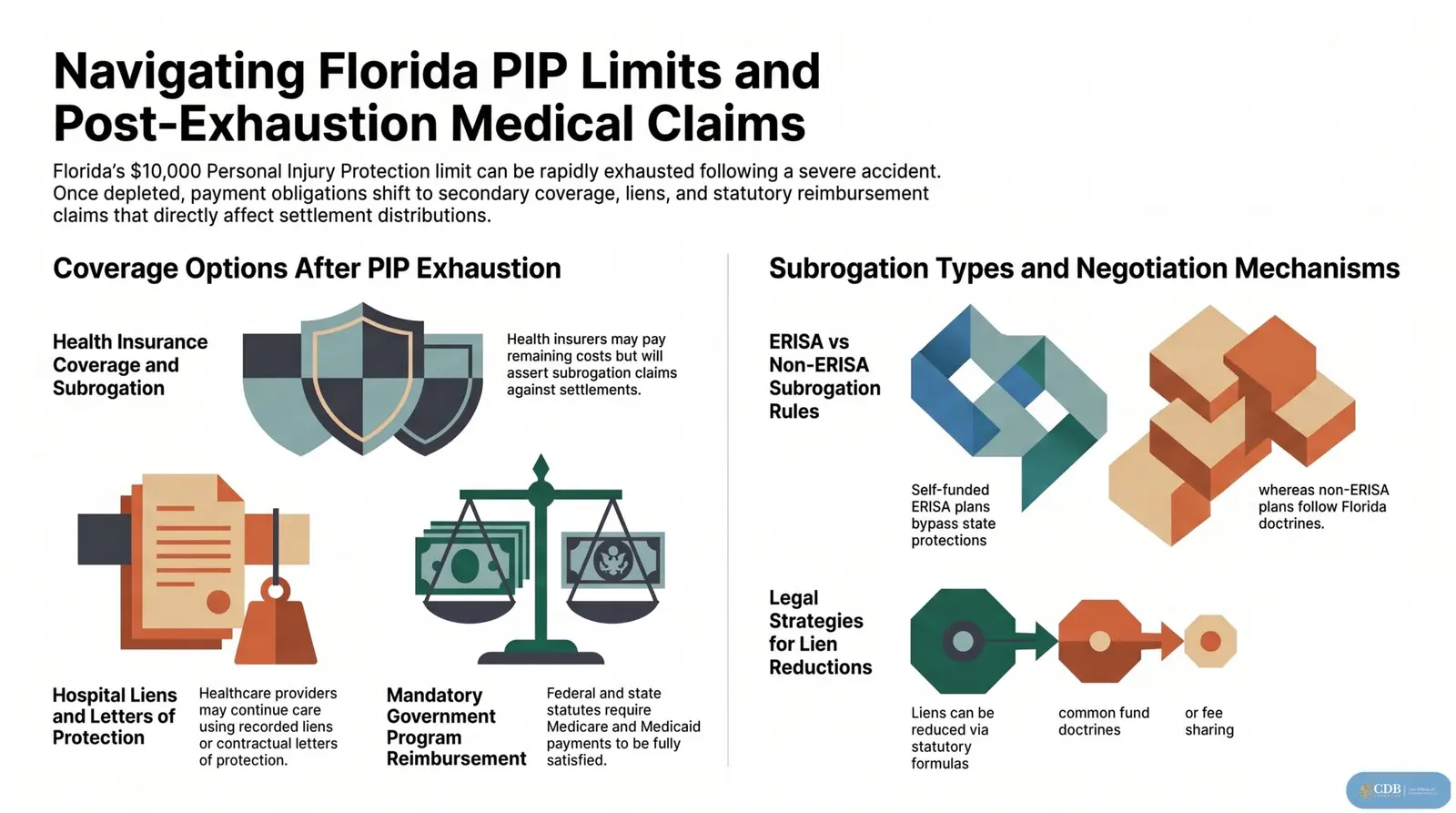
Once your PIP is depleted, several things can happen at once. Your health insurance may begin to cover costs, but this depends on your specific policy. Many health plans have clauses that can delay or complicate payments when another party is at fault. Medicare and Medicaid may cover treatment, but they are required by federal and state law to seek reimbursement from any settlement you receive. Your medical providers might agree to continue treatment on a lien basis, meaning they agree to wait for payment until your case is resolved. In the most difficult scenarios, treatment may stop. Not because it’s no longer needed, but because there is no clear source of payment.
The path you take after PIP runs out has long-term consequences. Treating on a lien means you have a debt that must be paid from your settlement funds. Using your health insurance can lead to subrogation claims that reduce the amount you ultimately receive. Stopping treatment can create gaps in your medical records that an insurance company might use to argue your injuries weren’t serious. Facing these choices alone can be overwhelming. Each path has trade-offs for your financial well-being, your ability to continue treatment, and the strength of your injury claim.
Medical Liens and Hospital Claims Under Florida Law
In Florida, hospital liens on personal injury recoveries are generally created by county charter provisions or special acts rather than by a single statewide statute, so whether a hospital has lien rights, and what steps it must take, can depend on where you were treated. Where a lien right exists, it typically attaches only after the provider records a claim of lien in the county where care was given, and it must be addressed before settlement funds are released to you. While that gives hospitals a powerful collection tool, they must follow strict procedural rules. If they fail to meet those requirements, the lien may be unenforceable.
Not all healthcare providers have lien rights. Physical therapists, imaging centers, and many specialists generally cannot use that process. Instead, they may ask you to sign a “letter of protection.” This is a contract where you agree to pay their bill out of your future settlement. These letters are contractual agreements, not statutory or charter-based liens. The difference is important, because a recorded hospital lien carries its own legal requirements and defenses, while a letter of protection is negotiated between your attorney and the provider.
Hospital liens can often be reduced. Under Florida’s common fund doctrine, a lienholder that benefits from a settlement created by your attorney’s work may be required to contribute proportionally to the attorney’s fees and costs. Furthermore, if a hospital’s bill is based on inflated “chargemaster” rates far higher than what it would accept from an insurance company, the amount claimed can be challenged as unreasonable. Careful negotiation can meaningfully lower what you have to pay back.
Subrogation Claims from Health Insurers
When your health insurance pays for accident-related treatment after PIP is exhausted, the insurer will almost always seek to get its money back. This is called a subrogation or reimbursement claim, which they make against any settlement you recover from the at-fault party. The strength of their claim depends on the type of health plan you have. Self-funded employer-sponsored plans governed by a federal law called ERISA often assert a right to full reimbursement. Other plans, including insured and non-ERISA plans, are subject to Florida’s equitable doctrines that can limit how much they recover.
ERISA reimbursement claims are particularly aggressive. Federal courts have generally held that the language in the ERISA plan document controls, and that state-level equitable protections are often preempted. If your plan includes a “first-dollar” reimbursement clause, the plan may seek to recover every cent it paid, even if you are left with little from your settlement. While we can still negotiate with these plans, they are not legally required to compromise.
For non-ERISA health plans, Florida law provides important protections. The “made-whole doctrine” generally holds that you must be fully compensated for your damages before your insurer can seek reimbursement, unless the policy clearly provides otherwise. If your settlement is not enough to make you whole, the insurer may recover nothing, or only a reduced amount. Insurers may also be required to share in the cost of your legal fees, which provides leverage to ensure a fair outcome.
Medicare, Medicaid, and Federal Recovery Rights
Medicare and Medicaid are bound by laws that require them to recover payments made for accident-related care. The Medicare Secondary Payer Act, 42 U.S.C. § 1395y(b), requires that Medicare be repaid for these “conditional payments” out of any liability settlement. Florida Medicaid has similar recovery rights under Florida Statutes § 409.910 and federal law, giving the program authority to seek reimbursement for payments made on your behalf.
These are not polite requests; they are legal obligations. Medicare will issue a conditional payment letter detailing the bills it has paid related to your accident. That amount must be addressed before your settlement funds can be distributed without risking a violation of federal law. Similarly, the Florida Agency for Health Care Administration will assert a Medicaid lien. Both programs have priority over most other creditors and carry significant consequences for non-compliance, including the risk of double damages under the Medicare Secondary Payer Act and personal liability for anyone who distributes settlement money without satisfying the government’s claim.
It is possible to reduce Medicare and Medicaid claims, but the process is exacting. Medicare has formal waiver and compromise procedures that can be used when a settlement isn’t large enough to pay all the outstanding claims. Under Florida Statutes § 409.910, the Medicaid lien is reduced by a statutory formula that accounts for attorney’s fees and costs, and an injured person may challenge the amount through an administrative process by showing that a smaller share of the recovery represents past medical expenses. Both require careful documentation and negotiation. A settlement is not truly finished until these claims are resolved or a portion of the funds is held in escrow pending final resolution.
Strategic Implications for the Bodily Injury Claim

While the mounting bills are a source of stress, they also serve as powerful evidence of how serious your injuries are. Extensive medical costs and long-term rehabilitation show an insurance company that your injuries are real and have had a significant impact on your life. The fact that a health insurer or Medicare paid for your treatment supports that it was medically necessary. The at-fault party’s insurance company will scrutinize every bill and every provider, but a well-documented record of substantial medical expenses is a cornerstone of a strong personal injury claim.
The timing of your settlement is crucial. Finalizing your claim too early can create legal and financial complications with programs like Medicare and Medicaid. Settling before all medical liens have been identified can cause serious problems when it’s time to distribute the funds. However, waiting too long can cause you to lose momentum or even miss the statute of limitations deadline. Balancing your ongoing medical care, the resolution of liens, and the timing of a settlement demand requires a coordinated legal strategy.
Consider this common scenario: You exhaust your PIP coverage within weeks of a serious collision. Your health insurance then pays another $30,000 for your surgery and therapy. That health plan is a self-funded ERISA plan that demands full reimbursement. The at-fault driver only has a $25,000 bodily injury policy. If you settle for the policy limit, the plan’s $30,000 claim exceedsyour entire recovery. Without skilled negotiation, a careful look at other coverage, such as uninsured or underinsured motorist benefits, you could be left with little or nothing.
This situation is unfortunately common when injuries are severe and insurance coverage is limited. The answer is not to avoid necessary treatment, but to have a plan that addresses these competing claims. We work to understand lien priorities, assert all available legal defenses, and negotiate reductions before a settlement is ever finalized. Every dollar we can reduce from a lien is another dollar that goes to you, helping you and your family rebuild.
- Even after PIP is exhausted, you have a duty to mitigate your damages by continuing with reasonable medical treatment.
- A hospital lien is only valid if it comes from a qualifying facility and every recording and notice requirement has been met.
- ERISA health plan reimbursement claims are controlled by federal law, which often preempts state-level protections for injured people.
- Medicare and Medicaid claims must be addressed, but both programs have processes for reduction or compromise when settlement funds are limited.
- Distributing settlement funds before resolving Medicare and Medicaid claims can create personal liability for you and your attorney.
When your medical bills climb higher than your PIP coverage, it can feel like the system has failed you. It is a stressful and, unfortunately, predictable reality for many people seriously injured in Florida. The most important thing to remember is that you are not just a number in a calculation. Your recovery is what matters. A high settlement offer means little if it is all consumed by medical liens. Our focus is on a different kind of math, the math that determines how much actually reaches you and your family. With a clear strategy and steadfast advocacy, we can work through these challenges together and pursue a resolution that genuinely serves your best interests.
Closing Remarks
If your PIP coverage has been exhausted while your treatment continues, or if you are facing claims from health insurance or Medicare, the financial pressure is real. You do not have to face this alone. CDB Injury Law helps injured individuals navigate lien resolution, reimbursement obligations, and the protection of their net recovery when medical bills exceed insurance limits. Let us talk about your recovery and the path forward.
Frequently Asked Questions
What happens if medical bills exceed the $10,000 PIP limit in Florida?
Once PIP is exhausted, responsibility for ongoing medical expenses shifts to other sources: health insurance, Medicare, Medicaid, or the injured person directly. Providers may agree to treat on a lien basis or under a letter of protection, deferring payment until settlement. If no secondary coverage is available and no lien arrangement is made, treatment may be delayed or discontinued unless paid out of pocket. Unpaid bills do not eliminate the at-fault party’s liability; those expenses remain recoverable as part of a bodily injury claim, but actual collection depends on the at-fault party’s insurance limits and assets, and on any available uninsured or underinsured motorist coverage.
Can health insurance refuse to pay for accident-related treatment?
Many health insurance policies contain coordination-of-benefits clauses or accident-related provisions that allow the insurer to deny or delay payment when another party may be liable. These provisions are generally enforceable if clearly stated in the policy and consistent with applicable law. In practice, most health insurers will pay for treatment and then assert a subrogation or reimbursement claim against any liability settlement. Self-funded ERISA employer plans have broad rights under federal law. Insured and non-ERISA plans are subject to Florida regulatory requirements and common law equitable principles, including the made-whole doctrine.
Are hospital liens in Florida automatically enforceable?
No. A Florida hospital lien is enforceable only if the hospital actually has lien rights under the applicable county ordinance or special act, the lien is properly and timely recorded in the county where services were provided, and required notice is given. The amount claimed may also be challenged on reasonableness grounds, particularly when charges reflect full retail “chargemaster” rates rather than the amounts the hospital accepts from Medicare or private insurers. Lienholders may additionally be required to contribute proportionally to attorney fees under the common fund doctrine, and practical reductions are often available where comparative fault or limited policy limits restrict the recovery.
What is the difference between an ERISA subrogation claim and a regular health insurance lien?
ERISA refers to the Employee Retirement Income Security Act, a federal law that governs most employer-sponsored health plans. Self-funded ERISA plans may enforce reimbursement provisions according to the plan document, and federal law can preempt state equitable doctrines like the made-whole rule. This means such a plan may recover a large share of what it paid, even if the injured personwas not fully compensated. Non-ERISA health plans, such as individual policies, church plans, or government plans, are subject to Florida law, which may limit recovery under the made-whole doctrine and require contribution to attorney fees and costs.
How does Medicare know about a personal injury settlement?
Medicare tracks liability claims through multiple channels. Providers report treatment with diagnosis codes indicating trauma, and Medicare’s conditional payment system flags accident-related claims. When a liability insurer or self-insured entity makes a settlement payment, federal law requires reporting through the Section 111 Mandatory Insurer Reporting system. In addition, a Tampa car accident attorney will typically query Medicare before settlement to obtain a conditional payment letter. Failing to satisfy a valid Medicare claim before distributing settlement funds can result in personal liability, including double damages under the Medicare Secondary Payer Act.
Can medical liens be negotiated or reduced?
Often, yes. Negotiation strategies vary by claim type. Hospital liens may be reduced based on the common fund doctrine, comparative fault, and comparison to Medicare or insurer-contracted rates. ERISA plan claims are harder to reduce but may still be negotiated when the plan administrator is presented with evidence of limited policy limits, litigation costs, or comparative negligence. Medicare offers formal waiver and compromise procedures when a settlement is insufficient to satisfy all claims. Florida Medicaid claims are subject to a statutory reduction formula that accounts for attorney’s fees and costs, and may be further reduced through an administrative challenge. Provider claims based on letters of protection are contractual and fully negotiable.
References
- Florida Statutes § 627.736 (Personal Injury Protection Benefits).
- 42 U.S.C. § 1395 (y(b) (Medicare Secondary Payer Act)).
- Florida Statutes § 409.910 (Responsibility for Payments on Behalf of Medicaid-Eligible Persons).
- Centers for Medicare & Medicaid Services, Coordination of Benefits & Recovery Overview