

After a personal injury settlement, medical providers and insurance companies may have a legal right, often called a lien or reimbursement claim, to be repaid from your funds. Florida and federal laws, insurance contracts, and local lien rules can affect who gets paid and when. Understanding this “pecking order” is critical, because mistakes can force you to pay a debt twice, jeopardizing your financial recovery.
You fought for this settlement. After all the uncertainty and pain, the check finally represents a chance to move forward. But just as relief begins to set in, the letters start arriving. Each one is a formal demand for a piece of your settlement, from the hospital, your health insurer, or even government programs like Medicare. Suddenly, the money you counted on for your future feels like it’s being claimed by everyone else. This isn’t just confusing; it’s deeply unsettling. The order in which these claims get paid isn’t always intuitive. It is shaped by a complex web of laws, contracts, and repayment rules, and a single misstep could leave you responsible for debts you thought the settlement had covered.
Understanding Medical Liens in Florida Personal Injury Cases
A medical lien or reimbursement claim is a legal demand against part of your settlement money, usually filed by a provider or insurer who paid for injury-related treatment. These claims can come from several sources: Medicare, Florida Medicaid, private health insurance, hospitals, and medical providers who treated you under a letter of protection or similar agreement.
Each type of claim has its own rules. Medicare’s right to reimbursement comes from federal law. Medicaid’s recovery rights in Florida are governed by Fla. Stat. § 409.910. A private health insurance company’s right to be repaid depends heavily on the policy language and whether the plan is governed by ERISA. Hospitals and other providers may rely on local lien ordinances where they apply, contractual assignments, or letters of protection rather than one statewide Florida hospital lien statute.
When multiple parties demand payment, you can’t simply pay them in the order the bills arrived. A practical “pecking order” is created by federal law, Florida law, local lien rules, and insurance contracts. Getting that order wrong can lead to a devastating outcome: paying the wrong party first can leave you personally exposed to higher-priority claims, effectively draining your settlement twice.
Federal Liens: Medicare, Medicaid, and the Priority They Command
When Medicare has paid for injury-related care, its right to be repaid is not just a request; it is backed by the Medicare Secondary Payer Act. Medicare generally must be reimbursed from a settlement, judgment, or other recovery connected to the same injury. Before issuing its final demand, Medicare typically applies a reduction for a share of the attorney’s fees and case costs required to obtain the recovery, often called procurement costs. That reduction matters, but Medicare’s remaining claim still carries serious federal enforcement power and should be resolved before funds are disbursed to the client.
Medicaid operates under related but different rules in Florida. The state’s right to recover what it paid is established by Fla. Stat. § 409.910. Florida law generally accounts for attorney’s fees and costs before Medicaid’s recovery is calculated, and federal Medicaid law limits recovery to the portion of a settlement that represents payment for medical care. In some cases, that allocation can be challenged when the settlement does not fully compensate you for all your damages, including pain, lost income, and future needs.
You cannot simply ignore these government liens. Both Medicare and Medicaid have formal processes for reporting a settlement and determining the final repayment amount. Failing to follow these procedures doesn’t make the lien go away, it just delays the process and can lead to serious collection actions directly against you.
Hospital and Provider Claims in Florida
Hospital and provider claims in Florida require careful review because there is no single statewide statute that gives every hospital the same automatic lien against a personal injury settlement. Some hospitals may assert rights under local ordinances where those rules apply. Others rely on assignments, billing agreements, or letters of protection signed during treatment. The source of the claim matters because it determines whether the demand is enforceable, how much priority it has, and whether the amount can be reduced.
Even when a hospital or provider has a valid claim, the amount demanded is not always the amount that should be paid. Hospitals often bill at their highest rates, especially when care is not processed through health insurance. A crucial part of resolving these claims involves reviewing the legal basis for the demand, confirming whether proper notice was given, and negotiating the balance down when the facts and law support a reduction.
Other medical providers, like your primary doctor, chiropractors, or physical therapists, often base their claims on a “letter of protection” or another agreement you signed. These claims can be important and should not be ignored, but they are usually contractual debts rather than federal statutory liens. That often gives your attorney more room to negotiate so your recovery is not consumed by medical balances alone.
Private Health Insurance Subrogation and ERISA Plans
Your health insurance company may also seek repayment. They generally do this through “subrogation” or “reimbursement.” In simple terms, subrogation means the insurer can “step into your shoes” to recover the money it spent on your medical bills. More commonly, reimbursement gives them a right to be paid back from your settlement. The critical factor determining the strength of their claim is whether your plan is governed by a federal law known as ERISA.
ERISA (Employee Retirement Income Security Act) is a federal law that governs many employer-sponsored group health plans. If your plan is a self-funded ERISA plan, it may not be bound by many Florida insurance rules that would otherwise protect an injured person. Federal courts often look closely at the plan’s written language, which means the insurer may demand repayment even if your settlement was not enough to cover all of your losses. Non-ERISA plans and some insured plans are more likely to be subject to state-law limits and equitable arguments that may support a reduction.
Unlike government programs, private insurers are often willing to negotiate their liens. An experienced attorney can often get these claims reduced by highlighting issues like shared fault in the accident, limited insurance coverage, disputed medical causation, or the fact that your settlement does not fully make you whole. It is vital to resolve these liens before the settlement money is distributed.
Attorney’s Fees, Costs, and the Common-Fund Doctrine
Your attorney’s fees and the costs of litigating your case often receive special treatment because those efforts created the settlement fund in the first place. Florida Medicaid law and Medicare’s procurement-cost rules both account for the cost of obtaining the recovery before the government’s final repayment amount is determined.
This priority is supported by a legal principle called the “common-fund doctrine.” It is based on a simple idea of fairness: since your attorney’s work created the settlement “fund” from which lienholders hope to be paid, those lienholders should often share in the cost of creating it. The doctrine can be powerful, but it is not automatic in every setting and may be limited by federal law or by the specific language of an insurance plan.
Some lienholders, especially self-funded ERISA plans, may have contract language claiming “first priority” to the funds and rejecting common-fund reductions. Those clauses create real challenges and must be addressed carefully. Resolving these conflicting claims requires careful negotiation to avoid disputes that could delay you from receiving your money.
The Payment Sequence in Practice
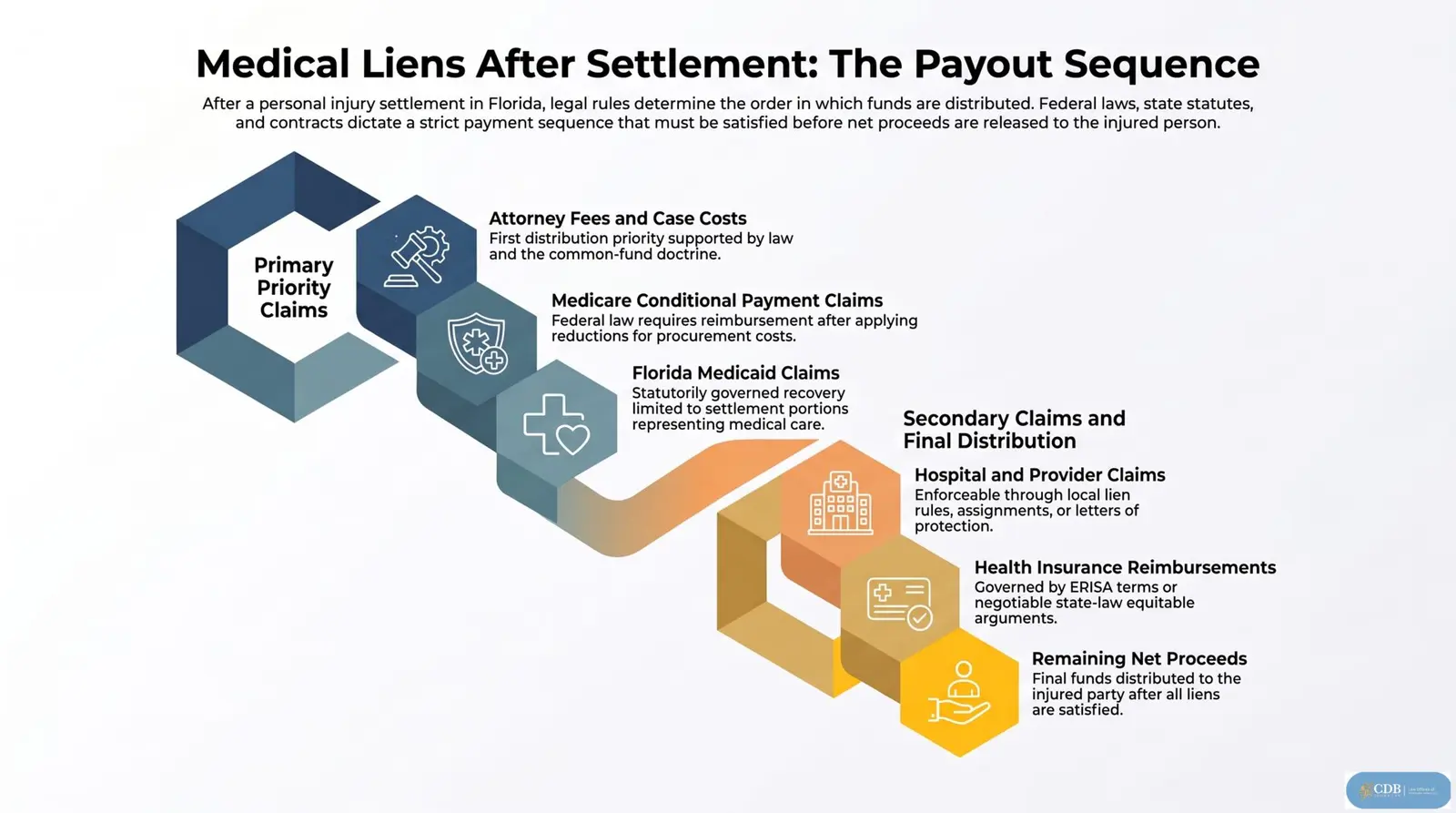
When it is time to distribute the settlement funds, the payment order in a Florida personal injury case generally requires reviewing these categories in a careful sequence:
- Attorney’s fees and case costs, as allowed by the fee agreement and applicable lien rules.
- Medicare conditional payment claims, usually after any procurement-cost reduction is applied.
- Florida Medicaid claims, calculated under Fla. Stat. § 409.910 and applicable federal limits.
- Hospital claims based on a valid local lien rule, assignment, billing agreement, or other enforceable basis.
- ERISA plan reimbursement claims, which depend heavily on the plan’s written terms and federal law.
- Non-ERISA health insurance liens, which are often more open to negotiation and equitable reductions.
- Other provider claims based on letters of protection or treatment agreements.
- The remaining net proceeds, which finally go to you, the injured person.
This list is a general guide, not an absolute rule. Federal law can override state priorities, local lien rules can vary, and insurance plan language can complicate matters. The most important principle is to identify and satisfy legally enforceable claims before money is released. Failure to do so exposes you to future liability.
To protect you, your attorney will typically hold your settlement funds in a trust account while they obtain final payment demands and written confirmation that each lien has been satisfied. This documentation is essential. Without it, a lienholder could claim later that they were never properly paid, putting your financial security at risk all over again.
Navigating this maze of federal mandates, state laws, local lien rules, and private contracts is more than any injured person should have to handle alone. A mistake in distributing funds doesn’t just reduce your recovery, it can create new legal and financial problems. The stakes are highest when a settlement is barely enough to cover massive medical bills, leaving you with little room for error and even less to rebuild your life. Understanding how insurance coverage layers impact recovery can also provide clarity on what funds are available to satisfy these claims.
Closing Remarks
If you have a settlement offer on the table but are facing liens from Medicare, hospitals, or your health insurer, the path forward can feel overwhelming. You do not have to face this alone. At CDB Injury Law, we don’t just secure your settlement; we protect it. We meticulously manage every lien and reimbursement claim to help ensure compliance with state and federal law, defending your recovery from overreach and miscalculation so you can focus on healing. Contact us to discuss your case and how we can help restore your peace of mind.
Frequently Asked Questions
Does Medicare always get paid before the injured person receives anything?
Not exactly. Medicare’s claim has very high priority, but Medicare typically reduces its final demand to account for a share of the attorney’s fees and costs required to obtain the settlement. After that reduction is applied, Medicare’s remaining right to be repaid is superior to most other claims, and failing to pay it can lead to federal collection actions and significant penalties.
Can a hospital lien or provider claim in Florida exceed the settlement amount?
A lien or provider claim may be larger than the settlement funds available to pay it, but that does not automatically mean the provider gets everything or that the demand is valid as written. The first step is to confirm the legal basis for the claim. If it is enforceable, the amount may still be negotiable, especially when the settlement is limited and other higher-priority claims must be paid.
What happens if an ERISA plan’s lien is ignored during settlement distribution?
Ignoring an ERISA lien is extremely risky. These plans can file lawsuits in federal court to enforce their right to reimbursement. Because federal law gives many ERISA plans strong enforcement rights, they often have significant leverage when the plan language is clear. You could be ordered to repay the lien even if your settlement did not fully cover your own losses.
How does Medicaid’s lien differ from Medicare’s in terms of priority and amount?
While both are government claims, they have key differences. Medicare’s lien is governed by federal law and has a high priority, but it is commonly reduced by procurement costs. Florida’s Medicaid lien is governed by state statute (Fla. Stat. § 409.910), accounts for attorney’s fees and costs under its own formula, and is generally limited to the portion of the settlement that represents payment for medical care. Medicaid allocations may be disputed when the settlement does not fully compensate the injured person.
Can lienholders renegotiate their claims after settlement funds have been distributed?
Generally, no. Once a lienholder accepts a payment and signs a release or satisfaction document, their claim is considered resolved. This is why it is critical for your attorney to get written confirmation from every lienholder before distributing any funds. If a lien was missed or ignored, that lienholder can still legally pursue you or, in some situations, others involved in the settlement distribution, which is a situation that proper legal management is designed to prevent.
References
- Fla. Stat. § 409.910 ((2023). Retrieved from The Florida Senate).
- 42 U.S.C. § 1395 (y(b) – Medicare as secondary payer. Retrieved from Cornell Law School Legal Information Institute).
- 42 C.F.R. § 411.37 (Amount of Medicare recovery when a primary payment is made as a result of a judgment or settlement. Retrieved from Electronic Code of Federal Regulations).
- 29 U.S.C. § 1132 (ERISA civil enforcement. Retrieved from Cornell Law School Legal Information Institute).