

Insurance adjusters operate under settlement authority limits that dictate which claims they can resolve pre-suit and which must escalate to supervisors or litigation. Understanding these thresholds, and the factors that push a claim beyond an adjuster’s approval ceiling shapes whether a demand will result in a fair offer or a stall tactic that forces filing.
The adjuster who answers the phone after a crash is not the final decision-maker. Behind every claim sits a matrix of authority limits, reserve brackets, and internal approval chains that determine whether the voice on the line can cut a check or merely take notes. When a demand letter lands, the adjuster’s power to settle hinges on the claim’s reserve value, the clarity of liability, the severity of injury, and the carrier’s internal protocols. Claims that exceed an adjuster’s ceiling enter a different realm. One where delays multiply, offers shrink, and the only language that moves the needle is the civil complaint. Knowing what adjusters can approve before suit is filed reveals whether negotiation will yield resolution or whether litigation is the only lever that matters.

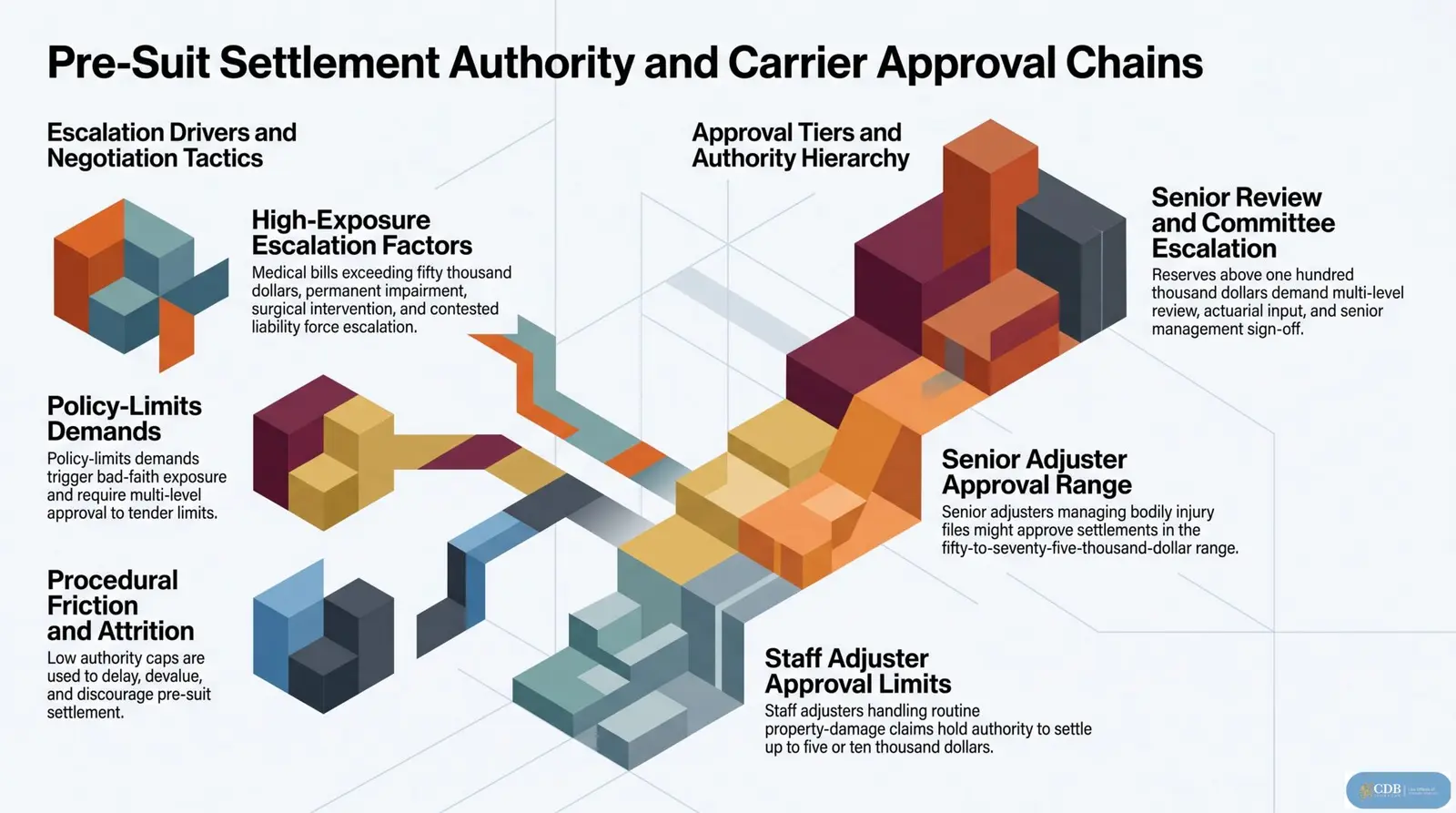
Settlement authority is not uniform across carriers or even within the same company. Authority limits scale with adjuster experience, claim complexity, and geographic region. A staff adjuster handling routine property-damage claims may hold authority to settle up to five or ten thousand dollars without supervisor approval. A senior adjuster managing bodily injury files might approve settlements in the fifty-to-seventy-five-thousand-dollar range. Beyond those thresholds, the claim escalates: first to a claims supervisor, then to a senior examiner, and in high-exposure cases, to a settlement committee or regional claims director. Each escalation layer adds time, scrutiny, and the risk that the claim will be flagged for litigation rather than pre-suit resolution.
What Drives Authority Limits
Carriers assign settlement authority based on predicted exposure. When a claim is opened, the adjuster sets a reserve, an internal estimate of what the carrier expects to pay. That reserve determines which approval tier governs. A reserve below twenty-five thousand dollars often sits within a line adjuster’s authority. A reserve between twenty-five and one hundred thousand may require supervisor sign-off. Claims reserved above one hundred thousand typically demand multi-level review, actuarial input, and sign-off from senior management. These thresholds are not disclosed to claimants, and they shift based on the carrier’s risk appetite, loss history, and whether the claim involves coverage disputes, multiple claimants, or catastrophic injury.
Liability clarity also shapes authority. A rear-end collision with undisputed fault and soft-tissue injury falls within a predictable range. An adjuster holding mid-tier authority can approve settlement without escalation. When liability is contested, comparative negligence applies, witnesses conflict, or accident reconstruction is pending, the reserve inflates and the claim moves up the chain. Florida’s modified comparative negligence rule further complicates the calculus: if the claimant bears any percentage of fault, damages reduce proportionally, and if fault reaches fifty-one percent or more, recovery is barred entirely under Florida Statutes § 768.81. Adjusters with limited authority will not settle contested-liability claims at full value because doing so requires sign-off from superiors who demand documented justification.
Injury Severity and Pre-Suit Caps
Soft-tissue injuries with short treatment durations and full recovery sit comfortably within adjuster authority. A three-month course of chiropractic care, ten thousand dollars in medical bills, and no permanent impairment will typically settle for a multiple of medical expenses, often two to four times specials, without leaving the adjuster’s desk. The formula is mechanical, the outcome predictable, and the authority sufficient.
Permanent injury shatters that simplicity. Surgical intervention, hardware implantation, permanent scarring, lost range of motion, or chronic pain syndrome push a claim into a higher reserve bracket. Personal injury claims involving herniated discs with surgical fusion, fractures requiring open reduction and internal fixation, or traumatic brain injury with cognitive deficits routinely exceed one hundred thousand dollars in exposure. At that threshold, line adjusters lose authority. The claim enters senior review, where the carrier’s litigation budget competes with settlement economics. If the carrier believes it can defend the claim for less than the settlement demand, the adjuster’s hands are tied. Pre-suit authority evaporates, and the claim enters a holding pattern until suit is filed and discovery forces recalibration.
Factors that escalate a claim beyond adjuster authority include:
- Medical bills exceeding fifty thousand dollars
- Permanent impairment ratings documented by treating physicians
- Loss-of-earnings claims with vocational evidence
- Future medical expenses supported by life-care plans
- Noneconomic damages involving disfigurement, chronic pain, or loss of consortium
- Multiple claimants or derivative claims from a single incident
- Policy-limits demands that trigger bad-faith exposure
When any of these elements appear, the adjuster’s role shifts from decision-maker to information-gatherer. The claim is no longer a negotiation. It is a file being prepared for defense counsel.
Policy Limits and Bad-Faith Leverage
A policy-limits demand changes the authority equation. When a claimant presents evidence that damages clearly exceed available coverage, typically twenty-five thousand or fifty thousand dollars in Florida bodily injury liability policies, the adjuster must escalate immediately. Policy-limits demands trigger bad-faith exposure under Florida law. If the carrier fails to accept a reasonable settlement within policy limits and the claimant later recovers a judgment exceeding those limits, the carrier may be liable for the excess. That risk compels senior claims personnel to review the file, assess bad-faith exposure, and decide whether to tender limits or risk litigation.
Adjusters rarely hold unilateral authority to accept policy-limits demands. Even when the offer is reasonable and liability is clear, carriers require multi-level approval to tender limits because doing so exhausts coverage and ends the carrier’s obligation. The decision involves underwriting implications, reinsurance considerations, and potential impact on the insured’s renewal rates. The adjuster may recommend acceptance, but the final call belongs to senior management or a settlement committee.
Underinsured motorist (UM) and uninsured motorist (UIM) claims add another layer. These are first-party claims against the claimant’s own carrier, and the adjuster’s authority is often more constrained. Carriers treat UM and UIM claims with heightened scrutiny because they represent direct losses rather than third-party exposure. An adjuster who can approve a twenty-five-thousand-dollar third-party bodily injury claim may lack authority to settle a fifteen-thousand-dollar UM claim without supervisor review. The internal logic is defensive: the carrier assumes claimants understand their own policy and may push harder when claiming against their own coverage. As a result, settlement negotiations on UM claims escalate more quickly and settle less readily pre-suit.
When Authority Limits Become Stall Tactics
Adjusters operate within their authority, but carriers engineer those limits to discourage pre-suit settlement. Low authority caps create procedural friction. A claimant demanding seventy-five thousand dollars faces an adjuster who can approve only fifty thousand. The adjuster offers forty thousand, citing authority limits. The claimant counters at sixty-five thousand. The adjuster says the supervisor is reviewing. Weeks pass. The supervisor requests additional records. More weeks pass. The claimant reduces the demand to sixty thousand. The adjuster says senior management is involved. The reserve is increased, but no offer materializes. The message is clear: file suit or accept the lowball offer.
This is not negotiation, it is attrition. Authority limits become a tool to delay, devalue, and discourage. The carrier knows most claimants will not file suit. The adjuster becomes the bearer of procedural bad news, citing limits as if they were immutable law rather than internal policy. The strategy works because claimants perceive the adjuster as powerless, when in fact the carrier designed the system to avoid paying full value before litigation.
Recognizing the tactic is the first step. When an adjuster repeatedly cites authority limits but never produces a supervisor’s counteroffer, the claim is being managed, not negotiated. When requests for medical records multiply but offers stagnate, the carrier is building a litigation file, not evaluating settlement. When the adjuster expresses sympathy but offers no path forward, the authority limit is a screen, not a ceiling.

The adjuster’s authority is a snapshot of the carrier’s willingness to resolve before litigation. It reflects reserve strategy, liability assessment, and injury severity. It also reflects the carrier’s calculation of whether the claimant will file suit. Pre-suit settlement authority is real, but it is not static. It expands when the carrier perceives litigation risk and contracts when the carrier believes the claimant will fold. Authority limits define the negotiation’s ceiling, but the decision to file suit defines whether that ceiling matters.
Closing Remarks
If an adjuster has cited authority limits for weeks without producing a supervisor’s offer, if a policy-limits demand has gone unanswered, or if a permanent injury claim is being evaluated as if it were a soft-tissue case, the pre-suit window has closed and litigation is the only lever that will move the number. CDB Injury Law represents injured Floridians whose claims exceed the adjuster’s willingness to pay. Contact us to discuss whether your claim requires the pressure only a lawsuit provides.
Frequently Asked Questions
Can an insurance adjuster settle a claim for any amount they choose?
No. Adjusters operate under settlement authority limits assigned by their carrier based on experience, claim type, and reserve value. Claims that exceed an adjuster’s authority must escalate to supervisors, senior examiners, or settlement committees. Authority limits vary widely, from five thousand dollars for junior adjusters handling property damage to seventy-five thousand or more for senior examiners managing bodily injury files. When a claim exceeds the adjuster’s ceiling, delays and reduced offers often follow.
What factors push a claim beyond an adjuster’s authority?
Permanent injury, surgical intervention, high medical bills, disputed liability, multiple claimants, loss-of-earnings claims, future medical expenses, and policy-limits demands all push claims into higher authority tiers. Carriers reserve claims based on predicted exposure. When that reserve exceeds the adjuster’s approval limit, the claim moves up the internal chain. Adjusters handling routine soft-tissue cases with clear liability and low damages often hold sufficient authority. Adjusters managing complex, high-exposure files rarely do.
How do policy-limits demands affect adjuster authority?
Policy-limits demands trigger mandatory escalation. Adjusters cannot accept limits without senior approval because doing so exhausts coverage and exposes the carrier to bad-faith liability if the demand is rejected and a later judgment exceeds policy limits. Even when liability is clear and damages obviously exceed available coverage, carriers require multi-level review before tendering limits. The process can take weeks, and carriers often use the delay to investigate aggressively or pressure claimants into reducing demands.
Do adjusters have less authority on UM and UIM claims?
Yes. First-party underinsured and uninsured motorist claims are treated with heightened scrutiny because they represent direct losses to the carrier rather than third-party exposure. Adjusters who can settle third-party bodily injury claims at moderate values often lack authority to approve smaller UM or UIM settlements without supervisor review. Carriers assume claimants will push harder against their own coverage and structure authority limits accordingly. Pre-suit UM settlements are less common and require more documentation than comparable third-party claims.