
In Florida personal injury mediation, settlement amounts and release language typically become binding once the agreement is reduced to writing and signed, but collateral terms like payment timing, lien resolution responsibilities, and confidentiality provisions can create enforcement disputes if they are not documented with precision. What gets locked in at mediation depends on what the agreement explicitly covers and whether it satisfies the elements of a binding contract under Florida law.
Mediation ends. Hands shake.A number appears on paper. Relief floods the room, until someone asks whether the Medicare lien gets paid from the gross settlement or the net, whether the two-week payment deadline carries interest if payment is late, or whether the confidentiality clause applies to the client’s own medical providers. The moment a mediation agreement is reduced to writing, certain terms crystallize into binding obligations. Others remain fluid, disputed, or dependent on details no one fully resolved. The difference determines whether the agreement holds or unravels in the weeks that follow.

Florida mediations in personal injury cases typically conclude with a handwritten or typed memorandum signed by the parties and their counsel. Under Florida Rule of Civil Procedure 1.730(b), when an agreement is reached at mediation, it must be reduced to writing and signed by the parties and their counsel, if any. That document becomes a binding settlement agreement if it includes the essential terms: parties, claims released, and consideration. But between the mediation table and the final closing, disputes emerge over terms that were mentioned, assumed, or left deliberately vague. Understanding which elements become locked at mediation and which remain subject to negotiation protects against post-settlement litigation and ensures that the resolution reached in good faith does not collapse under its own ambiguity.
Core Settlement Terms: What Becomes Binding at Mediation
You’ve finally agreed on a number. The relief is real. But what does that signature on the mediation summary truly mean? In Florida, that document is treated as a serious contract. The core terms you just agreed to are considered locked in, providing the certainty and closure you need to move forward. The law respects this moment of finality because it’s meant to end the stressful uncertainty that brought you here.
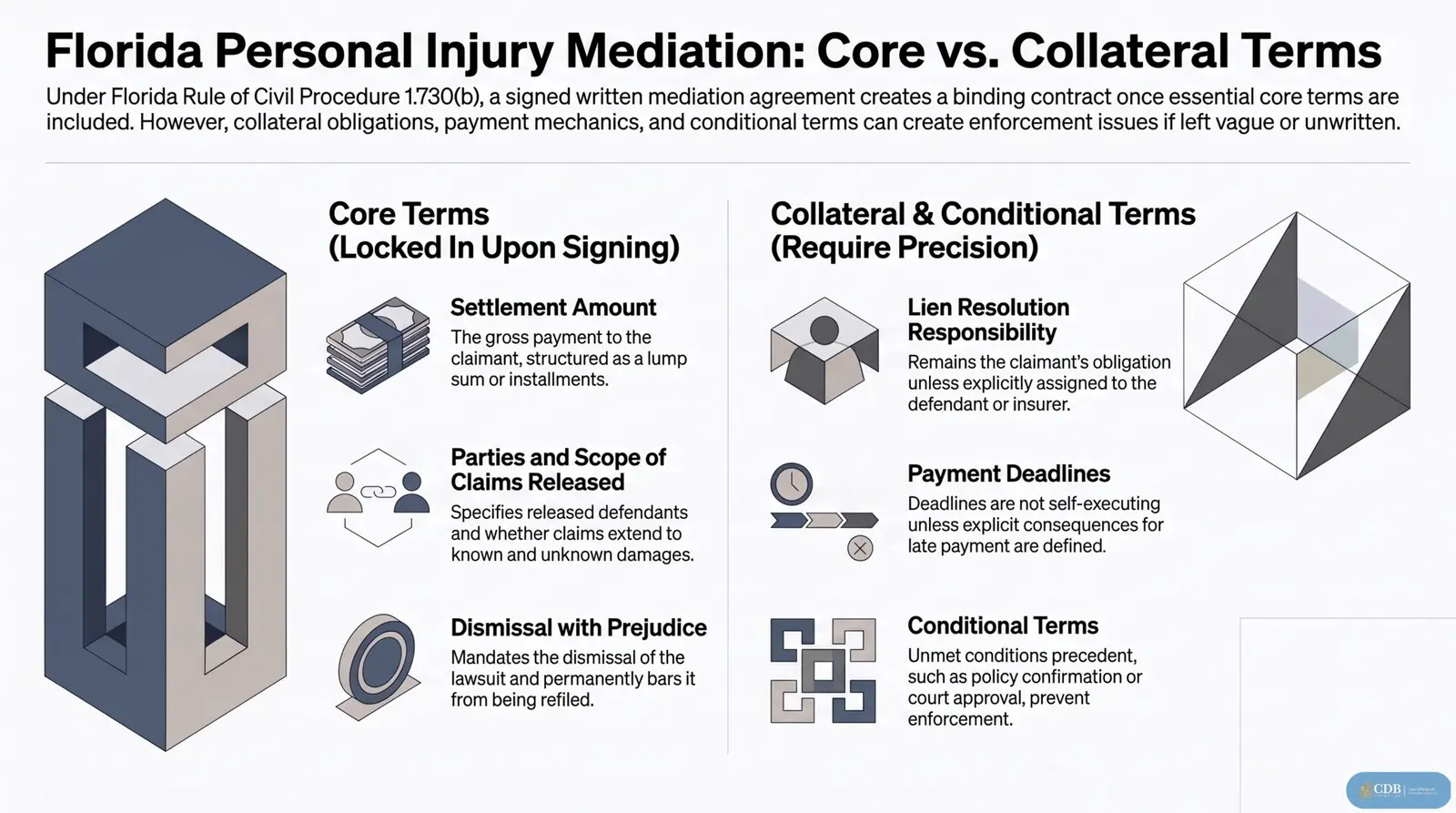
Once signed, the following terms are almost always non-negotiable:
- Settlement amount: The gross payment to the claimant, whether structured as a lump sum or installments.
- Parties to the release: Which defendants, insurers, or related entities are released from liability.
- Scope of claims released: Whether the release is limited to the injuries and damages alleged in the complaint or extends to all known and unknown claims.
- Dismissal with prejudice: Language requiring the dismissal of the lawsuit and barring it from being refiled.
After these terms are in writing and signed, courts in Florida will generally enforce them, even if you later have second thoughts or feel the amount was too low. The time for negotiation is over on these points; the agreement is meant to provide closure.
Collateral Terms: Payment Timing, Liens, and Logistics
While the main settlement amount feels final, you might leave mediation with nagging questions about the details. “When will the check actually arrive?” “Who handles the hospital lien?” “Am I allowed to talk about this?” These collateral terms, the logistics of payment, liens, and confidentiality, can feel like a gray area. If they aren’t clearly defined and agreed upon in writing, what felt like a firm deal can quickly become a source of new frustration.
Payment Deadlines
It’s common for a mediation agreement to state that payment will be made within 14 or 30 days. That promise can be enforceable, but it is not self-executing. Unless the agreement also specifies a consequence for late payment, such as interest, attorney’s fees for enforcement, or another agreed remedy, the delay may require a motion to enforce the settlement or a separate breach-of-contract claim. That process takes more time and money, adding stress at the very moment you expected the case to be ending.
Lien Resolution Responsibility
One of the biggest post-mediation headaches involves medical liens and reimbursement claims. You might assume the settlement covers all your bills from Medicare, Medicaid, hospitals, or your own health insurer. But that can be a dangerous assumption. Unless your signed agreement explicitly states that the defendant or insurer is responsible for paying specific liens from the gross settlement amount, lien resolution usually remains your responsibility as the claimant. This is a critical detail that can expose you to future financial risk and delay your access to your funds.
Confidentiality Clauses
Did you agree not to discuss your settlement? Confidentiality clauses are common, but they aren’t always ironclad. A vague, one-sided confidentiality term in a handwritten mediation summary may not hold up in court. More importantly, no agreement can force you to violate the law. You are still required to report the settlement to government entities like Medicare when federal reporting and reimbursement rules apply, regardless of what a confidentiality clause says.
Conditional Terms and Contingencies: When the Deal Is Not Yet Done
Sometimes, a settlement isn’t truly final when you leave mediation. It might depend on a future event, known as a condition precedent. These conditions create an escape hatch that can cause the entire agreement to fall apart if not met.
For example, a defendant might agree to pay a certain amount “subject to confirmation of the insurance policy limits within five days.” If it turns out the policy limits are lower than believed, the condition may fail, and the settlement may not become enforceable at the stated amount. You may not be able to force payment because the deal was never truly finalized on those terms. The uncertainty you thought was over has returned.
Other common conditions that can put a settlement on hold include:
- Court approval in cases involving minors, guardianship issues, or wrongful death settlements involving minors or incapacitated persons, as required by Florida law in specific circumstances.
- Verification of all final lien amounts before any money is paid out.
- An express statement that the settlement is contingent on both parties signing a more formal, detailed release agreement.
Each of these contingencies means your settlement is still in a fragile state. Until every condition is met and documented, the path to recovery isn’t fully clear.
Ambiguities and the Parol Evidence Rule
What happens when the signed agreement is vague? Florida courts look to the principles of contract law, but the process can be complicated. The parol evidence rule generally prevents parties from using verbal discussions or prior emails to contradict what’s in the final written agreement. However, if the written agreement itself is unclear, that outside evidence might be allowed to clarify what everyone intended.
Imagine your agreement says the “Defendant to pay all reasonable medical liens.” This simple phrase can ignite a new conflict. What is “reasonable”? Does it include a hospital lien that seems inflated? If the insurance company disagrees with your interpretation, the ambiguity in that single word could send you back into a legal fight, stalling payment and defeating the purpose of the settlement.
For more on how insurance coverage can affect injury claims and settlement posture, see CDB Injury Law’s Tampa car accident resources.
Enforceability of Unsigned or Incomplete Agreements
In the relief of reaching a deal, it’s tempting to think a handshake or a brief confirmation message is enough. In a Florida court-ordered mediation, that is risky. The safer rule is simple: reduce the agreement to writing, include every material term, and make sure it is signed by the parties and counsel as required by the mediation rule.
Think of this scenario: Your lawyer emails the defense, “We accept the $100,000 offer.” They reply, “Confirmed.” No formal mediation agreement is signed, and the email exchange does not clearly describe the release, dismissal, lien handling, or payment terms. A court may find that the exchange does not prove a complete enforceable settlement, especially if the parties were still negotiating material details. On the other hand, some written or electronic communications can matter if they clearly show intent and contain all essential terms. This is why precision at mediation is so important.
While actions like the insurance carrier sending a check can sometimes help prove an agreement existed, they do not replace the need for a clear, comprehensive, and signed document that protects your rights.

The line between what locks in at mediation and what remains negotiable is not always clear in the moment. Payment terms, lien obligations, and confidentiality provisions feel like details when the settlement amount is finally agreed upon. But those details determine whether the check arrives on time, whether you are later pursued by a lienholder, and whether the resolution provides the finality it promised. The mediation agreement is not the end of the case. It is the beginning of a different phase, one that requires the same precision and advocacy that brought the case to settlement in the first place.
Closing Remarks
If a mediation agreement leaves lien responsibility undefined, if payment deadlines pass without consequence, or if conditional terms threaten to unravel the settlement, the deal may fail before the dismissal is filed. CDB Injury Law represents injured individuals through every stage of settlement, from demand to mediation to enforcement, ensuring that agreements are clear, enforceable, and protective of recovery. You do not have to face this alone. Let us talk about your recovery and the path forward.
Frequently Asked Questions
Can a mediation agreement be enforced if it does not specify who pays medical liens?
A mediation agreement that is silent on lien responsibility usually leaves the claimant responsible for resolving Medicare reimbursement obligations, Medicaid liens, valid hospital or provider liens, and health insurance reimbursement claims. The carrier is not obligated to pay those liens unless the agreement explicitly allocates that responsibility. The claimant may negotiate lien reductions or payment plans, but the obligation remains unless the settlement document assigns it to the defendant or insurer.
What happens if the defendant misses the payment deadline stated in the mediation agreement?
If the mediation agreement includes a payment deadline but does not specify a remedy for breach, the claimant may need to file a motion to enforce the settlement or bring a separate breach-of-contract action. Neither provides immediate relief. To strengthen payment deadlines, the agreement should include per diem interest, attorney’s fees for enforcement, or another consequence for late payment. Without such language, the deadline may still be enforceable, but enforcement can be slower and more burdensome.
Is a settlement binding if the parties signed the mediation summary but never executed a formal release?
Florida courts can enforce mediation agreements that contain the essential terms: amount, parties, and scope of release, even if a formal release is never signed, provided the mediation summary itself functions as a complete contract. If the summary states that the agreement is contingent on execution of a separate release, the settlement may not be final until that condition is satisfied. Ambiguity on this point often leads to disputes, particularly when one party seeks to withdraw after the mediation but before final documentation.
Can a confidentiality clause in a mediation agreement prevent disclosure to Medicare or Medicaid?
No. Confidentiality provisions in settlement agreements cannot override statutory reporting or reimbursement obligations. The Medicare Secondary Payer Act governs Medicare reimbursement issues, and Florida Medicaid law imposes its own lien and recovery rights. A confidentiality clause that purports to prevent disclosure to these agencies is unenforceable to the extent it conflicts with federal or state law. Claimants and their counsel must account for legally required reporting and lien resolution regardless of confidentiality language.
What happens if one party wants to back out of a mediation agreement after it is signed?
Once a mediation agreement is signed and includes the essential terms, it is a binding contract under Florida law. A party cannot unilaterally withdraw due to remorse, newly discovered damages, or a change of heart. The opposing party can file a motion to enforce the settlement, and Florida courts routinely grant such motions absent fraud, duress, mutual mistake, or a failure of a condition precedent. The time to negotiate is at mediation, not after the ink dries.
References
- Florida Rule of Civil Procedure 1.730(b)
- 42 U.S.C. § 1395 (y(b)(2) (Medicare Secondary Payer Act)).