
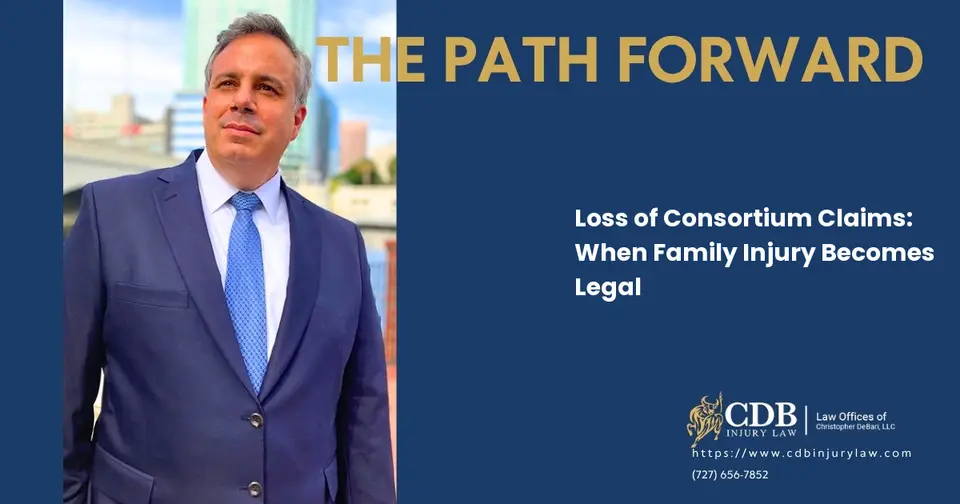
Loss of consortium claims allow family members to recover damages when a loved one’s injury disrupts the relationship itself, the intimacy, companionship, support, and partnership that make a family whole. These claims recognize that serious injuries ripple outward, affecting not just the person hurt but everyone who depends on them emotionally and practically.
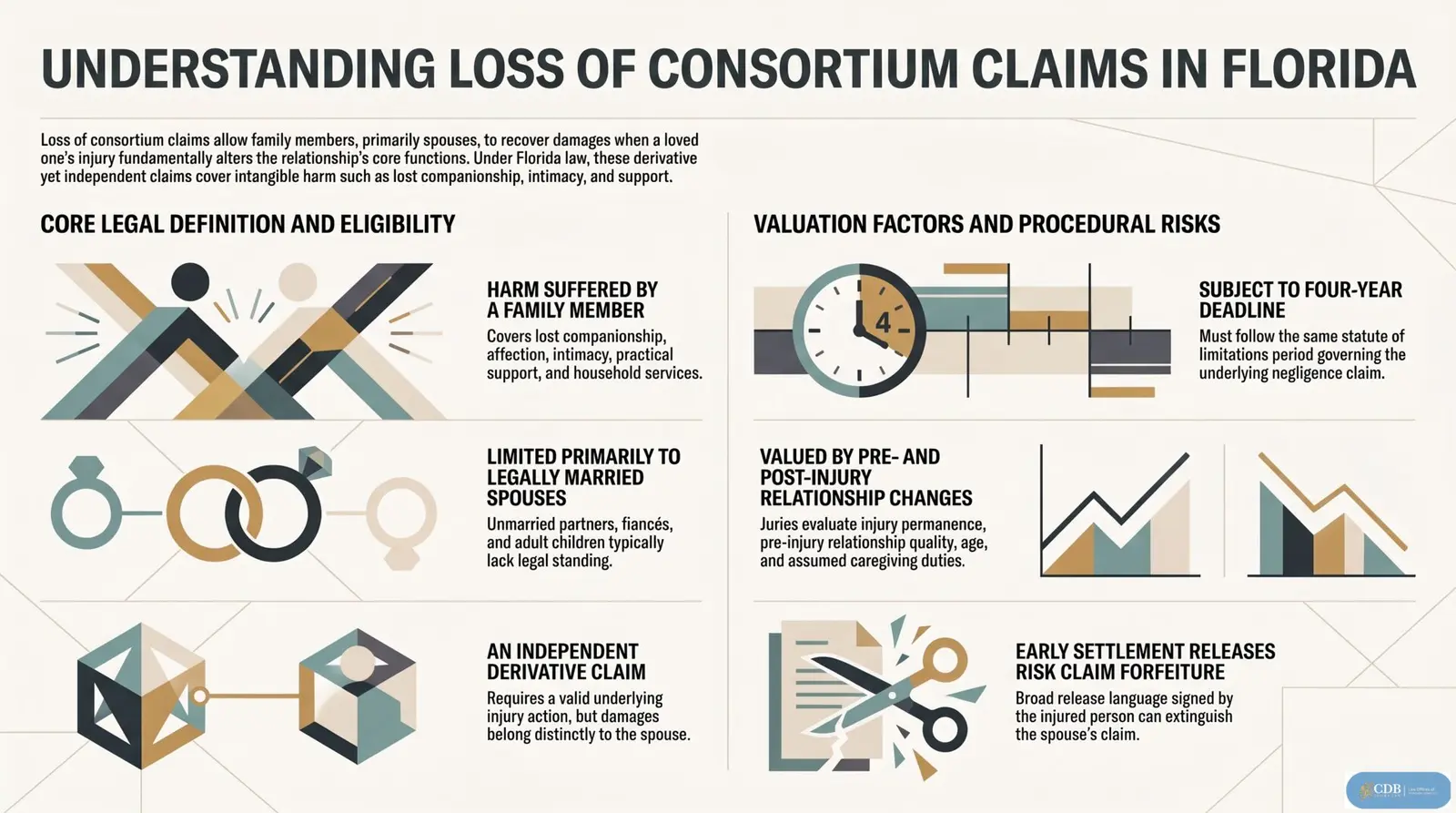
The accident changes more than one life. A father who once coached his daughter’s soccer team now struggles to leave the hospital bed. A wife who shared evening walks and weekend plans with her husband now coordinates his care appointments and navigates the silences where conversation used to live. The injury belongs to one person; the loss belongs to the family. Florida law acknowledges this reality through loss of consortium claims, a pathway to compensation for the intangible but profound damage inflicted on relationships when someone’s negligence leaves a loved one permanently changed.

Most people discover loss of consortium claims exist only after they are already living the problem. The insurance company has offered a settlement for the injured person’s medical bills and lost wages, but no one has mentioned the thousands of hours a spouse will spend as a caregiver, the intimacy that will never return, or the emotional weight of watching someone once independent now need help with basic tasks. These losses have names in the law, and they carry compensable value.
What Qualifies as Loss of Consortium
Loss of consortium describes the harm suffered by a family member, most commonly a spouse, when an injury to their loved one disrupts the core functions of the relationship. Florida courts have recognized these claims for decades, grounding them in the recognition that marriage and family bonds carry legal significance beyond contract or sentiment. The injury need not be fatal; it must be serious enough to meaningfully alter the relationship.
The damages typically include loss of companionship, loss of affection, loss of sexual relations, loss of services, and loss of support, both emotional and practical. A spouse who can no longer share household responsibilities, participate in hobbies, or offer the same level of emotional presence creates a void that the law treats as a distinct injury to the uninjured partner.
Consider a hypothetical: A man suffers a traumatic brain injury in a collision with a distracted driver. He survives, but his cognitive function declines. He forgets conversations, struggles with impulse control, and withdraws from the activities he once enjoyed with his wife. She remains married to him, but the partnership they built over twenty years has fundamentally changed. Her loss is real, measurable in the erosion of companionship and the emotional labor of managing a relationship that now feels one-sided. Florida law permits her to pursue a separate claim for that loss.
Who Can Bring a Loss of Consortium Claim in Florida
Florida law limits loss of consortium claims primarily to spouses. Parents may also bring claims for loss of their child’s companionship and services, though these claims operate under slightly different standards. Unmarried partners, fiancés, and adult children typically lack standing to pursue loss of consortium damages, regardless of the depth of the relationship or the practical reality of their loss.
The claim belongs to the family member, not to the injured person. It is a derivative claim, it depends on the injured person having a valid underlying claim, but it is independent in its damages. The spouse’s emotional suffering, lost companionship, and altered relationship are hers to prove and hers to recover. The injured person’s settlement or verdict does not automatically include these losses unless the spouse actively asserts them.
Timing matters. Loss of consortium claims must be filed within the same statute of limitations period that governs the underlying injury claim, typically two years in Florida for negligence claims arising on or after March 24, 2023. Waiting too long forfeits the claim entirely, even if the injured person’s claim proceeds. Understanding the procedural requirements early preserves options that cannot be recovered later, which is why consulting an experienced personal injury attorney at the outset is so important.
How Loss of Consortium Claims Get Valued
Valuing loss of consortium presents challenges absent from more concrete economic damages. There are no billing statements for lost intimacy, no wage records for companionship. Juries evaluate these claims based on testimony, testimony about what the relationship was before the injury and what it has become since.
Several factors influence valuation:
- The length and quality of the relationship before the injury
- The severity and permanence of the injury
- The degree to which the injury has altered daily interactions, intimacy, and emotional support
- The age of the claimant and the injured party
- The extent to which the claimant has assumed new caregiving responsibilities
- Whether the injured party can ever return to their prior level of functioning
Defense counsel often minimize these claims, framing them as derivative or speculative. Insurance carriers prefer to focus on the injured person’s tangible losses, medical bills, property damage, lost income, and dismiss the spouse’s suffering as unmeasurable or exaggerated. But the law treats loss of consortium as a distinct, compensable harm. The challenge lies in presenting it with specificity: not “things are hard now,” but “here is what we did together, here is what we cannot do, and here is the weight of that absence.”
Documentation strengthens these claims. Journals, photos from before the injury, testimony from friends and family who witnessed the relationship’s transformation, and expert testimony about the permanence of the injury all contribute to a more concrete picture. The intangible becomes tangible through narrative, through stories that help a jury understand what has been taken and what cannot be replaced.
Common Pitfalls That Undermine Consortium Claims
Loss of consortium claims fail most often when they are treated as afterthoughts. A spouse learns about the right to pursue a claim only after the injured party has already settled, releasing not only their own claims but, inadvertently, any derivative claims their spouse might have had. Settlement agreements often include broad release language that extinguishes all claims arising from the incident, and courts interpret those releases to include loss of consortium unless the spouse is a named party asserting independent claims.
Another pitfall: inconsistency between the injured person’s claim and the spouse’s. If the injured party testifies that the injury has had minimal impact on daily life, the spouse’s claim of profound relational disruption loses credibility. Both claims must align in their portrayal of severity and permanence, even as they describe different dimensions of harm.
Privacy concerns sometimes suppress necessary evidence. Spouses hesitate to testify about intimate aspects of their relationship, sexual dysfunction, emotional withdrawal, the shift from partner to caregiver. But these details form the substance of the claim. Without them, the loss remains abstract, and juries struggle to attach value to abstraction. Effective presentation balances dignity with specificity, framing the testimony as a necessary articulation of real harm rather than an invasion of privacy.
Finally, some families delay filing because they hope the injured person will improve. Waiting for a prognosis to stabilize is reasonable; waiting past the statute of limitations is fatal. Loss of consortium claims are subject to the same deadlines that govern the underlying injury claim. While there are narrow exceptions that can toll the statute of limitations, they rarely apply in straightforward negligence cases.
Strategic Considerations in Multi-Claim Cases
When both the injured person and their spouse pursue claims, coordination becomes critical. Filing both claims together in the same lawsuit avoids duplication, ensures consistent presentation, and preserves leverage in settlement negotiations. Insurance carriers prefer to resolve all claims arising from a single incident in one transaction; fragmenting the claims reduces their incentive to negotiate fairly.
Settlement dynamics shift when consortium claims are on the table. A carrier that might offer policy limits for the injured person’s claim alone may hesitate when the same incident exposes them to additional damages for the spouse’s loss. This exposure can open room for negotiation that would not otherwise exist, particularly in cases where the injured person’s economic damages fall below policy limits but the combined claims exceed them.
Trial strategy also changes. Juries sometimes respond more viscerally to a spouse’s testimony about relational loss than to the injured person’s recitation of medical treatment and financial harm. The spouse humanizes the case, transforming a litigation file into a story about real people whose lives have been irrevocably altered. Presenting both claims effectively requires balancing the clinical detail of the injury with the emotional reality of its consequences.

Loss of consortium claims acknowledge a truth often overlooked in injury litigation: harm radiates outward. The person struck by the car suffers fractures and surgeries; the spouse at home suffers the slow erosion of a partnership they thought would last a lifetime. The law allows recovery for both, but only when the claims are asserted deliberately, documented carefully, and presented with the seriousness they deserve. These losses do not heal with time. They require recognition, and compensation, commensurate with their depth.
Closing Remarks
If your spouse has suffered a serious injury, if the relationship you built together has fundamentally changed, or if an insurance company has offered a settlement that ignores your own losses, the window to assert those claims is closing. CDB Injury Law represents families navigating the legal and emotional aftermath of life-altering injuries, ensuring that every dimension of harm, including the one that belongs to you, receives the attention and compensation it warrants. Contact us to discuss your path forward before time or settlement language forecloses the option entirely.
Frequently Asked Questions
Can I file a loss of consortium claim if my spouse and I were not legally married at the time of the injury?
Florida law generally limits loss of consortium claims to legally recognized spouses. Common-law marriages, domestic partnerships, and long-term cohabitation, no matter how committed, typically do not provide standing to pursue these claims. The relationship must meet the legal definition of marriage under Florida law at the time the injury occurred. Exceptions are rare and highly fact-specific, making consultation with counsel essential before assuming eligibility.
What happens if my spouse settles their injury claim before I file a loss of consortium claim?
Settlement agreements often include broad release language that discharges all claims arising from the incident, including derivative claims like loss of consortium. Once the injured spouse signs that release, the uninjured spouse’s claim may be extinguished even if they were not a party to the settlement. Filing the consortium claim before any settlement protects the right to recover, and coordinating both claims ensures neither is inadvertently waived.
How do I prove loss of consortium when the harm is mostly emotional and private?
Proof comes through testimony, yours, your spouse’s, and witnesses who knew the relationship before and after the injury. Describing specific activities you once shared, the intimacy that has changed, and the practical ways your daily life has shifted all contribute to a concrete picture of loss. Photos, diaries, and expert testimony about the permanence of the injury strengthen the narrative. The claim requires vulnerability, but specificity transforms abstract harm into compensable damage.
Can parents bring loss of consortium claims if their child is injured?
Yes, but the analysis differs. Parents may recover for loss of their minor child’s services and companionship, though Florida courts apply different standards than they do for spousal claims. The child’s age, the nature of the injury, and the degree to which the parent-child relationship has been disrupted all factor into valuation. Adult children generally cannot bring consortium claims for injuries to their parents, a limitation that courts have consistently upheld despite the emotional reality of those losses.
References
- No substantive legal citations (statutes, cases, regulations, or official agency/court sources) appear in the article body